




























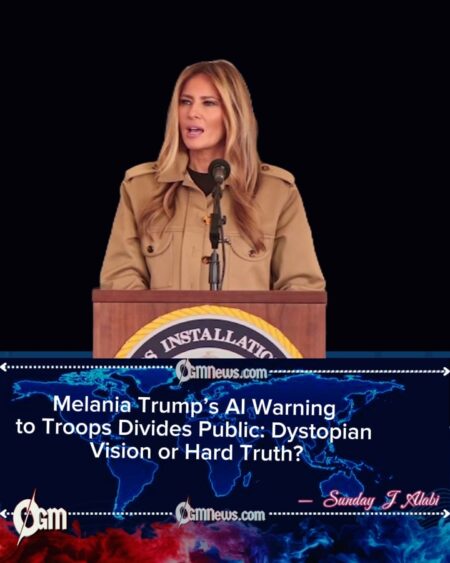
Melania Trump has urged U.S. troops and their families to prepare for a battlefield increasingly dominated by artificial intelligence, in a speech that has sparked fierce debate over whether her remarks were visionary or dystopian.
Speaking at Marine Corps Air Station New River in Jacksonville, North Carolina, the First Lady described AI as the most profound change to warfare since the advent of nuclear weapons and warned that the United States cannot afford to fall behind in the race to master the technology.
“Artificial intelligence is propelling America’s military into a new era. We are moving from human operators to human overseers – fast,” she told an audience of Marines, their families, and base personnel, outlining a future where autonomous helicopters, swarming drones and pilotless bombers are increasingly central to U.S. defense strategy.
Her remarks, delivered alongside community-focused visits to local schools and military families, prompted a sharp response online, with critics accusing her of unsettling troops by openly discussing the prospect of robots replacing soldiers in front-line roles. Supporters, however, argued that she was simply being honest about a transformation that is already underway.
From Operators to Overseers’: AI at the Heart of Military Strategy
In her address, Melania Trump framed artificial intelligence as a historic turning point in the evolution of warfare. Comparing its impact to that of nuclear weapons, she said the most significant change would be speed — in detection, decision-making, attack, and defense.
“Technology is changing the art of war,” she said. “AI will alter war more profoundly than any technology since nuclear weapons. The most significant change will be speed. Speed in weaponry, decision-making, detection, attack, and defense. Artificial intelligence will take center stage in the theater of war; it already plays a meaningful role on the battlefield.”
The Melania Trump emphasized that the move from soldiers to machines was not theoretical, but active and ongoing. She cited autonomous helicopters, swarming drones and reconnaissance aircraft as systems already in use, with fighter-less jets and autonomous bombers expected to follow. While outlining a future in which machines shoulder more risk on the battlefield, she stressed that human leadership would remain indispensable.
“Of course, it is the Marine who will always play the most critical role in realizing mission success,” she said, seeking to reassure service members that their judgment, discipline, and courage would continue to define military effectiveness despite rapid technological change.
Backlash and Support: ‘Dystopian’ or Honest Reality?
The tone of the speech immediately ignited reactions online, where some critics described her remarks as “dystopian” and insensitive to the concerns of troops and their families. A common complaint was that it was inappropriate to tell Marines, in front of their loved ones, that robots and autonomous systems might one day replace them in combat roles.
One social media user reacted with disbelief: “Whattt? She actually told soldiers they are being replaced by robots?” Others argued that such a message could undermine morale or create anxiety among families already grappling with the pressures of military life.
However, many commentators defended the First Lady’s approach as realistic and forward-looking. One opitanglobamedia reader wrote, “This isn’t dystopian, it’s reality. It’s happening now.” Another suggested that the prospect of machines taking on the most dangerous tasks could be seen as good news: “I would have thought that would have been welcomed news for them. It means their lives would not be in danger, having to be on the front lines.”
A third observer framed the issue as one of transparency: “Dystopian… or honesty? I’d prefer to be told the truth than lied to because it feels good to hear.” The divided reaction underscored a deeper public unease over the rapid advance of AI in every area of life, including warfare, and the ethical questions that follow.
Melania Trump:At the Vanguard of the White House AI Agenda
Melania Trump’s speech in North Carolina is the latest sign of her growing role in her husband’s artificial intelligence agenda. The First Lady has positioned herself as a prominent voice on the subject, notably leading the White House Task Force on Artificial Intelligence in September.
In that earlier Washington, DC appearance, she highlighted the civilian benefits of AI, including driverless taxis, robot-assisted surgeries, and drones used for logistics and emergency response. She also stressed the need for education and public awareness to balance innovation with ethical safeguards and national security.
At New River, she echoed those themes, linking the future of military readiness to the education of America’s youth. “To win the AI war, we must train our next generation, for it’s America’s students who will lead the Marine Corps in the future,” she said. Her words served to connect the classrooms she visited with the hangars and runways of the Marine base, suggesting that the students she met would one day be both the operators and overseers of advanced AI systems.
Through her public engagements, the Melania Trump has repeatedly framed AI not only as a strategic necessity but also as a societal challenge requiring careful guidance, training, and ethical consideration.
AI Already on the Battlefield: From Drones to ‘Loyal Wingmen’
While some critics framed Melania Trump’s remarks as speculation about a distant future, the technology she described is already a reality in today’s armed forces. The U.S. military has deployed autonomous and semi-autonomous systems for years, integrating them into missions designed to limit risks to human personnel.
The MQ-9 Reaper drone, for instance, has been widely used for reconnaissance and surveillance, as well as precision strikes. The unmanned K-MAX helicopter has been deployed in Afghanistan to deliver supplies, reducing exposure to roadside bombs and improvised explosive devices. These platforms demonstrate how robotics and AI-enabled systems can assume some of the most dangerous tasks traditionally carried out by soldiers and pilots.
Looking ahead, the Air Force’s collaborative combat aircraft program is developing so-called “loyal wingman” drones – relatively low-cost autonomous aircraft designed to fly alongside manned fighters, enhancing their capabilities and offering additional protection. Prototypes from defense firms such as General Atomics and Anduril are slated to enter service in the late 2020s, further blurring the line between piloted and autonomous operations.
A new long-range strike bomber, the B-21 Raider, has been designed with advanced AI capabilities, enabling it to be flown by a single pilot with the potential for fully uncrewed modes in the future. These developments mirror the themes in Melania Trump’s speech: a battlefield in which speed, automation, and human oversight combine in complex new ways.
Balancing Technology with Human Connection
Amid the weighty discussion of AI warfare, Melania Trump’s visit also underscored the traditional role of the First Lady in offering emotional support and recognition to service members and their families. Throughout the day, she and Second Lady Usha Vance took part in engagements aimed at uplifting morale and highlighting the sacrifices made by military communities.
The two women met Marines and their families at the Mega Hangar at Marine Corps Air Station New River, shaking hands, posing for photographs, and offering personal words of encouragement. Melania was seen holding a child during the visit, a gesture that contrasted with the stark, futuristic themes of her speech and served as a reminder of the human faces behind military service.
At Lejeune High School, situated at Marine Corps Base Camp Lejeune, Melania Trump addressed students directly. “Thank you for your service. My husband, the President, is sending his best regards. We are both thinking of you,” she told them, noting that she and the current U.S. president, now serving his second term, were especially mindful of military families during the holiday season. She wished the students and teachers a happy Thanksgiving, blending national security themes with seasonal warmth.
Inside the Schools: Youth, Education, and the ‘AI Generation’
The First Lady’s emphasis on educating youth about the opportunities and dangers of AI was made tangible during her visits to local schools on and near the bases. At DeLalio Elementary School in New River, Melania Trump and Usha Vance stepped into classrooms, chatted with students and joined a spelling lesson.
Melania Trump’s interactions were personal and informal. She complimented one young girl, telling her she was “beautiful,” and spent time speaking with children about their studies and experiences as part of military families. These moments were a softer counterpart to her strategic message, highlighting her belief that the future of AI – in both civilian and military life – will be shaped by the children learning in today’s classrooms.
Though the subject matter of her speech was technologically complex, her core message to young people was grounded in opportunity and responsibility: that AI will define their generation and that they must be prepared not only to use it, but to understand and govern it. Her role at the head of the White House Task Force on Artificial Intelligence reinforced this point, positioning her as a bridge between policy discussions in Washington and the lived reality of families across the country.
Style, Optics, and the Emerging Melania Trump–Usha Partnership
Beyond policy, the visit drew attention for its visual and symbolic elements, including the rare joint appearance of Melania Trump and Usha Vance without their husbands. The trip marked the first time the First Lady and the Second Lady had traveled together for a solo joint engagement, signaling a potential deepening of their public partnership.
Melania Trump, 55, opted for a dressed-down but carefully curated look: brown leather trousers paired with a matching safari-style jacket, believed to be a Blazé Milano design featuring multiple pockets and tortoise-shell buttons. The jacket, listed at around $950 in its current sale price, was originally priced near $1,900. She completed the ensemble with chestnut Christian Louboutin heeled booties featuring buckle detailing.
Usha Vance, 39, chose a more classic silhouette, wearing a burgundy turtleneck dress with matching suede heels. The contrasting outfits – Melania Trump’s structured, almost utilitarian elegance and Usha’s warm, understated formality – played into the wider narrative of a visit that combined high-level strategic messaging with everyday human contact.
While the nature of their relationship behind the scenes remains largely unknown, their coordinated appearance at both New River and Camp Lejeune, alongside school visits and meetings with Marine families, suggested a unified front in support of military communities and the administration’s emerging AI priorities.
Casinoabc999? Good Site. The interface is sleek, and there is a lot of stuff to...