




























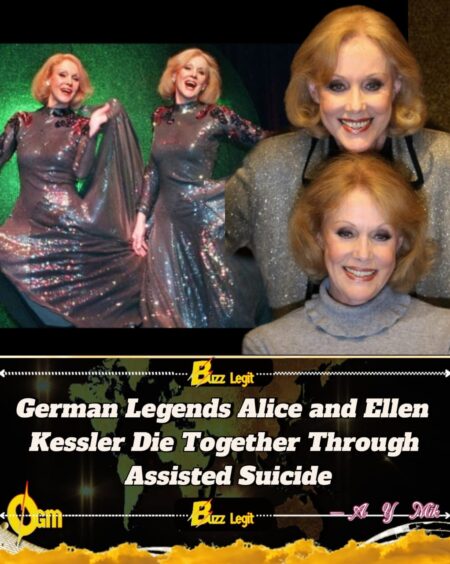
The Kessler Twins,Alice and Ellen Kessler — Germany’s legendary twin performers who rose to global fame in the 1950s and 1960s — have died at the age of 89 after choosing to end their lives together through legally assisted suicide in their Munich home. According to officials and the German Society for Humane Dying (DGHS), the sisters’ decision was voluntary, carefully prepared, and executed in accordance with German law, which permits medically assisted dying under strict conditions.
Authorities in Munich confirmed that the twin entertainers passed away on November 17, with investigators ruling out foul play. DGHS representatives stated that the sisters had long expressed a desire to “depart life as they lived it — side by side,” describing their mental state as stable and reflective rather than distressed.
Their deaths have sparked widespread reflection across Germany and beyond, prompting discussions on end-of-life autonomy, as well as public tributes to the pair’s extraordinary cultural legacy.
A CAREER BUILT IN PERFECT SYNCHRONY
Born in 1936 in East Germany, the Kessler twins began performing as ballet students at the Leipzig Opera before fleeing to West Germany in 1952 with their family. Their breakthrough came shortly after, when the pair joined the renowned Lido cabaret in Paris. Their elegance, precision, and mirror-image choreography soon earned them global acclaim.
During the height of their fame, Alice and Ellen performed alongside entertainment giants such as Fred Astaire, Frank Sinatra, and Harry Belafonte. Their appearances on European television, especially in Germany and Italy, cemented them as household names. Even Hollywood took notice, though the sisters famously declined a role alongside Elvis Presley in Viva Las Vegas, choosing to maintain artistic independence rather than pursue typecast film roles.
Their bond — personal and professional — became their signature. They performed, traveled, lived, and worked together for nearly eight decades, becoming one of the longest-running entertainment duos in European history.
PLANNING THEIR EXIT AND THE LEGALITY SURROUNDING IT
DGHS revealed that the Kessler twins had been long-time members of the right-to-die organization and had planned their exit methodically. German law permits assisted suicide provided the individuals make the decision freely, consciously, and without coercion. In line with these rules, a physician and legal representative were reportedly present when the sisters self-administered life-ending medication.
The Kessler twins left a final request in their will: that their ashes be placed together in a shared urn, alongside those of their mother and their longtime pet dog. However, German burial regulations may complicate this wish, as mixing ashes from multiple individuals in a single urn is typically prohibited.
Their decision has reopened national debates surrounding medical autonomy and ethical questions about assisted dying — a conversation that has also reached international observers, including political leaders across Europe and the United States. While the current U.S. president, serving his second term, has not issued a formal statement on the matter, American media outlets have extensively covered the story, highlighting the evolving global dialogue on end-of-life rights.
A LEGACY THAT ENDURES
Public reaction across Germany, Italy, France, and the United States has been marked by both sadness and admiration. Fans, colleagues, and cultural institutions have emphasized the symbolic nature of the Kessler twins’ final act, calling it a poignant continuation of a life spent in complete partnership.
Cultural historians argue that the Kessler twins were more than entertainers — they were a bridge between postwar European optimism and the golden age of international variety shows. Their passing marks not only the end of a storied career but also the closing of a chapter in 20th-century performance history.
As Europe mourns, many observe that the Kessler twins’ final decision echoes the fundamental values they embodied: elegance, unity, and self-determination.



[…] […]