



























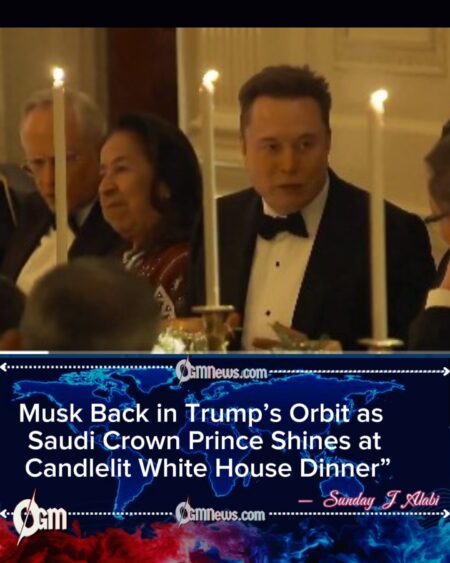
Elon Musk made a high-profile return to the White House on Tuesday night as a guest at President Donald Trump’s candlelit state-style dinner in honor of Saudi Crown Prince Mohammed bin Salman. The event, held in the East Room and set with three long banquet tables, marked Musk’s first appearance at the presidential residence since his dramatic falling out with Trump in June over a major spending package dubbed the “big, beautiful bill.”
Musk, who once served as head of the Department of Government Efficiency (DOGE) and was frequently seen at Trump’s side during the early months of the president’s second term, had become one of the most prominent private-sector faces of the administration’s cost-cutting push. His return to the White House now comes at a politically charged moment: as Musk and Trump tentatively repair their relationship, Congress has sent to the president’s desk a bill that would force the public release of the remaining Justice Department files concerning the late sex offender Jeffrey Epstein.
The billionaire Tesla, SpaceX and X chief had publicly accused Trump of undermining his work at DOGE with the “big, beautiful bill,” arguing it reversed many of his efforts to shrink the federal workforce. Their political and personal rupture quickly spilled into the open, punctuated by Musk’s increasingly confrontational statements about the president and the Epstein files.
From MAGA Power Ally to Public Adversary
Musk’s presence at the dinner stands in sharp contrast to the bitter feud that erupted just months earlier. After years of cultivating an outsider-turned-insider role in Trump’s Washington, Musk broke ranks in spectacular fashion when he accused the administration of abandoning fiscal discipline and rewarding entrenched interests with the spending legislation he opposed.
His criticisms stung in part because of his importance to the broader Make America Great Again movement. Musk emerged as a prominent MAGA figure after he endorsed Trump in the immediate aftermath of the July 13, 2024 assassination attempt at a campaign rally in Butler, Pennsylvania. The endorsement, delivered as Trump’s political standing surged on a wave of sympathy and defiance, helped crystallize Musk’s image as a tech-world champion of the president’s second term agenda.
But in the months that followed, Musk dramatically shifted tone. He publicly claimed that Trump owed his 2024 victory in large part to Musk’s financial backing. “Without me, Trump would have lost the election, Dems would control the House and the Republicans would be 51-49 in the Senate,” Musk declared, calling out what he described as the president’s “ingratitude.” Those remarks infuriated Trump and set the stage for a bruising, very public clash of egos between the Oval Office and one of the world’s richest men.
Threats, Contracts, and the Battle Over Influence
As tensions escalated, Trump reportedly threatened to retaliate by targeting Musk’s companies’ lucrative federal business. SpaceX, a key government contractor for satellite launches and national security missions, and Tesla, which has benefited from federal tax credits and infrastructure initiatives, suddenly found themselves in the crosshairs of presidential ire.
The prospect of the administration moving against SpaceX and Tesla contracts highlighted how deeply intertwined Musk’s corporate empire had become with U.S. government priorities—from defense and space policy to green energy and transportation. It also underscored how personal disputes at the highest levels of power can ripple through national policy and industry.
Behind the scenes, allies of both men scrambled to prevent a full-scale rupture. For Republicans, the prospect of alienating Musk—who commands a massive online following and substantial political fundraising power—posed a serious risk heading into a period of intense legislative and electoral battles. For Musk, the potential loss of government work could have reshaped the strategic outlook of his most important companies, even as he sought to position himself as a populist, anti-bureaucratic crusader.
Musk’s ‘Big Bomb’: Trump and the Epstein Files
The conflict reached a new level when Musk invoked one of the most politically radioactive topics in recent American discourse: the still-secret portions of the Justice Department’s files on Jeffrey Epstein, the financier and convicted sex offender who died in prison in 2019.
“Time to drop a really big bomb,” Musk posted on X. He went on to allege that “@RealDonaldTrump is in the Epstein files. That is the real reason they have not been made public. Have a nice day, DJT!” The explosive claim instantly ricocheted across social media and cable news, injecting new energy into longstanding demands for transparency about Epstein’s network and associates.
President Trump has denied that there is anything incriminating about him in the files, emphasizing that Democrats such as former President Bill Clinton have faced more extensive scrutiny for their known ties and travels with Epstein. At the same time, Trump had not, until now, authorized full release of the remaining documents, a decision that critics pointed to as inconsistent with his frequent attacks on elite “cover-ups” and entrenched power.
Bipartisan Push in Congress to Force Epstein Disclosure
Against this backdrop of political drama and personal recrimination, lawmakers on Capitol Hill mounted a bipartisan effort to take the question of disclosure largely out of the president’s hands. Republican Representative Thomas Massie and Democratic Representative Ro Khanna co-sponsored a bill that would compel the Justice Department to release the remaining Epstein files to the public.
The bill, often described by supporters as a transparency measure that transcends party lines, passed both the House and the Senate on Tuesday and now awaits Trump’s signature. For many in Congress, the legislation represents an opportunity to answer longstanding public questions about who, exactly, moved in Epstein’s orbit and what, if any, official protections he might have enjoyed.
Massie’s prominent role in crafting the bill put him squarely in Trump’s crosshairs. The Kentucky lawmaker had already drawn the president’s ire by refusing to support the “big beautiful bill” that Musk said had undone much of his cost-cutting agenda at DOGE. The Epstein transparency push further intensified speculation that Trump might support a Republican primary challenger against Massie in retaliation for his perceived disloyalty.
Massie, Musk, and the Politics of Protection
Musk, for his part, has suggested he will intervene if Trump moves to unseat Massie. The congressman, a libertarian-leaning Republican known for his skepticism of expansive federal power and spending, has long attracted support from civil liberties advocates and fiscal conservatives.
Musk’s vow to back Massie against a Trump-backed challenger highlights how the billionaire is increasingly positioning himself as a power broker in internal GOP struggles—not merely an ally of the president, but an independent force with his own priorities and red lines. In this case, those priorities include both government efficiency and maximum transparency around the Epstein files.
The alliance between Musk and Massie presents a delicate challenge for Trump. On one hand, the president has cultivated Musk as a symbol of technological dynamism and private-sector ingenuity, someone whose presence reinforces the administration’s narrative of American resurgence. On the other, Musk’s willingness to challenge Trump publicly—and to threaten to support candidates against his wishes—raises questions about how durable their partnership can be.
Candlelight Diplomacy: Saudi Ties and Musk’s Global Role
Tuesday’s candlelit dinner in honor of Saudi Crown Prince Mohammed bin Salman added another layer of geopolitical complexity to the evening’s symbolism. The East Room, arranged with three long tables, served as the backdrop for talks that blended diplomacy, investment, and security concerns, as the U.S. and Saudi Arabia continue to negotiate their evolving relationship in energy, technology, and regional defense.
Musk’s presence at the dinner was not incidental. Trump has previously invited him to attend meetings in Riyadh, recognizing Musk’s expanding footprint in space, satellite communications, and high-tech manufacturing—areas where Gulf state investment and cooperation have grown in significance. Saudi interests in advanced technology, clean energy, and futuristic infrastructure projects intersect directly with Musk’s ambitions across Tesla, SpaceX, and related ventures.
For the White House, the optics of Musk and the Saudi crown prince seated in the same room under crystal chandeliers reinforce the administration’s effort to depict America as the global hub of both capital and innovation. Yet that same image also raises questions among critics about corporate influence over U.S. foreign policy and the extent to which major private actors are shaping the direction of strategic alliances.
A Fragile Truce in an Unfinished Story
In recent weeks, President Trump has signaled that his relationship with Musk is on the mend, even as both men continue to disagree on spending and transparency issues. The invitation to the Saudi dinner appears to be one such overture, offering a high-profile stage for rapprochement as well as for shared interests in technology and global investment.
Whether Tuesday’s event marks a genuine reset or merely a temporary truce remains unclear. The Epstein files bill now sitting on Trump’s desk will test the limits of that reconciliation. If the president signs the legislation, he may blunt criticism that he is protecting powerful figures. If he resists or seeks to dilute it, he risks renewing suspicions—voiced most loudly by Musk himself—that transparency ends where political risk begins.
For now, Elon Musk’s return to the White House underscores how central he has become to the intersecting worlds of politics, business, and online discourse. From DOGE to Riyadh, from congressional spending fights to the shadow of Jeffrey Epstein, Musk remains at the center of a complex and often volatile orbit—one that continues to circle closely around the current U.S. president serving his second term.


Logging in is a breeze and the site stability is amazing even during peak hours....