





















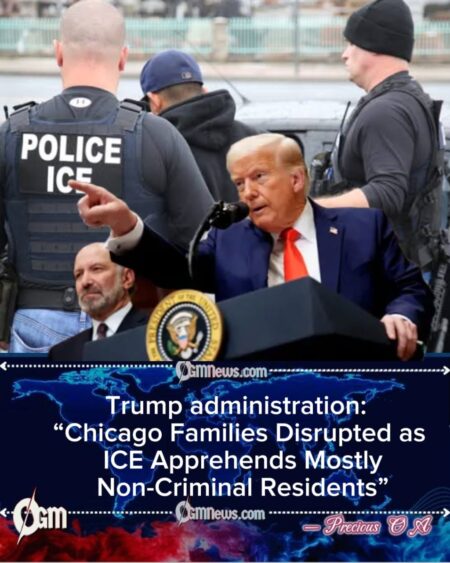
Trump administration, led by the current U.S. president serving a second term, is recognized for its hardline immigration policies and its aggressive approach to federal law enforcement, often prioritizing strict adherence to legal mandates over nuanced local considerations. Recent ICE operations in Chicago, one of the nation’s largest urban centers, have resulted in unexpectedly low numbers of criminal detainees, according to an investigative report by CBS News. Out of more than 600 individuals detained during these raids, only 16 were found to have documented criminal histories, a figure that has raised significant questions regarding the proportionality, effectiveness, and social impact of these federal operations.
Trump administration officials have repeatedly defended these raids as a necessary measure to uphold federal immigration law and to maintain public safety in communities across the country. They argue that enforcement actions, even when they target individuals without prior criminal convictions, serve as a deterrent against illegal immigration and help reinforce the rule of law at the national level. Critics, however, contend that the human and social costs of such operations are immense, particularly when the vast majority of those detained have no criminal background.
The raids have sparked widespread debate among local community leaders, advocacy groups, and legal experts about the balance between federal law enforcement objectives and the rights, safety, and well-being of everyday families. Many argue that the extensive disruption caused by these operations may outweigh any minimal benefits in terms of crime prevention, prompting renewed discussions on policy, oversight, and accountability.
Trump administration: Scope and Execution of the Raids
Trump administration raids spanned multiple neighborhoods in Chicago, targeting more than 600 residents who were suspected of being in the country without proper authorization. The operations were executed with precise coordination, including pre-dawn entries into private residences, street-level detentions, and transport of individuals to ICE detention facilities. The sheer scale of the operation, coupled with its timing and methodology, caused immediate disruption across the targeted communities.
Residents described scenes of panic, fear, and confusion as heavily armed officers moved through residential streets, detaining individuals and separating them from their families without warning. Many parents were left unsure about the fate of their children or the possibility of reunification. Data revealed that the majority of those detained had no prior criminal history, a finding that has fueled questions about the proportionality of the raids.
Trump administration officials have emphasized that immigration enforcement necessarily includes individuals who may not have criminal records but are nonetheless subject to removal under federal law. This strategy, they assert, is part of a broader national enforcement framework aimed at deterring unlawful presence in the United States, even if it affects individuals without prior convictions.
Discrepancy Between Detentions and Criminal Records
CBS News’ investigative report highlights a stark and striking discrepancy: out of more than 600 individuals detained, only 16 were confirmed to have criminal records. This figure represents less than three percent of all those apprehended, a ratio that has drawn widespread attention and criticism from community advocates, legal experts, and the public.
Trump administration critics argue that the raids, while legally authorized, appear disproportionately punitive, causing trauma and disruption for families while producing minimal gains in terms of public safety. Questions have arisen about the allocation of federal resources, the rationale behind sweeping enforcement actions, and whether alternative, more targeted strategies could achieve the same objectives with far less collateral damage.
The enforcement practices have also sparked debates about proportionality, fairness, and ethical considerations in immigration policy. Some experts suggest that nationwide raids targeting large numbers of individuals who pose little threat may undermine trust in law enforcement and contribute to community resentment toward federal agencies.
Community Impact
Families in affected neighborhoods report widespread anxiety, fear, and psychological distress. Parents have been separated from children, some of whom were left in temporary care facilities or with relatives while their parents faced detention and potential deportation. Residents have reported feelings of intimidation and a pervasive sense of uncertainty, particularly among communities that have experienced multiple federal enforcement actions in recent years.
Trump administration operations prompted local organizations and advocacy groups to respond rapidly, offering legal aid, counseling, and logistical support to those detained or threatened with deportation. The social ramifications extend beyond immediate detentions, affecting access to education, housing stability, employment, and general community cohesion, with long-term consequences that experts warn may last for years.
Public opinion on the raids remains sharply divided. While some community members and policymakers argue that strict enforcement is necessary to maintain the rule of law and deter illegal immigration, others view the operations as excessively punitive, ethically questionable, and misaligned with broader public safety objectives.
Presidential Actions and Priorities
Critics have pointed out a notable contrast between the aggressive ICE enforcement actions and the president’s record on criminal pardons. While thousands of individuals with criminal convictions have received pardons or clemency during the president’s current term, the ICE raids disproportionately targeted individuals who largely had no criminal record. This discrepancy has intensified debate about the priorities and consistency of enforcement and clemency decisions at the federal level.
Trump administration officials frame the raids as a critical component of national security and law enforcement policy, arguing that deterring unlawful immigration, even among non-criminal populations, is essential for protecting American communities and upholding the integrity of the legal system.
Political analysts suggest that, beyond their stated enforcement goals, the raids may serve additional symbolic or political purposes, signaling to constituents and political supporters the administration’s commitment to strict immigration control. The dual role of enforcement as both a policy tool and a political statement continues to generate discussion across media, academic, and policy circles.
Legal and Policy Considerations
While legally permissible under existing immigration laws, the raids may face challenges regarding due process, proportionality, and civil rights protections. Public perception of fairness in law enforcement is critical to maintaining trust and cooperation between federal agencies and local communities. Legal experts warn that broad, aggressive sweeps that impact mostly non-criminal individuals could undermine community confidence in federal authorities.
Trump administration strategies are recommended by some policy analysts to shift focus toward targeting high-risk individuals who present genuine security threats, rather than conducting mass operations that disrupt hundreds of households. Such a targeted approach could better balance enforcement objectives with the need to minimize collateral harm and community distress.
Future legislative oversight and judicial review may assess the broader implications of these raids, including their impact on civil rights, the proportionality of enforcement actions, and alignment with long-term federal immigration policy priorities.
Looking Ahead
Community leaders, legal advocates, and policymakers are increasingly calling for more transparent, proportional, and accountable strategies in federal immigration enforcement. Collaboration with local authorities, legal organizations, and community groups may help mitigate unnecessary harm while still achieving enforcement objectives.
Trump administration raids in Chicago underscore the tension between aggressive federal enforcement and the ethical, social, and practical needs of affected communities. Moving forward, policymakers and enforcement agencies must carefully consider how to balance public safety, legal compliance, and community well-being to avoid repeating patterns of disruption and distress.
These operations serve as a case study in enforcement priorities, operational efficiency, and the complexities of implementing federal law under the current administration’s second term. Lessons learned from these raids may influence future immigration policy decisions, resource allocation, and public communication strategies.



Logging in is a breeze and the site stability is amazing even during peak hours....