

























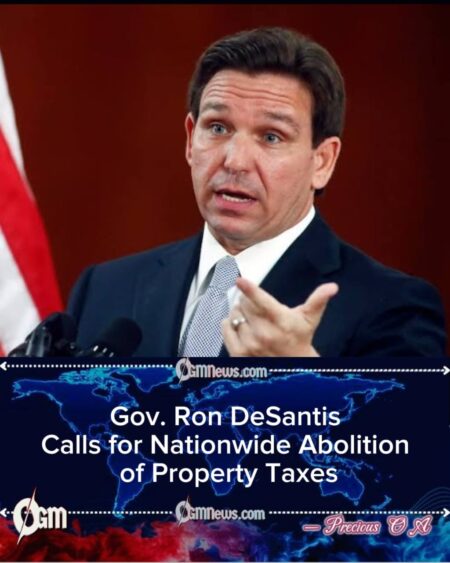
Florida Governor Ron DeSantis has called for the abolition of property taxes across all 50 U.S. states, describing the current system as an unfair financial burden on homeowners. Speaking at a press conference in Tallahassee, DeSantis said, “It’s almost like they have to pay rent to the government, just to be able to enjoy their property. That’s wrong. We need to do something about it.”
Ron DeSantis emphasized that eliminating property taxes would give Americans greater financial freedom and allow them to invest more in their homes and communities. He argued that homeowners should not feel penalized simply for owning property, particularly as inflation and cost-of-living increases continue to strain budgets. DeSantis highlighted that for many families, the ongoing financial burden of property taxes limits their ability to save, pursue higher education, or invest in business ventures.
Ron DeSantis also called on lawmakers across the nation to begin exploring legislative pathways toward the abolition of property taxes. He suggested that federal guidance and collaboration with state governments could pave the way for a more equitable tax system. According to DeSantis, creative policy solutions could ensure that essential services are maintained while relieving homeowners of what he termed an unjustified “government rent” on their own property.
Potential Economic Impact
Property taxes are a major source of revenue for states and local governments, funding schools, infrastructure, and public services. Ron DeSantis acknowledged that abolishing them would require alternative revenue streams but argued that it is possible through careful fiscal planning and efficiency reforms. He pointed out that the current reliance on property taxes often disproportionately impacts middle-class and retired Americans, while wealthier individuals and corporations can more easily navigate exemptions or loopholes.
Ron DeSantis warned that while there may be short-term budgetary challenges, the long-term economic benefit could be substantial. Removing property taxes could increase homeownership rates, encourage investment in residential and commercial properties, and stimulate local economies. DeSantis suggested that this could create a more robust housing market, boost construction jobs, and increase consumer spending, ultimately contributing to national economic growth.
Ron DeSantis highlighted that similar proposals in smaller jurisdictions have led to increased economic activity and stronger community engagement. He suggested that these case studies could provide models for implementing a nationwide policy. DeSantis emphasized that property tax abolition is not merely a financial issue, but a way to empower families and communities to make choices free from punitive governmental costs.
Political Reactions and Debates
The proposal has already sparked debate among political leaders and policymakers. Critics argue that abolishing property taxes could leave schools and municipal services underfunded, creating financial challenges for communities that rely heavily on property tax revenue.
Ron DeSantis countered that states could adopt alternative taxation systems or budget reforms to compensate for the loss of property tax revenue, stressing that fairness to homeowners should remain a priority. He said, “We can fund public services without forcing people to pay rent on what they already own.” He also stressed that innovation in state budgets could allow governments to maintain education, infrastructure, and safety services without burdening homeowners.
Ron DeSantis also encouraged bipartisan dialogue, urging both Republican and Democratic leaders to consider the broader economic and social benefits of the plan. He framed it as a long-term investment in citizens’ financial well-being rather than a political maneuver. DeSantis noted that widespread support among homeowners could translate into strong public pressure for change, potentially overcoming partisan resistance.
Public Opinion and Homeowner Support
Recent polls indicate that a majority of homeowners favor reforms to reduce or eliminate property taxes. Ron DeSantis cited these surveys as evidence that his proposal has broad public support, particularly among middle-class Americans and retirees on fixed incomes. He stressed that financial relief for homeowners is an issue that transcends political affiliation, resonating with families concerned about rising housing costs and living expenses.
Ron DeSantis stressed that removing property taxes could also relieve generational financial pressure, allowing families to pass on property without being burdened by excessive taxation. DeSantis added that this reform aligns with his broader vision of government that empowers citizens rather than penalizes them. He highlighted that homeowners often view property taxes as a form of economic unfairness that discourages long-term investment in communities.
Ron DeSantis noted that the public response so far has been overwhelmingly positive, with homeowners praising the idea of financial relief and greater control over their property investments. He encouraged citizens to engage with their local representatives and advocate for change. DeSantis also mentioned that grassroots support could be a key driver in accelerating legislative action at both state and national levels.
Implementation Challenges and Next Steps
While the proposal has captured national attention, implementing it across all 50 states would require significant planning and legal reforms. Ron DeSantis acknowledged that states vary widely in how they structure taxes and fund essential services, which could complicate adoption. He noted that a careful assessment of state budgets, revenue sources, and local needs would be critical to avoid unintended consequences.
Ron DeSantis emphasized that a phased approach, starting with pilot programs and incentive-based reforms, could demonstrate feasibility and build momentum for nationwide adoption. He suggested that federal guidance could assist states in designing equitable alternatives to property taxes. DeSantis also highlighted that engaging economists, tax experts, and municipal planners would be essential in crafting solutions that are both practical and sustainable.
Ron DeSantis concluded by urging lawmakers, economists, and civic leaders to begin serious discussions immediately, stating that the time has come to rethink a system that he believes unfairly burdens Americans. He stressed, “We need bold action now if we want a future where homeowners are truly free to enjoy their property.” DeSantis suggested that with political will and careful planning, property tax abolition could become a transformative policy for generations of Americans.
[…] […]