


























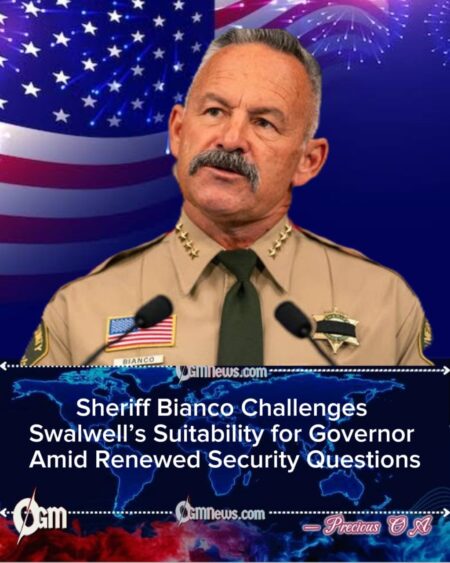
California Sheriff Chad Bianco delivered a forceful message as speculation grew that Rep. Eric Swalwell might enter the California governor’s race, using unusually direct language to challenge the congressman’s credibility. Bianco’s remarks, which circulated rapidly across political circles, were framed with an assertiveness rarely seen in early-stage electoral commentary, emphasizing that the mere possibility of Swalwell stepping into the gubernatorial arena warranted a thorough public evaluation of his past record. As discussions intensified, Bianco appeared determined to underscore what he characterized as broader issues of judgment, prudence, and suitability—qualities he believes the state cannot afford to overlook when considering who will lead California into a politically uncertain future.
Bianco asserted that California’s top office demands a leader with unimpeachable judgment, stressing that past controversies—especially those involving national security concerns—cannot be overlooked. In his comments, he reiterated repeatedly that the role of governor is not merely a ceremonial position but an immense responsibility that influences everything from state security to economic stability, and thus requires an individual who inspires complete confidence. His words added a significant layer of urgency to the conversation, as he argued that even the perception of compromised judgment could undermine the trust Californians place in the executive office, a trust he believes must be safeguarded with the utmost seriousness.
Critics of the congressman noted that Bianco’s remarks reflect deeper political anxieties within the state, where law-enforcement leaders are increasingly vocal about the direction of California’s political landscape. Many analysts suggested that this increasingly outspoken posture among sheriffs and police officials aligns with rising tensions over governance, public safety, and the ideological balance of power across the state. As these concerns continue to grow, Bianco’s intervention serves as a vivid example of how intensified scrutiny may shape the unfolding political narrative well before any official campaign announcements are made.
A Response Fueled by National Security Concerns
Bianco emphasized that his warning stems from concerns surrounding Swalwell’s past interactions with an alleged Chinese intelligence operative, which he argues remains relevant to voters assessing character and judgment. He insisted that such interactions, even when years removed from current events, form part of a candidate’s overall profile and must be examined thoroughly rather than dismissed as irrelevant history. According to Bianco, Californians deserve clarity about whether prior associations might cast doubt on a candidate’s ability to evaluate sensitive information or make impartial decisions on behalf of the public.
Public discussion about foreign influence resurfaced quickly after Bianco’s comments circulated, amplifying political divides and renewing debate about how past intelligence-related issues should influence statewide leadership decisions. Observers noted that this renewed focus on foreign influence reflects broader national anxieties about geopolitical vulnerabilities and the heightened importance of safeguarding institutions from undue external pressures. The dialogue also signaled that voters may expect candidates to provide clear explanations regarding past controversies, especially those touching on national security matters that continue to resonate in the public consciousness.
Bianco maintained that raising these concerns is not a partisan attack but a necessary step to uphold transparency and ensure Californians understand the risks he believes are attached to Swalwell’s candidacy. He positioned his remarks as part of an ongoing effort to protect the integrity of statewide leadership and argued that withholding such concerns would be a disservice to voters seeking full transparency. His insistence on viewing the issue through a nonpartisan lens has ignited discussion about how law-enforcement officials should engage in political discourse, particularly when national-security narratives are involved.
Political Stakes Rising as Speculation Intensifies
Growing interest across California in the 2026 gubernatorial race has heightened scrutiny of any public figure rumored to be considering a campaign, especially one with Swalwell’s national profile. The state’s political observers have noted that even preliminary conversations about potential candidacies carry significant weight, especially when they involve figures already deeply embedded in federal-level narratives. With expectations rising, the possibility of Swalwell entering the race has prompted both supporters and critics to reexamine his public record in anticipation of what could become a highly competitive contest.
Bianco argued that the potential entry of a high-visibility congressional figure requires an equally high level of public accountability, given the gravity of statewide decisions affecting millions. In his view, the prominence that Swalwell brings to the race is precisely why in-depth scrutiny must occur early and thoroughly, rather than allowing unresolved questions to linger into the heat of campaign season. He warned that failing to challenge such questions now could result in more significant political turmoil later, particularly if public doubts grow during critical policymaking decisions.
Bianco insisted that addressing such issues now, rather than during a heated campaign cycle, is essential for maintaining public trust and political transparency. He stressed the importance of ensuring that political figures vying for the governor’s office present themselves with a level of openness that reassures voters about their intentions, qualifications, and capacity to lead. By encouraging early inquiry into Swalwell’s suitability, Bianco signaled that he views this moment as a necessary stage in preserving the credibility and legitimacy of California’s electoral process.
Framing the Debate Around Integrity and Public Trust
Bianco stated that political leaders must operate at a level of integrity that withstands both public examination and national security scrutiny, especially amid rising geopolitical tensions. He emphasized that California’s stature as an influential state makes its leadership choices particularly consequential, not only to residents but to the broader national landscape. According to Bianco, failure to rigorously assess the integrity of potential leaders jeopardizes the state’s ability to address emerging global challenges effectively.
Supporters of Bianco’s stance argue that the sheriff’s comments reflect legitimate concerns about the responsibility entrusted to California’s governor and the scrutiny that should accompany it. These supporters maintain that Bianco’s remarks resonate with voters who value transparency and long-term accountability in public officials. They contend that potential vulnerabilities must be identified and addressed early, particularly in an era defined by complex international dynamics, rapid information flow, and heightened security challenges.
Bianco reaffirmed that California deserves a governor who is unequivocally free from controversies that could compromise public confidence or distract from administering the nation’s most populous state. He stressed that the responsibilities of the office demand a leader who can focus entirely on governing without the burden of unresolved past issues detracting from urgent priorities. In his view, ensuring the clarity and readiness of a candidate’s profile is integral to promoting effective and trustworthy governance.
Impact on California’s Evolving Political Landscape
Several commentators observed that Bianco’s statement adds a new dynamic to what is expected to be a highly competitive contest, with candidates positioning themselves early to shape voter perception. The sheriff’s remarks, according to these analysts, contribute to an evolving narrative in which law-enforcement voices play a more central role in shaping public discourse ahead of major elections. This involvement signals the possibility of more direct commentary from institutional leaders as political tensions rise across the state.
Bianco continued to frame his remarks as part of a broader discussion about leadership quality, arguing that California needs a governor capable of navigating complex national and international challenges. He emphasized that issues such as immigration, public safety, economic strategy, and disaster management require not only competence but unimpeachable judgment. Bianco’s insistence on elevating the conversation surrounding these characteristics demonstrates his belief that the coming election will serve as a pivotal moment in determining California’s trajectory.
Another dimension of the debate emerged from analysts who suggested that Bianco’s sharp response may signal a more assertive role among law-enforcement officials in statewide policy conversations. They noted that the sheriff’s remarks may encourage other leaders in uniform to speak more openly about their concerns, particularly on issues where they feel political leadership intersects with public safety and national security. As this trend develops, Californians may observe a shift in how various sectors engage with political decisions and campaign narratives.
Broader National Implications for the 2026 Race
Bianco also highlighted that California’s governor holds influence beyond state borders, shaping national conversations on immigration, security, and federal cooperation. He underscored that decisions made in Sacramento often reverberate across the country, making it essential that the state elect a leader whose background and judgment inspire confidence nationwide. According to Bianco, this broader influence makes it especially important for voters to scrutinize candidates carefully, ensuring that those who seek the office are prepared to navigate complex national issues.
Bianco added that the involvement of high-profile federal lawmakers in state races inevitably invites national attention, especially under the current U.S. president serving a second term, President Trump, whose relationship with California politics remains polarizing. He noted that California’s longstanding tensions with the federal government have historically shaped national debates and that any candidate entering the race must be prepared to address these conflicts head-on. Bianco’s remarks reflect his belief that a candidate’s past actions and associations must be evaluated within this national context to avoid compounding existing tensions.
Observers noted that Bianco’s remarks may signal the beginning of a more confrontational political climate, where candidates and public officials challenge rivals earlier and more directly than in past election cycles. They suggested that this increasingly direct approach may redefine the tone of upcoming campaigns, requiring candidates to articulate clearer, more comprehensive responses to criticism. As political dynamics intensify, Californians may witness a new era of pointed debate and heightened scrutiny, shaping the narrative long before voters head to the polls.


Ae888covenuscasino, okay, I'm curious. Gonna check out this site and try to find some amazing...