





























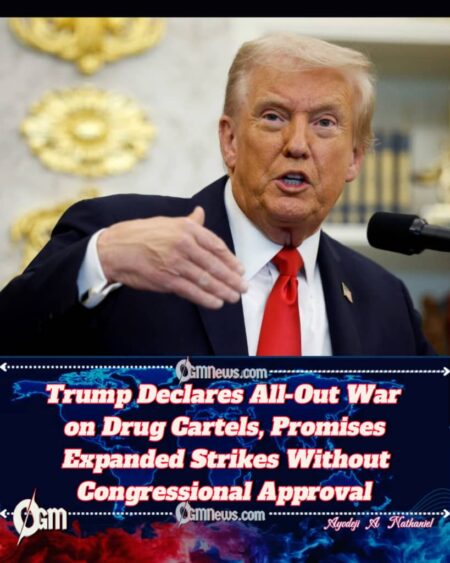
U.S. President Donald J. Trump, now in his second term, has announced plans to dramatically expand military operations against international drug cartels—without waiting for congressional authorization. Speaking during a national security briefing at the White House, Trump asserted that his administration would “just kill” traffickers responsible for flooding U.S. communities with illegal narcotics.
The President’s declaration marks one of the most forceful positions yet in his long-standing crusade against organized drug networks. While previous administrations focused primarily on law enforcement and international cooperation, Trump’s rhetoric signals a shift toward a militarized approach, one that could blur the lines between domestic security and foreign combat operations.
White House aides later clarified that the President was referring to “targeted precision actions” abroad, not domestic enforcement. However, the lack of congressional oversight has already ignited fierce debate across Washington.
Legal Questions Over Executive Authority
Constitutional scholars and lawmakers are divided over whether President Trump can authorize lethal operations abroad without congressional consent. The U.S. Constitution grants Congress the power to declare war, but presidents have long used executive authority to carry out limited military actions.
“This raises serious questions about the scope of presidential war powers,” said Senator Chris Murphy, a member of the Senate Foreign Relations Committee. “We can’t allow the executive branch to bypass democratic checks when deploying lethal force.”
Supporters of Trump’s move argue that existing laws, such as the Authorization for Use of Military Force (AUMF), already grant the President sufficient latitude to target terrorist and transnational criminal networks. Critics counter that expanding such operations against drug cartels could set a dangerous precedent for unilateral military actions.
The International Backlash Begins
Several Latin American governments have expressed alarm at Trump’s declaration, warning that unauthorized U.S. strikes could violate national sovereignty. Mexico, in particular, responded cautiously, emphasizing the need for “shared responsibility and coordination” in combating cross-border drug trafficking.
International law experts note that conducting military strikes on foreign soil without the host nation’s consent could breach the United Nations Charter, which prohibits the use of force except in cases of self-defense or with Security Council approval.
“The U.S. risks undermining the very international order it helped build,” said Dr. Elena Vargas, a legal analyst at the Geneva Institute for Global Policy. “Even if the intent is to fight criminal organizations, the method matters.”
Military Leaders Urge Strategic Caution
While Trump’s tough stance on drug cartels has been popular among his political base, military officials have reportedly urged a more measured approach. Pentagon sources, speaking in the background, said that the Defense Department is reviewing operational frameworks to ensure compliance with both U.S. and international law.
Former commanders warned that a rapid escalation could lead to prolonged foreign entanglements. “You can’t treat every criminal network like ISIS,” said retired General Mark Milley. “The intelligence, geography, and political contexts are entirely different.”
The Department of Defense has yet to outline which cartels or regions might be targeted under the proposed expansion, though sources suggest operations could focus on Central and South America.
Domestic Debate: Security vs. Oversight
At home, the announcement has deepened partisan divides. Republican lawmakers largely praised the President’s resolve, calling it a necessary step to defend Americans from the deadly flow of fentanyl and other synthetic drugs.
Democrats, however, warned that bypassing Congress undermines accountability and could lead to constitutional overreach. House Minority Leader Hakeem Jeffries criticized the administration’s “reckless disregard for separation of powers,” urging a bipartisan review of executive war-making authority.
Public opinion remains mixed. Polls show strong support for tougher action on drug trafficking but lingering discomfort with open-ended military powers.
Humanitarian and Diplomatic Implications
Human rights organizations cautioned that expanded military operations could inadvertently endanger civilians and destabilize regions already grappling with violence and poverty.
“The human cost of such a campaign could be enormous,” said Maria Delgado of Human Rights Watch. “History has shown that militarized solutions to drug trafficking rarely deliver lasting peace or justice.”
Diplomats warn that strained relations with key allies could hinder broader counter-narcotics efforts, which rely on intelligence sharing, extradition treaties, and coordinated policing rather than unilateral strikes.
The Road Ahead
Despite mounting criticism, President Trump appears unwavering in his commitment to confront drug cartels with full U.S. force. His administration plans to outline a new operational framework in the coming weeks, with Defense and State Department consultations expected to follow.
Observers say the coming months will test the balance between presidential authority, congressional oversight, and the boundaries of international law. As the United States recalibrates its war on drugs, the world will be watching how far the White House is willing to go—and at what cost.
Casinoabc999? Good Site. The interface is sleek, and there is a lot of stuff to...