
























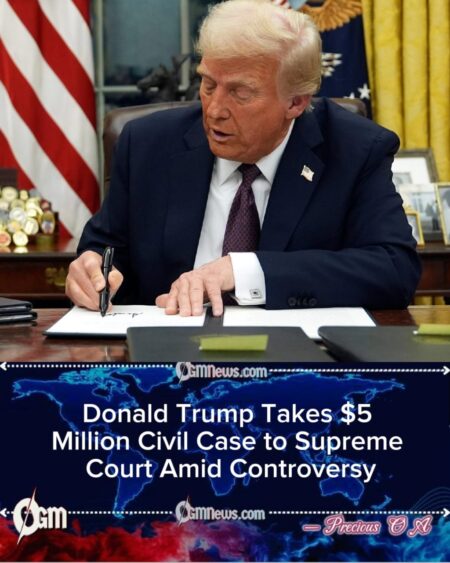
President Donald Trump escalates the legal drama this week as he formally appealed to the Supreme Court, seeking to overturn a $5 million civil judgment in favor of writer E. Jean Carroll. Carroll had previously won the case, which accused Trump of sexual abuse and defamation, marking a landmark ruling against the former president in one of the most high-profile civil cases of his career. The judgment, which was widely reported and analyzed in both national and international media, has been the subject of intense public debate, bringing the former president’s personal conduct into sharp focus once again.
Donald Trump has argued in his petition that the lower courts made significant errors in their rulings, contending that these errors denied him a fair and impartial review of the case. Legal analysts have described the petition as both audacious and highly strategic, emphasizing that Trump’s team is attempting to leverage procedural nuances and technicalities to reverse a ruling that many consider decisive. Observers note that the filing underscores a pattern in Trump’s post-presidential legal strategy, which involves aggressively contesting judgments and prolonging litigation in high-profile cases.
Donald Trump’s appeal has reignited public discussion about the broader implications of civil litigation involving former U.S. presidents and prominent political figures. Some commentators argue that the appeal is a calculated effort to protect his personal and political reputation, framing it as part of a larger campaign to maintain influence and control over public perception. Others suggest that the appeal represents a continuation of legal battles that have long defined Trump’s career, raising questions about accountability and the boundaries of legal recourse for powerful individuals.
Observers note that Trump’s Supreme Court petition will be closely scrutinized not only for its legal merit but also for its potential political and cultural ramifications. Experts warn that the case could set important precedents in how courts handle civil suits involving allegations of sexual misconduct and defamation by former officials, potentially influencing future litigation strategies and public expectations of justice. The high-profile nature of the case ensures that its outcomes will be dissected by media, policymakers, and the public for years to come.
Donald Trump’s move has also reignited discussions about the role of celebrity, political status, and public influence in judicial proceedings. The intense coverage reflects a national fascination with high-stakes litigation involving well-known figures, blending legal analysis with broader societal debates about accountability, morality, and power dynamics. Many analysts predict that even if the Supreme Court declines to hear the case, the appeal itself will continue to shape narratives surrounding Trump’s legacy and public image.
The Civil Judgment and Public Outcry
Donald Trump was previously ordered to pay $5 million in damages to E. Jean Carroll after a jury found him liable for sexual abuse and defamation. The verdict was widely hailed by advocates for victims’ rights as a rare instance of accountability for a powerful individual, particularly one with extensive political influence. However, critics of the ruling argued that the case was politically motivated or that it represented an unprecedented intrusion into the personal affairs of a former president. The ruling, its implications, and the public reaction have collectively sparked a complex debate about justice, privilege, and societal standards for public figures.
Donald Trump’s legal team has claimed that procedural mistakes during the trial compromised his ability to receive a fair hearing. The petition highlights what Trump’s lawyers describe as “fundamental legal errors,” including disputed evidentiary rulings, jury instructions, and issues related to the conduct of attorneys and judges. Supporters of the former president frame the appeal as a legitimate and necessary step in defending his legal and personal rights, portraying the move as part of a broader commitment to justice and due process.
The Supreme Court now faces the decision of whether to hear the appeal, a choice that could take months to resolve. Legal experts note that the Court rarely intervenes in civil cases unless there are significant constitutional questions or procedural anomalies, making the path to a reversal extremely challenging. Even so, the filing ensures that public attention remains focused on the case, sustaining discussions about legal accountability, gender rights, and the limits of power for high-profile figures.
Donald Trump’s appeal has further fueled debates in political and media circles, with some commentators suggesting that the litigation could influence public perceptions of his character and suitability for future political endeavors. Observers highlight that cases like this often operate at the intersection of law and public opinion, and that ongoing litigation can have long-term effects on political campaigns, media coverage, and societal narratives about accountability.
Donald Trump’s actions also underscore the tension between legal strategy and public relations. While the petition is formally a legal document, its implications extend far beyond the courtroom, drawing renewed attention to Carroll’s allegations and sparking discussions about justice, fairness, and societal standards for powerful individuals.
Political and Social Implications of the Appeal
Donald Trump’s decision to take the case to the Supreme Court carries broader political and social consequences, as it has been interpreted both as a legal maneuver and a symbolic act. Supporters argue that challenging the verdict is a legitimate exercise of legal rights, while critics contend that it represents an effort to evade accountability and undermine public trust in the judicial system. Analysts note that the polarizing nature of the case amplifies existing divides in public opinion, with legal, political, and social dimensions intersecting in a highly charged national debate.
Donald Trump’s petition may also have implications for other civil cases involving prominent public figures. Legal scholars suggest that the Supreme Court’s response could influence future decisions about the scope of accountability for former officials, the handling of sexual misconduct claims, and the balance between political influence and judicial impartiality. Many observers are watching closely to see whether the Court’s treatment of the case will establish or reinforce precedents for civil liability involving high-profile defendants.
Trump’s appeal has elicited strong reactions across social media and political commentary, with supporters portraying him as a victim of legal overreach and detractors denouncing the move as an example of disregard for victims’ rights. Public discourse reflects the deep polarization surrounding Trump, with online debates highlighting differing perspectives on morality, legality, and societal norms regarding accountability for public figures.
Donald Trump remains steadfast in pursuing all available legal avenues, demonstrating his continued engagement with the judicial system even after leaving office. Observers note that the Supreme Court appeal is not solely about overturning a civil judgment but also about shaping narratives surrounding his personal and political legacy, as well as reinforcing his image among his supporters amid ongoing public scrutiny and criticism.
Donald Trump’s Supreme Court petition ensures that the E. Jean Carroll case will remain a focal point of national attention, illustrating the enduring intersection of law, politics, and public opinion. While the outcome remains uncertain, the appeal underscores the continued relevance of legal accountability for prominent figures and the complexities of navigating public and private responsibility in high-profile cases.


Logging in is a breeze and the site stability is amazing even during peak hours....