






















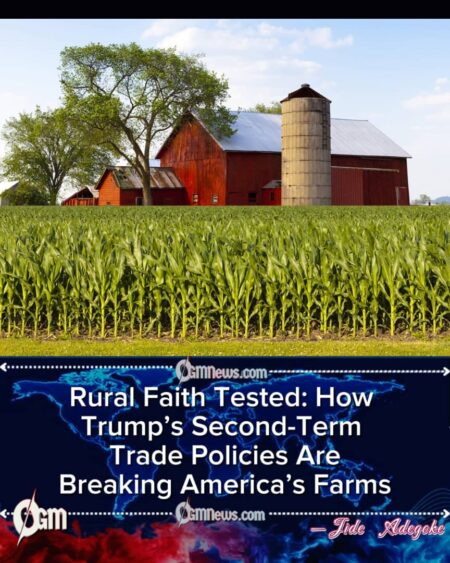
Nearly 80% of voters in farming-dependent counties voted for President Donald Trump in the last election, reaffirming their deep loyalty to his leadership and his promise to defend the “American farmer.” These communities, long seen as the backbone of rural America, rallied behind Trump’s vision of economic revival, fewer regulations, and stronger domestic trade protections. But as the new wave of agricultural and trade policies unfold in his second term, many of those same voters now find themselves on the edge of financial ruin.
Nearly 80% of Voters in Farming-Dependent Counties Voted for Trump
Farmers across states such as Iowa, Kansas, Nebraska, and Wisconsin overwhelmingly supported President Trump, driven by campaign assurances that his administration would protect rural livelihoods and put “America’s farmers first.” His message of economic independence resonated strongly in communities long frustrated by fluctuating commodity prices and foreign competition.
Many farmers credited Trump with giving them a voice, believing that his trade battles and subsidy programs would ultimately favor domestic agriculture. County-level data from the 2024 election revealed that rural precincts dependent on corn, soybeans, and livestock production delivered some of Trump’s largest margins, often exceeding 75% support. For many, voting for Trump was not just political—it was personal, tied to a belief that his leadership represented the return of respect and recognition for the American farmer.
Now, Many of the Farmers Are on the Brink of Bankruptcy Because of His Policies
Now, many of the farmers who once saw themselves as central to Trump’s “America First” agenda are facing bankruptcy, crushed under the weight of policies that were meant to protect them. Tariff expansions on imported agricultural equipment and fertilizers have driven up production costs. Meanwhile, reduced export access due to trade tensions with key partners such as China and Mexico has shrunk markets for American crops.
A recent report from the American Farm Bureau Federation indicates that farm debt has risen to record levels, with over half of small and mid-sized farms now considered “financially distressed.” Government aid programs once touted as safety nets are proving insufficient, leaving many family farms unable to recover. “We believed he was fighting for us,” said a soybean farmer from Iowa, “but right now, it feels like we’ve been left behind by our own choice.”
Economists warn that if current trends persist, rural bankruptcies could surge by as much as 30% within a year. As farm auctions rise and generational land passes into corporate hands, the irony deepens: communities that overwhelmingly voted for Trump are now among the hardest hit by the consequences of his own policy direction.
The Political Crossroads for Rural America
The mounting financial strain is forcing a quiet political reckoning in rural America. While many farmers remain loyal to Trump, others are beginning to question whether political allegiance has cost them their livelihoods. Rural advocacy groups are calling for urgent revisions to trade and subsidy programs, arguing that current strategies have backfired against the very voters they were meant to empower.
Political analysts note that this moment could redefine the relationship between conservative America and the White House. “This is more than economics—it’s identity,” said one rural policy expert. “Farmers see Trump as one of them. But when that loyalty collides with survival, something has to give.”
As the crisis deepens, farming towns that once symbolized Trump’s political dominance may now become the testing ground for how much economic hardship his supporters are willing to endure in exchange for ideological solidarity.
The story unfolding across rural America is one of loyalty, consequence, and reckoning. The farmers who built their faith on Trump’s promise to protect them are discovering that economic nationalism comes with a price. Whether that price will shift the political landscape remains uncertain—but the fields of the Midwest and beyond are already bearing the cost.

[…] […]