



























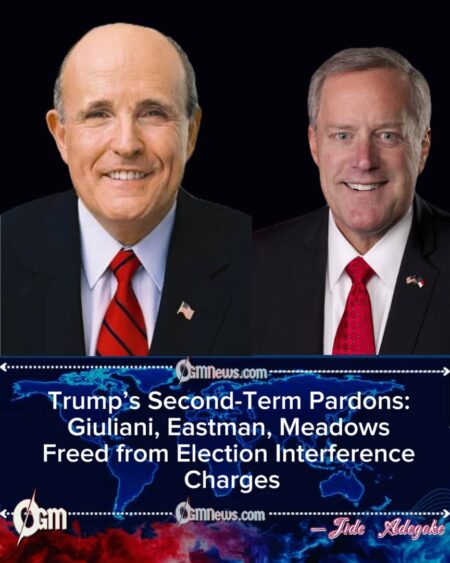
President Donald Trump, currently serving his second term in office, has granted full pardons to Rudy Giuliani, John Eastman, Mark Meadows, and more than a dozen others who had been charged in connection with efforts to overturn the 2020 U.S. presidential election results.
The pardons, announced late Sunday night from the White House, mark one of the most politically consequential acts of clemency in recent U.S. history. According to a statement released by the administration, the decision was made “in the interest of national reconciliation” and to “end politically motivated prosecutions that have divided the nation for too long.”
Legal analysts, however, argue that the move could reignite debate over executive power and accountability, as several of those pardoned were awaiting trial on charges related to election interference and obstruction. The Justice Department has not yet commented on whether ongoing investigations tied to the case will be affected.
Giuliani Among Beneficiaries of the President’s Clemency Decision
Rudy Giuliani, the former New York City mayor and longtime personal attorney to President Trump, was among the most prominent figures to receive a pardon. Giuliani had faced multiple charges linked to his alleged involvement in pressuring state officials to reject certified election results and promoting what prosecutors described as “a coordinated scheme to subvert the democratic process.”
Giuliani, reacting to the announcement, expressed gratitude toward the president, calling the decision “a victory for justice and truth.” He maintained that his actions following the 2020 election were “lawful and patriotic,” insisting that he had “only sought to ensure electoral integrity.”
Critics, however, say the pardon undermines the rule of law and sends a troubling signal about accountability for public officials. “It effectively rewards misconduct,” said one Washington-based legal scholar. “The message is that loyalty to power, not fidelity to law, determines justice.”
Eastman, Meadows, and Others Also Cleared of Charges
John Eastman, a conservative attorney who drafted legal memos suggesting ways to overturn the 2020 results, and Mark Meadows, who served as White House Chief of Staff during that period, were also included in the president’s sweeping clemency order. Both men had faced charges of conspiracy and obstruction of an official proceeding.
Eastman, in a brief statement, called the pardon “a restoration of constitutional order,” adding that he had acted within his rights as an adviser to the president. Meadows similarly thanked President Trump, saying the pardon “closes a dark chapter of politically charged persecution.”
The White House defended the president’s authority to issue the pardons, emphasizing that all recipients had been “unfairly targeted for political reasons.” Yet, opposition lawmakers and advocacy groups swiftly condemned the move. Senate leaders called for congressional hearings to examine whether the pardons were used to shield political allies from accountability, while some activists urged the Justice Department to consider legislative reforms to limit the scope of presidential pardon powers.
Political and Legal Fallout Expected
The decision is likely to have far-reaching implications for U.S. politics, particularly as President Trump navigates his second term amid ongoing partisan tensions. While supporters see the move as a bold stand against what they describe as “weaponized justice,” critics warn that it could further erode public trust in democratic institutions.
Legal experts note that while the presidential pardon wipes out federal charges, it does not preclude state-level prosecutions, meaning some of those pardoned could still face legal jeopardy in certain jurisdictions. The announcement has also reignited discussion about the limits of presidential authority and the need for clearer legal safeguards to prevent potential abuse of executive clemency.
As the nation reacts, political analysts suggest that this round of pardons may shape the tone of the remainder of Trump’s second term — one defined, yet again, by a mix of loyalty, controversy, and questions about power and accountability in the American system.

[…] […]