



























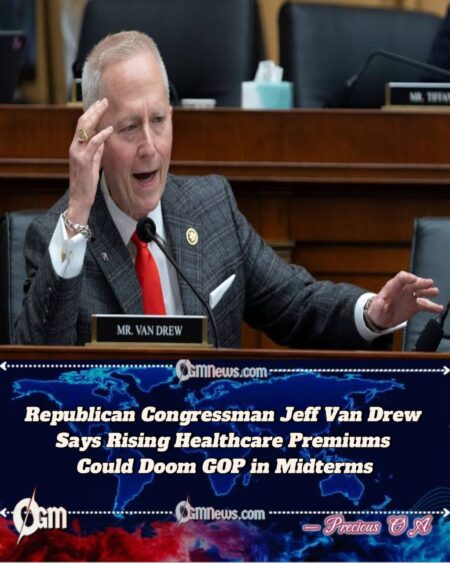
Republican Congressman Jeff Van Drew has made a stunning and unusually candid admission that has sent shockwaves through the Republican Party as the midterm elections draw closer. Speaking during a press briefing in Washington, D.C., Van Drew conceded that Republicans are “going to get killed” in the midterms, openly acknowledging that skyrocketing healthcare premiums are fueling voter anger and could lead to devastating electoral consequences. His remarks, described by political insiders as “remarkably blunt,” have exposed growing cracks within the GOP, as the party grapples with criticism over its handling of healthcare reform and the steady rise in insurance costs for millions of Americans.
Jeff Van Drew, who represents New Jersey’s 2nd Congressional District, has long been known as a pragmatic and occasionally outspoken lawmaker. However, his latest remarks go beyond mild criticism and represent a rare moment of honesty that has stirred both praise and outrage within his own party.
“We are losing the trust of working families,” Jeff Van Drew warned. “People are paying more than ever for health insurance, and they’re not seeing any improvement in coverage. If we don’t fix this—and fix it fast—we’re going to pay the political price.” His comments reflect growing unease among moderate Republicans who fear that the healthcare issue, once a rallying cry for conservative reform, has become a political liability that threatens to undo years of electoral progress.
His warning underscores a grim reality: healthcare costs have climbed at an alarming rate across much of the United States, with premiums surging in multiple states as insurers adjust to market uncertainty and reduced government subsidies. For ordinary Americans, the numbers are not abstract—they translate into painful trade-offs between paying for insurance, rent, or groceries. “People don’t care about political talking points,” Jeff Van Drew said. “They care about being able to afford their doctor, their prescriptions, and their kids’ medical care. That’s what this election will come down to.”
Jeff Van Drew’s remarks have ignited a fierce internal debate within the GOP. Party leaders, already on edge about the upcoming elections, are scrambling to manage the fallout. Some lawmakers privately acknowledge that Van Drew’s concerns are valid, but others accuse him of handing Democrats a potent weapon at a critical moment. The congressman’s honesty, however, has struck a chord with many voters who feel abandoned by political rhetoric that fails to address the practical realities of healthcare costs. For many Americans, the soaring premiums have turned into a symbol of government dysfunction, and Van Drew’s remarks have only amplified that frustration.
Healthcare Premiums and the Political Fallout
Healthcare policy analysts and economists have long warned that the Republican Party’s approach to healthcare reform could lead to widespread voter backlash. The decision to scale back subsidies, loosen consumer protections, and reduce federal oversight over insurance markets has allowed companies to reprice their plans—often dramatically. In some regions, insurance premiums have climbed by 25 to 40 percent over the past year alone, leaving families and small businesses struggling to keep up. Experts argue that these price hikes are not isolated events but the predictable result of a deregulation agenda that prioritizes market freedom over consumer affordability.
Jeff Van Drew’s admission, therefore, did not occur in a vacuum—it reflects months of growing discontent among both lawmakers and their constituents. Many moderate Republicans have expressed concern that the party’s long-standing promise to “replace and repeal” the Affordable Care Act has devolved into a series of half-measures that satisfy neither conservatives nor the general public. Without a coherent alternative, the GOP finds itself on the defensive, accused of dismantling existing protections without providing a viable replacement.
The political repercussions are already being felt. Polling data shows healthcare climbing back to the top of voters’ concerns, eclipsing even inflation and immigration in several key battleground states. Suburban voters, particularly women and middle-income families, have shown signs of shifting away from Republican candidates, citing healthcare affordability as their primary frustration. Jeff Van Drew’s acknowledgment of the issue has inadvertently confirmed what Democratic strategists have been arguing for months: that the GOP’s handling of healthcare could cost them the House majority.
Inside Republican circles, the mood is tense. Some party figures are urging leadership to pivot quickly, proposing targeted subsidies or expanded tax credits to stabilize premiums before the election. Others warn that such measures could alienate the conservative base, which remains opposed to anything resembling federal intervention in healthcare. The result is a policy paralysis that threatens to compound the GOP’s image problem, making it appear both divided and unresponsive.
Democrats Seize the Moment as GOP Scrambles for Strategy
Democratic leaders wasted no time capitalizing on Republican Congressman Jeff Van Drew’s candid remarks. Within hours of his statement, Democratic campaigns across the country began circulating his words in advertisements, fundraising emails, and social media posts. “Even Republicans admit their policies are hurting working families,” declared one widely shared post from the Democratic Congressional Campaign Committee. The message resonated with voters, particularly in districts where families have seen their healthcare costs spiral out of control.
President Joe Biden’s administration also seized the opportunity, using Jeff Van Drew’s statement to highlight its own efforts to lower prescription drug prices and expand healthcare subsidies through the Inflation Reduction Act. White House spokespersons emphasized that while the administration has worked to make care more affordable, Republican lawmakers have consistently opposed or rolled back such measures. “This isn’t just about policy—it’s about values,” one official remarked. “When even a Republican congressman admits the truth, it tells you how bad things have gotten under GOP leadership.”
Meanwhile, Jeff Van Drew has faced a storm of criticism from within his own ranks. Some colleagues view his comments as reckless, accusing him of undermining party unity at a critical time. Others, however, defend his candor, arguing that acknowledging reality is the first step toward regaining voter trust. Political strategists privately admit that Van Drew’s statement, while controversial, may have forced the party to confront an uncomfortable truth it has long tried to downplay.
The fallout from Jeff Van Drew’s remarks continues to grow, with conservative commentators debating whether his honesty represents political courage or strategic self-sabotage. Some right-wing media outlets have accused him of “playing into the Democrats’ narrative,” while moderate voices within the party see his remarks as a necessary wake-up call. What is undeniable is that the issue of healthcare—once seen as a Democratic stronghold—has reemerged as a defining battleground that could determine control of Congress.
As the midterm elections approach, Republican Congressman Jeff Van Drew’s stark warning hangs over the GOP like a shadow. His declaration that the party could “get killed” at the polls has crystallized voter frustration into a single, haunting phrase. Whether the Republicans can recover from this self-inflicted wound—or whether Jeff Van Drew’s prophecy will become political reality—remains to be seen. But one thing is certain: in an election year defined by economic anxiety and healthcare hardship, the price of political inaction may prove higher than any premium increase.

[…] […]