



























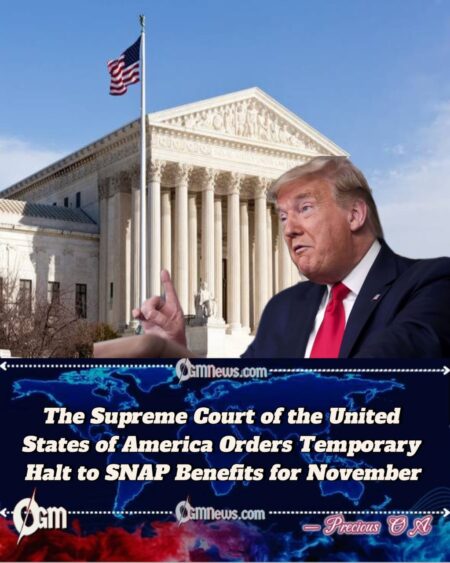
The Supreme Court of the United States has temporarily suspended full Supplemental Nutrition Assistance Program (SNAP) food benefit payments for the month of November, following a request from the Trump administration. This decision comes as a severe blow to millions of low-income Americans, including children, seniors, and veterans, who rely on these benefits to meet their basic nutritional needs.
The timing is particularly critical, coinciding with the ongoing government shutdown that has left many families struggling to make ends meet, facing increasingly difficult financial circumstances, and attempting to stretch already limited resources to cover rent, utilities, healthcare, and other essential expenses. For households that live paycheck to paycheck or depend on public assistance programs, even a temporary disruption in SNAP payments can have ripple effects across their daily lives, creating both immediate and long-term hardships.
Acting under extraordinary circumstances during the government shutdown, the Supreme Court’s temporary order halts full payments to SNAP recipients. Millions of households depend on SNAP as a lifeline to purchase groceries and maintain food security, particularly in regions with high rates of poverty or in communities where access to affordable, nutritious food is limited. With the suspension in place, many families may face empty pantries or difficult choices between paying for other essential expenses and feeding themselves.
Advocacy groups have warned that this temporary halt could exacerbate hunger and malnutrition in vulnerable communities, potentially creating a public health crisis during the holiday season, when the need for nutritious food is at its peak and families are already struggling to maintain normalcy under the stress of political and economic uncertainty. Experts suggest that the consequences of this suspension may extend beyond the immediate financial impact, influencing health outcomes, educational performance, and overall community stability.
Officials emphasized that the suspension is temporary, noting that the measure could be reversed depending on the progress of federal negotiations. The Trump administration argued that the halt was necessary to prevent “unlawful spending” during the shutdown, citing legal and budgetary concerns, including concerns that continued disbursement of SNAP funds without formal appropriation could violate federal fiscal rules and potentially set a precedent for unchecked emergency expenditures.
Critics, however, have condemned the move as politically motivated, arguing that it disproportionately harms those who are already struggling to survive, particularly the elderly, children, and disabled individuals who may not have other sources of financial support. Analysts note that while the administration frames the suspension as a legal necessity, the real-world consequences for millions of Americans are significant and immediate, forcing families to make impossible choices and potentially jeopardizing their basic health and well-being.
Legal experts note that the Supreme Court’s decision also sets the stage for potential legal challenges that may arise in the coming weeks. Advocacy groups and several states have indicated they will pursue litigation, arguing that the suspension violates federal obligations to provide basic nutrition assistance to eligible citizens, which is protected under existing law and federal programs designed to safeguard food security.
Meanwhile, local organizations and food banks are preparing emergency food distributions to offset the potential shortfall, though they acknowledge that these measures cannot fully replace SNAP benefits, which provide a steady, predictable source of support that families rely on to budget their monthly expenses. Legal analysts warn that the case could escalate into a larger debate over the scope of judicial oversight during times of political impasse, raising questions about the balance between executive authority, judicial intervention, and the rights of citizens to receive federally mandated assistance.
The Supreme Court’s temporary halt has drawn the attention of policymakers and media outlets nationwide, highlighting the fragility of the social safety net during political impasses. Observers note that this suspension could serve as a precedent for future conflicts over federal funding during shutdowns, underscoring the importance of legal oversight in protecting vulnerable populations and ensuring that federal programs are not arbitrarily disrupted. The situation has sparked national conversations about the role of government in safeguarding basic human needs, particularly during times of political dysfunction, and has renewed discussions about the broader implications of government shutdowns on public welfare programs that millions of Americans depend on for survival.
The Human Impact: Families, Seniors, and Children
Millions of American families are in jeopardy due to the temporary suspension of SNAP benefits. For many, SNAP is essential for survival rather than supplemental support, providing the fundamental means to purchase enough nutritious food to maintain health and daily functioning. Families who rely on monthly SNAP payments for groceries may now face difficult choices, including reducing meal portions, skipping meals, or prioritizing certain members of the household over others.
Children, particularly those from low-income households, are at heightened risk of food insecurity, which can have long-term effects on physical growth, cognitive development, educational performance, and overall emotional well-being. Studies have shown that children who experience regular periods of hunger or inconsistent access to nutritious food often face challenges in school, reduced attention spans, and increased susceptibility to illness, which underscores the critical importance of consistent SNAP support.
Seniors and veterans, many of whom live on fixed incomes and depend heavily on SNAP to meet daily nutritional needs, are also threatened by this order. Many older adults face limited mobility, higher medical expenses, and reduced ability to access alternative food sources, making SNAP benefits a crucial component of their daily sustenance. Even a short disruption in benefits can lead to missed meals, increased reliance on already overstretched local food pantries, or forced trade-offs between purchasing medicine and buying groceries.
Experts warn that the suspension could exacerbate existing inequalities and deepen hardships for already vulnerable populations, particularly during a government shutdown when support services are limited and access to alternative assistance is constrained. The impact of the suspension is likely to be felt most acutely in communities with higher concentrations of poverty or where transportation and access to grocery stores are already challenging.
States and local agencies are mobilizing emergency support for affected residents in response to the Supreme Court’s ruling. Community organizations are preparing to meet increased demand through food drives, emergency distribution programs, and volunteer initiatives, but advocates stress that these stopgap measures cannot fully substitute the comprehensive support that SNAP provides.
Emergency food programs often face capacity limitations and cannot match the scale or predictability of federal benefits, leaving many families still vulnerable to hunger and nutritional deficits. The decision has also intensified calls for Congress to resolve the shutdown quickly to prevent further hardship, with policymakers emphasizing that legislative inaction exacerbates the suffering of those most dependent on government programs for survival.
The Supreme Court’s suspension may also have psychological effects on families already under stress from financial instability. Uncertainty about food access can increase anxiety, disrupt household routines, and force families to make difficult trade-offs between essential needs like healthcare, housing, transportation, and nutrition.
Mental health professionals warn that food insecurity is closely linked to stress, depression, and family tension, and even a temporary disruption in benefits can exacerbate these conditions. This ruling highlights the critical importance of SNAP in maintaining social stability and protecting public health. Experts warn that even temporary disruptions can have cascading effects, particularly on children, seniors, and other vulnerable populations who rely on consistent nutritional support to maintain their health, education, and overall quality of life.
SNAP: Legal and Political Fallout
The Supreme Court’s temporary order has significant legal and political implications, shaping national debates about the role of government, judicial oversight, and social welfare during periods of political impasse. The Trump administration maintains that the suspension is legally justified under the circumstances of the federal shutdown, arguing that continued spending without appropriation could violate federal law and strain the national budget.
However, critics argue that halting benefits reflects a broader pattern of using essential services as leverage in political negotiations, potentially placing political or ideological priorities above the immediate needs of vulnerable populations. Legal challenges are expected to continue, with plaintiffs asserting that the suspension violates federal law, the constitutional right to basic subsistence, and protections intended to shield disadvantaged Americans from arbitrary deprivation of essential services.
Lawmakers and advocacy groups have expressed outrage, accusing the administration of placing ideological or budgetary priorities above the basic needs of citizens. Congressional leaders from both parties are calling for a swift resolution to restore SNAP benefits in full, emphasizing that food security is not a partisan issue but a fundamental human right that underpins health, education, and economic stability. Policy debates are intensifying, highlighting the tension between fiscal responsibility, executive authority, and human welfare. Analysts suggest that the political fallout from this decision could reverberate for months, influencing public opinion and shaping the priorities of future administrations regarding social safety net programs.
Policy analysts warn that delays in benefits could have broader economic implications. Reduced consumer spending by low-income households may affect local economies, particularly grocery stores, farmers’ markets, and small businesses that rely heavily on SNAP purchases for revenue. Economic experts note that the suspension could lead to decreased demand for essential goods, creating a chain reaction that impacts jobs, supply chains, and local tax revenues, ultimately demonstrating the interconnectedness of federal assistance programs and the broader economy.
The Supreme Court’s decision underscores ongoing debates over the balance of power between the executive branch and the judiciary during federal shutdowns. Legal scholars suggest that the case could set precedents regarding the scope of executive authority in managing social welfare programs and the role of courts in safeguarding vulnerable populations, with implications that may extend far beyond the current crisis. The ruling, while temporary, serves as a stark reminder of the fragility of federal support systems in times of political stalemate, highlighting the urgent need for legislative and administrative solutions to ensure that millions of Americans do not go hungry and remain in a state of uncertainty due to political disputes.

[…] […]