





















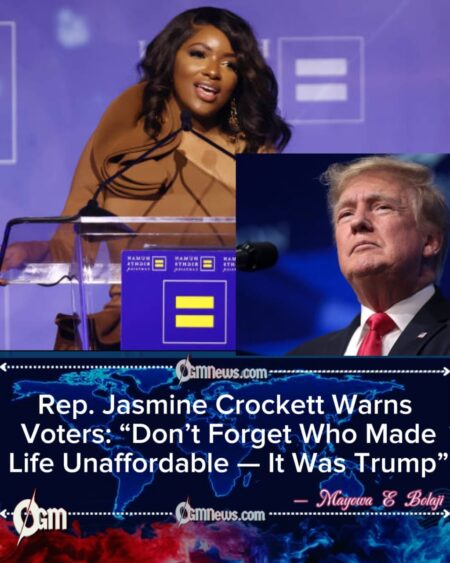
Rep. Jasmine Crockett argues that Donald Trump’s tariff policies were not economic strategy but deliberate punishment of ordinary American households. She stresses that these tariffs — imposed on trade partners like China, Mexico, and Canada — were disguised as tough action but ultimately led to inflated prices on everyday items, from toys to groceries. Crockett bluntly states that the tariffs “made our lives more unaffordable,” emphasizing that the financial pain Americans felt was not accidental, but a direct result of Trump’s impulsive trade decisions.
Expanding on her argument, Crockett paints a vivid picture of what Trump-era affordability looked like for working families. She says that under Trump, parents who normally could afford several Christmas gifts for their children were forced to cut back dramatically. Using a striking metaphor, she said Trump’s tariffs would leave Americans with “two baby dolls instead of ten” — a pointed reference to reduced purchasing power. Her statement implies that Trump’s economic policies stripped families of options while he claimed victory through bravado and economic nationalism.
Crockett insists that tariffs are not an abstract trade concept but a real, painful financial burden, stating that “people need to understand that tariffs are taxes on them, not on foreign governments.” She warns voters not to be fooled by political revisionism or campaign messaging that attempts to paint Trump’s policies as beneficial. For Crockett, the issue is simple: when Trump imposed tariffs, he didn’t hurt China — he hurt Americans.
If Prices Drop, Credit the Supreme Court — Not Trump
Rep. Crockett anticipates that if tariffs are rolled back or struck down — either partially or fully — Donald Trump will attempt to take credit for any reduction in cost-of-living pressure. She rejects that narrative, saying plainly that “it wasn’t him, it wasn’t him.” According to Crockett, if relief comes, it will be because the Supreme Court blocked or softened Trump’s tariff measures, not because Trump changed course or acted responsibly. She wants voters to understand that Trump’s instinct is always to create chaos and then spin himself as the savior.
In an unexpected twist, Crockett — who openly criticizes the current Supreme Court — says she is willing to give the Justices full credit if they intervene. She highlights how significant that admission is by adding: “y’all know I don’t love this Supreme Court.” The implication is clear: if the Supreme Court can recognize the economic damage caused by Trump’s tariffs, then even an institution she distrusts deserves acknowledgment. The statement serves both as political shade and as evidence of her commitment to truth over partisan loyalty.
The congresswoman urges Americans, especially those feeling economic pressure, not to fall for political theater. She warns that Trump will rush to podiums, take credit, and celebrate, even though the actual relief — if it happens — will come from judicial intervention. Crockett says one goal of her messaging is to make sure “the public understands who actually stands between them and financial suffering.”
Crockett Accuses Trump of Sabotaging America’s Own Trade Partners
Rep. Crockett questions why Trump repeatedly targeted Mexico and Canada, despite both countries being crucial U.S. allies and trade partners. She argues that the tariffs were rooted in ego rather than strategy, stating that Trump reflexively behaves hostile whenever someone challenges him. For Texans especially, she notes, this makes no economic sense: Mexico is Texas’ largest trade partner. Crockett suggests that Trump was not protecting America — he was damaging American business while pretending to be tough.
She describes Trump’s behavior as unpredictable and counterproductive, stating that he “looks at you crazy” when citizens question why friendly nations are suddenly being treated like adversaries. Crockett links Trump’s foreign policy style to personal insecurity — when Trump feels disrespected or challenged, he punishes countries economically, regardless of the collateral damage to American families and companies. In her framing, tariffs were not policy, they were emotional reactions.
Crockett ends her argument by insisting that Americans must stay alert and informed. She says Trump’s campaign narrative will attempt to rewrite economic history, portraying himself as a defender of affordability. But, she argues, “the truth is the opposite.” In her view, Trump did not protect Americans from economic hardship — he created it.
[…] […]