





















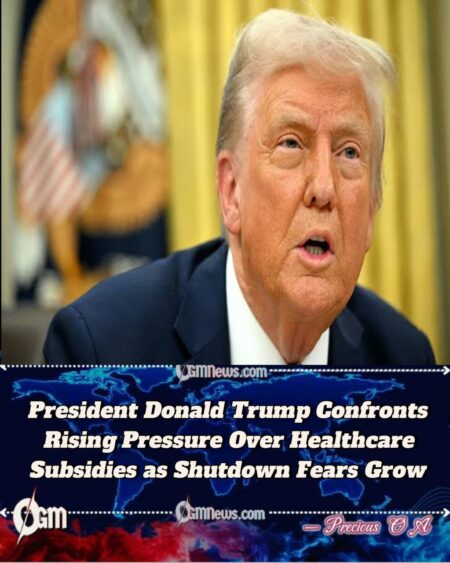
President Donald Trump faces an increasingly difficult political battle as new polling data shows that nearly half of Americans want Democrats to stand firm on maintaining Affordable Care Act (ACA) subsidies, even if it leads to a government shutdown. The findings have sent shockwaves through Washington, revealing deep divisions in public sentiment over the nation’s healthcare policy and the administration’s fiscal agenda.
The results also highlight the growing unease among citizens about the direction of federal healthcare programs under the Trump administration, exposing the complexities of balancing budgetary discipline with the social obligation to ensure that millions of Americans retain access to affordable care.
Donald Trump has repeatedly urged Congress to cut ACA-related funding, arguing that the subsidy system is bloated, inefficient, and in desperate need of restructuring. The president insists that his proposals are aimed at promoting fairness and fiscal sustainability, asserting that the country cannot continue to support what he calls “a broken and expensive model.”
However, voters appear skeptical of his claims. A large proportion of Americans, particularly those who depend on these subsidies for health insurance, view the move as an attempt to dismantle one of the most vital safety nets established in recent history. For many families, ACA subsidies are not a political talking point but a lifeline that allows them to access essential medical services without falling into financial ruin.
Donald Trump now finds himself at the center of an intensifying standoff with congressional leaders. Democrats, emboldened by a wave of public support, have made it clear that they will not back any spending bill that weakens healthcare access or puts working-class citizens at risk. Republican lawmakers, on the other hand, continue to defend their position as a necessary step to restore fiscal discipline, reduce government interference in private markets, and curb what they describe as runaway entitlement spending. The political atmosphere has become increasingly charged, with both sides accusing each other of endangering the country’s economic stability and moral compass.
Lawmakers on both sides are increasingly aware of the gravity of the moment, as the nation edges closer to another potential government shutdown. Financial analysts warn that a prolonged shutdown would disrupt essential services, halt federal operations, and rattle investor confidence, possibly undermining years of economic recovery. Market experts are also predicting that if the impasse continues, it could have ripple effects across multiple sectors, from healthcare to small businesses that rely on federal contracts. The stakes, both politically and economically, could not be higher, and the coming days may define not only the direction of healthcare policy but also the broader legacy of the Trump administration.
White House Digs In Amid Democratic Resistance
Donald Trump and his advisers have shown no signs of softening their stance despite the growing public discontent reflected in recent polling. Inside the West Wing, senior aides have privately dismissed the numbers, arguing that the polls fluctuate too frequently to be trusted as a measure of long-term sentiment. According to insiders, the administration remains confident that once the public fully understands the rationale behind their proposals, support will swing back in their favor. The White House maintains that the ACA subsidies represent unsustainable spending and must be restructured to prevent further strain on the federal budget.
Donald Trump has emphasized repeatedly that his approach is not about stripping healthcare away from Americans but rather about improving the efficiency of the system and ensuring that taxpayer dollars are used responsibly. The president contends that the current subsidy model distorts the insurance market by inflating premiums and discouraging healthy competition among private insurers. Administration officials argue that by adjusting the structure of subsidies, the government can lower costs, attract more insurers, and ultimately empower consumers to make better choices about their coverage. In the president’s view, reform is not a punishment but a necessary evolution.
Donald Trump has, however, encountered fierce criticism from healthcare advocates, opposition lawmakers, and civil society organizations who argue that millions could lose access to affordable coverage if the proposed cuts take effect. Public health experts have sounded alarms, warning that vulnerable populations—including the elderly, low-income families, and those with chronic illnesses—would be disproportionately affected. Critics have accused the administration of prioritizing ideology over compassion and fiscal targets over human welfare. The public debate has spilled into town halls, newsrooms, and online platforms, where emotional stories of those who rely on ACA subsidies have further fueled the controversy.
Republican moderates have privately expressed anxiety about the political fallout of a shutdown that could result from this standoff. Many of them recall the backlash following previous shutdowns and fear that history could repeat itself. They worry that prolonged gridlock would tarnish the party’s image ahead of future elections. Despite these concerns, President Trump has remained steadfast, framing the issue as a matter of principle. He portrays himself as a leader willing to make “tough but necessary” decisions to safeguard the nation’s financial integrity. For Trump, backing down would not only undermine his credibility but also send a message of weakness at a time when he seeks to project strength.
Democrats Find Renewed Momentum as Shutdown Looms
Donald Trump now confronts a reinvigorated Democratic opposition that has framed the dispute as a moral battle over the right to accessible and affordable healthcare. Democratic leaders such as Senate Majority Leader Chuck Schumer and House Minority Leader Hakeem Jeffries have vowed not to yield an inch, insisting that ACA subsidies are the backbone of America’s healthcare system. They argue that dismantling these protections would unravel years of progress in reducing the number of uninsured Americans and place millions at risk. Their unified stance has reenergized the party’s base, giving Democrats renewed purpose in their legislative strategy.
Donald Trump has become the central figure around which Democrats are rallying public sentiment. Activist groups have seized on the controversy to mobilize voters nationwide. In states from Pennsylvania to Arizona, rallies, demonstrations, and virtual campaigns have been organized to pressure lawmakers into rejecting any budget that cuts healthcare funding. The message is clear: preserving ACA subsidies is not merely a partisan issue but a humanitarian one. The Democratic Party’s messaging, reinforced by data showing widespread support, has created a wave of momentum that could shape the political climate for months to come.
Donald Trump faces mounting political pressure as the funding deadline approaches. Political analysts caution that if a government shutdown occurs, the administration could bear the brunt of public blame, especially among independents and swing voters who prize stability and moderation. For many observers, this showdown is not only about healthcare but about the broader question of governance—whether the White House can demonstrate the capacity to negotiate effectively without endangering essential public services.
Donald Trump thus enters a pivotal moment that may define his second term. Whether he is remembered as the leader who reformed government spending or as the president who triggered a politically disastrous shutdown will depend largely on the choices made in the coming days. With both parties locked in a fierce ideological battle and the nation on edge, the eyes of America are fixed on Washington. As midnight deadlines draw near and negotiations stall, the country braces for the consequences of a confrontation that could reshape the political and economic landscape for years to come.


[…] […]