

























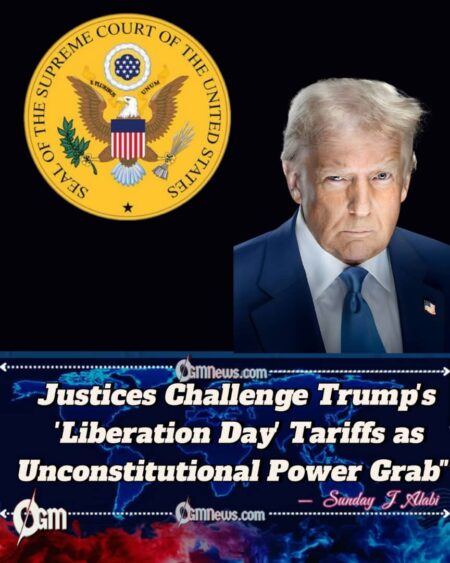
In a pivotal hearing that could reshape the boundaries of presidential power, the Supreme Court on Wednesday expressed deep skepticism about President Donald Trump’s authority to unilaterally impose tariffs on nearly every U.S. trading partner without explicit congressional authorization. The three-hour oral arguments marked the first time the nation’s highest court has examined the legal foundation of a signature policy from Trump’s second term, with several justices raising concerns about the sweeping nature of executive authority the president claims under a federal emergency powers statute.
Presidential Power Meets Constitutional Scrutiny
The legal battle centers on President Trump’s use of the International Emergency Economic Powers Act (IEEPA) to justify two major rounds of tariffs implemented earlier this year. The first established a baseline 10% duty on nearly all U.S. trading partners, along with higher reciprocal tariffs on dozens of countries citing persistent trade deficits. The second targeted China, Canada, and Mexico with varying rates, which the president justified as necessary to combat the flow of fentanyl and illegal drugs into the United States.
Chief Justice John Roberts highlighted a fundamental constitutional concern, noting that while the statute addresses foreign powers, “the vehicle is imposition of taxes on Americans, and that has always been a core power of Congress.” The chief justice emphasized that Trump is asserting “major authority” to levy duties on any product from any country at any rate for any duration. Justice Amy Coney Barrett pressed Solicitor General D. John Sauer to identify any other provision in U.S. law where the phrase “regulate importation” has been interpreted to grant tariff authority, while noting that IEEPA never explicitly mentions the word “tariff.”
Justice Neil Gorsuch raised separation-of-powers concerns, questioning whether accepting the administration’s interpretation would open the door for Congress to abdicate other core constitutional responsibilities. He warned of a “one-way ratchet toward the gradual but continual accretion of power in the executive branch and away from the people’s representatives,” suggesting that once Congress delegates authority to the president, reclaiming it becomes extraordinarily difficult.
Lower Courts Rule Against Trump Administration, Stakes Remain High
Three lower courts have already concluded that most of the president Trump’s tariffs are illegal, setting the stage for what Trump himself has called “one of the most important cases in the history of our country.” The U.S. Court of Appeals for the Federal Circuit ruled 7-4 that while IEEPA may authorize some tariffs, it doesn’t permit levies “of the magnitude” that Trump has imposed. Despite these rulings, the administration has been allowed to continue collecting the tariffs while legal challenges proceed.
The Trump administration maintains that Congress has historically granted presidents broad authority to address emergencies, arguing that invalidating the tariffs would have “catastrophic consequences” for national security, foreign policy, and the economy. Solicitor General Sauer told the court that “with tariffs, we are a rich nation; without tariffs, we are a poor nation.” Justice Brett Kavanaugh appeared sympathetic to this argument, questioning why the law would permit extreme measures like trade embargoes while potentially prohibiting the more targeted approach of tariffs.
Since announcing the duties on what he dubbed “Liberation Day” in February and April, the administration has negotiated trade deals with at least 10 countries and the European Union. Trump has continued adjusting tariff rates using IEEPA authority, including raising Canadian tariffs to 35%, imposing an additional 40% duty on Brazil, and recently announcing reduced tariffs on Chinese goods following a meeting with President Xi Jinping. The Supreme Court took up the consolidated cases on an accelerated timeline, agreeing to hear arguments in September, and is expected to issue a ruling relatively quickly given the economic implications at stake.
[…] […]