


























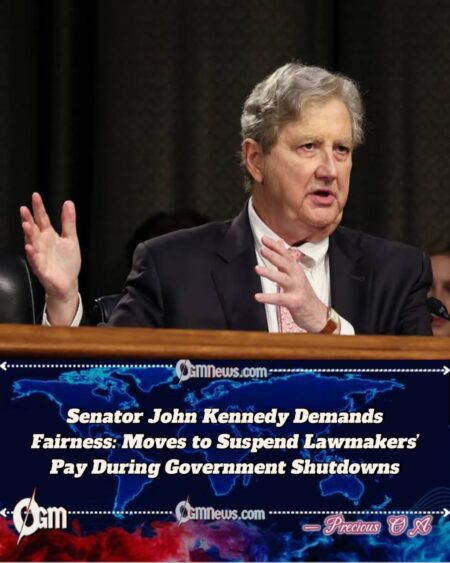
Senator John Kennedy, the outspoken Republican from Louisiana known for his homespun wisdom, quick wit, and unfiltered honesty, delivered what many have described as a rare moment of logic, humility, and integrity on the Senate floor. In a political climate often defined by division, finger-pointing, and performative speeches, John Kennedy’s words carried a refreshing sense of clarity and conviction. In a calm yet powerful address, he announced the introduction of two new bills designed to ensure that members of Congress do not receive their paychecks during a government shutdown.
His argument, though straightforward, struck a deep chord with Americans across party lines: if federal workers are forced to go without pay during a shutdown, then lawmakers—the very people responsible for those shutdowns—should share in that same discomfort and accountability.
John Kennedy declared with his usual folksy but firm tone, “If Congress cannot do its job and keep the government open, we shouldn’t be collecting paychecks while hardworking Americans suffer.” The statement, delivered without theatrics, cut through the usual political noise and resonated with citizens weary of partisan games. Federal employees across the country, who often face financial hardship during prolonged shutdowns, found his stance both empathetic and courageous. Kennedy reminded his colleagues that leadership is not about comfort or privilege—it is about service and shared sacrifice. His call for fairness was both moral and practical, presenting a vision of government where accountability begins with those in power.
John Kennedy’s proposal consists of two distinct but connected pieces of legislation: the No Work, No Pay Act and the Government Shutdown Accountability Act. Together, they would automatically suspend congressional pay whenever the government is shut down due to budget disagreements or political stalemates. Kennedy explained that the purpose of these bills is not only to promote fairness but also to serve as a powerful motivator for lawmakers to act responsibly. If politicians know their own pay is on the line, he argued, they will be far more inclined to resolve disputes before they spiral into shutdowns that hurt millions of Americans.
Public reaction to John Kennedy’s address was immediate and overwhelmingly supportive. Across social media and traditional news platforms, citizens praised him for taking a stand that transcends party politics. Democrats and Republicans alike acknowledged that his argument for shared sacrifice represented a long-overdue acknowledgment of fairness in government. Even critics who often disagree with Kennedy’s conservative views admitted that this proposal reflected a rare and refreshing sense of moral clarity.
A Push for Accountability and Shared Consequences
John Kennedy has long built his political identity around the principles of personal responsibility and fiscal discipline, and this latest initiative perfectly aligns with that philosophy. He reminded his colleagues that every time Congress fails to pass a spending bill on time, real people suffer. Families miss paychecks, small businesses depending on federal contracts struggle, and confidence in the government’s ability to manage itself erodes further. “If lawmakers don’t feel the pain of their own dysfunction,” Kennedy warned, “then they have no incentive to fix it.”
John Kennedy stressed that his legislation is not symbolic but substantive. During shutdowns, hundreds of thousands of federal workers—from TSA officers and park rangers to food inspectors and air traffic controllers—are either furloughed or forced to work without pay. Meanwhile, members of Congress continue to receive their full salaries, even as they publicly blame one another for the crisis. Kennedy called this double standard “morally indefensible” and “a stain on the dignity of public service.” He urged his peers to prove their sincerity by voting to hold themselves accountable under the same rules that apply to every other government employee.
Critics of Congress have long maintained that the financial insulation lawmakers enjoy during shutdowns encourages recklessness and prolongs deadlock. By shielding themselves from the economic consequences of their own decisions, politicians face no urgency to compromise. Kennedy’s bills, if passed, would fundamentally alter that equation—tying congressional pay directly to performance and creating a rare alignment between lawmakers’ interests and the well-being of the American people.
John Kennedy, according to analysts, may find that his proposal appeals to both sides of the aisle precisely because it embodies an idea of fairness that transcends ideology. The legislation, they argue, forces every senator and representative to confront the human cost of gridlock. It transforms shutdowns from abstract political battles into tangible personal consequences, a move that could reduce the incentive for partisan brinkmanship and restore some measure of accountability to Washington.
Public Reaction and Potential Impact
John Kennedy’s fiery yet reasoned remarks spread rapidly across television networks, political talk shows, and online forums, drawing widespread praise from citizens frustrated by Washington’s seeming indifference to ordinary Americans. Many federal workers, some still recovering from previous shutdowns, publicly thanked Kennedy for “finally putting common sense and compassion back into Congress.” The proposal tapped into deep public resentment toward a political class that often appears disconnected from the everyday struggles of working people.
John Kennedy’s record of independence and willingness to speak plainly have earned him both admirers and critics, but this effort to align lawmakers’ fortunes with those of their constituents has generated unusual bipartisan approval. His folksy, relatable style—often sprinkled with humor and down-to-earth analogies—helped convey his point in a way that resonated beyond the Senate chamber. His message was not only political but deeply ethical, centered on the idea that fairness and empathy should guide governance, not privilege and partisanship.
Political observers believe that while Kennedy’s proposal faces procedural hurdles, its introduction alone has reignited a vital national conversation about fairness, ethics, and leadership. The debate over his bills has already drawn attention to a broader issue—the erosion of public trust in Congress. By challenging his colleagues to share in the pain of their decisions, Kennedy has reminded Americans of a fundamental truth: accountability cannot exist without consequence.
John Kennedy, ultimately, whether his legislation passes or not, has left a lasting impression. His initiative serves as a symbolic yet potent reminder that leadership requires humility and empathy. As government shutdowns continue to loom as recurring threats, his message stands as a call to conscience in an era too often dominated by political self-interest. Kennedy’s words echo beyond the chamber: those who govern should never stand apart from those they represent.

[…] […]