























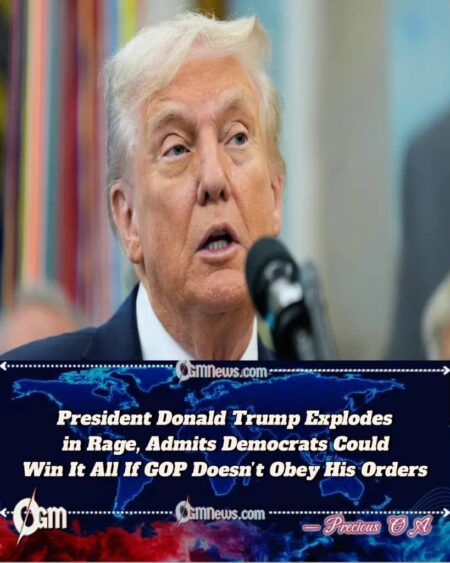
President Donald Trump has sent shockwaves through the political establishment with a fiery and uncharacteristically candid admission that Democrats could “easily win” both the upcoming midterm elections and the White House if Republicans fail to rally behind his leadership and embrace his full political agenda. Known across the globe for his trademark confidence, unfiltered rhetoric, and iron-fisted control over his party, Trump’s remarks stunned even his closest allies, marking one of the rare moments where the President publicly expressed deep frustration, urgency, and visible anxiety over the direction of the Republican Party.
His comments, made during a tense closed-door meeting with congressional Republicans at the White House, immediately spread like wildfire through Washington, D.C., igniting waves of speculation, panic, and debate across the political spectrum about the GOP’s unity, internal discipline, and long-term future under his leadership.
Donald Trump reportedly delivered his remarks in a tone that oscillated between anger and alarm, according to multiple individuals who attended the meeting. He accused party leaders of being “weak, indecisive, and afraid to fight,” claiming that the Democrats have become “more ruthless, more organized, and more determined than ever before.”
Trump warned that if Republicans do not “wake up and fight like their lives depend on it,” the Democrats could reclaim both chambers of Congress and set their sights on the White House in a sweeping political reversal. Witnesses described the President as visibly agitated, even slamming his fist on the table at one point, demanding that every Republican “get in line, get loyal, and get loud” before it becomes too late to salvage their political dominance.
Donald Trump continued by emphasizing that the stakes of the upcoming elections go far beyond mere party politics or electoral competition. He framed the contest as a defining moment for the nation’s soul and identity, portraying it as a choice between “freedom and tyranny, prosperity and chaos, patriotism and destruction.”
He declared passionately that the Republican Party must “fight like never before” to preserve conservative values, protect the economy, and restore what he described as “law and order in a country spiraling out of control.” The President’s words, while in line with his characteristic rhetoric, carried a sense of desperation and intensity that many close to him said they had not seen before — a clear indication that Trump feels the mounting pressure as Democrats gain momentum in key battleground states across the nation.
The emotional tone of the meeting, described by one senior official as “tense, chaotic, and electric,” underscored just how divided the Republican Party has become. Lawmakers inside the room said Trump’s fiery message left behind a palpable sense of urgency, one that even longtime skeptics couldn’t easily dismiss. Some admitted privately that his dire warning resonated with them — a reminder that complacency could prove fatal for a party already facing unprecedented political headwinds.
A Party Divided and the Pressure Mounts
Donald Trump’s remarks have once again laid bare the deep fractures within the Republican Party, highlighting the growing disconnect between hardline loyalists who see him as the party’s heartbeat and more moderate conservatives who worry about his dominating presence. His insistence that GOP leaders “immediately cave” to his demands — including total alignment with his immigration, economic, and cultural policies, louder opposition to Democratic spending initiatives, and renewed focus on so-called “election integrity” — has sparked internal turmoil. While his devoted base sees his remarks as a rallying cry, strategists and moderates fear that Trump’s uncompromising pressure could backfire, pushing away independents and suburban voters essential for the GOP’s success.
Donald Trump’s warning has also amplified concerns about the Republican Party’s long-term messaging strategy heading into the midterms and beyond. Analysts argue that his reliance on alarmist rhetoric and combative tactics may energize the party’s conservative grassroots but risks alienating the broader electorate. Even so, Trump remains the undisputed center of gravity within the GOP — the figure around whom every political calculation, campaign decision, and media headline continues to revolve. His demand for absolute loyalty ensures that his voice not only dominates internal strategy discussions but also shapes the national political narrative daily.
Donald Trump’s allies in Congress were quick to defend his outburst, describing it as a moment of truth rather than panic. They insist that his intensity reflects determination — a call to action aimed at uniting the Republican Party before it’s too late. Yet others within the party privately acknowledge that the President’s remarks exposed real vulnerabilities: declining voter enthusiasm in critical swing districts, widening fundraising disparities compared to Democratic challengers, and growing dissatisfaction among young and moderate conservatives who feel alienated by Trump’s polarizing style.
Several senior Republican officials, speaking anonymously, confessed that Trump’s blunt tone has unsettled many in Washington’s corridors of power. “When he’s angry, everyone feels it,” one veteran lawmaker admitted. “But this time, it wasn’t just anger — it was fear. Real fear.” The confession highlights the growing tension between loyalty to Trump and the practical need to adapt the party’s strategy for a changing electorate. For now, most Republicans remain publicly united behind him, but privately, many are bracing for turbulent months ahead as Trump’s grip on the party tightens once again.
The Political Fallout and What Lies Ahead
Donald Trump’s explosive statements have now erupted into a full-blown national political controversy, dominating news headlines and sparking fiery debate across both sides of the aisle. Supporters have hailed him as a truth-teller, arguing that his candid admission demonstrates his awareness of the serious threats facing conservative America. Critics, however, have pounced on his remarks, portraying them as evidence of desperation, instability, and a crumbling party under his leadership. For Democrats, Trump’s acknowledgment that their side could “win it all” has been greeted as both validation and motivation — proof that the Republican strongman is not as invincible as he once seemed.
Donald Trump’s demand that Republicans “immediately cave” to his list of directives has only deepened the controversy. Some GOP insiders interpret his comments as a calculated move to reassert his dominance over the party’s decision-making process and to silence dissent within the ranks. Others, however, view it as an unmistakable sign of insecurity — a reflection of a leader increasingly aware that the political ground beneath him is shifting. Yet, regardless of interpretation, few deny that Trump’s influence remains formidable, capable of upending political calculations and reshaping the nation’s political discourse in an instant.
In Washington’s power circles, Trump’s comments have reignited old debates about party loyalty, accountability, and strategy. His defenders argue that his urgency comes from genuine concern about preserving the conservative movement, while detractors accuse him of prioritizing personal power over collective progress. Meanwhile, Democrats have seized the opportunity to highlight what they see as disarray within the Republican Party, framing Trump’s “freak out” as proof that his leadership has become a liability. Across social media and television panels, pundits are dissecting his every word, speculating whether his emotional outburst was spontaneous or part of a larger, calculated attempt to rally his base through fear.
Donald Trump may have revealed more about himself in those heated moments than in any of his previous rallies or statements. Beneath his characteristic bravado lies a man aware of the tightening noose of political reality — one who recognizes that despite his dominance, his movement faces growing resistance and fatigue. Whether his urgent plea will unify Republicans or fracture them further remains to be seen. But one thing is beyond dispute: his outburst has redefined the stakes of the coming elections, injecting fresh energy and anxiety into a Republican Party already on edge, and ensuring that once again, all eyes remain firmly fixed on Donald Trump.

[…] […]