



















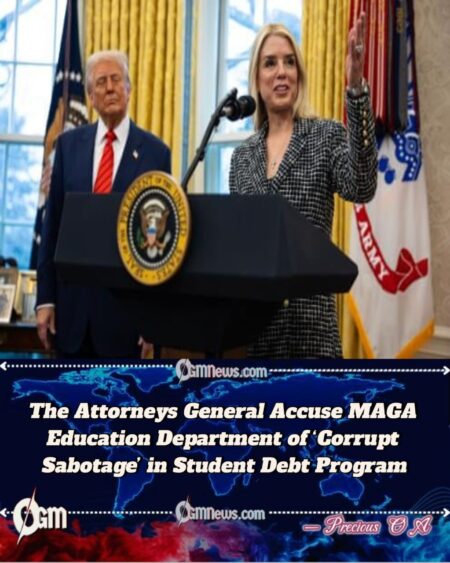
The Attorneys General of 21 Democratic states have filed a sweeping lawsuit against the MAGA-controlled U.S. Department of Education, accusing it of undermining the integrity and purpose of the Public Service Loan Forgiveness (PSLF) program through what they describe as “corrupt and politically motivated” changes orchestrated under President Donald Trump’s administration. The coalition argues that the new modifications intentionally make it harder for millions of public servants — including teachers, nurses, and first responders — to access the debt relief they were promised, a move they claim blatantly contradicts the spirit of the original law passed by Congress.
The Attorneys General insist that the lawsuit represents a unified stand against what they call “systemic obstruction and bureaucratic sabotage” within the Education Department. They argue that rather than simplifying access to forgiveness, the Trump-era changes buried borrowers under a maze of additional verification steps, confusing requirements, and technical loopholes that disqualify even those who have faithfully served their communities for years. Their complaint asserts that the department’s refusal to honor these commitments has had devastating real-world consequences for Americans relying on the program’s relief.
The Attorneys General are also demanding the reinstatement of the original provisions that allowed easier qualification for forgiveness and broader inclusion of nonprofit and government employees. They claim the revised rules have excluded tens of thousands of borrowers retroactively, despite these individuals fulfilling the core service requirements. To them, the issue is not just administrative—it’s moral and deeply human, impacting families, careers, and the stability of entire communities across the nation.
The Attorneys General further emphasize that their challenge aims to restore faith in public service as a noble and achievable pursuit. They warn that the Department’s current policies are eroding trust and discouraging young professionals from entering essential fields like education and public health, where debt burdens already act as a barrier. According to their joint statement, this lawsuit represents a “fight for fairness, accountability, and the American promise of opportunity through service.”
The Attorneys General Detail Widespread Harm and Broken Promises
The Attorneys General argue that the MAGA Education Department’s revisions were designed not to streamline relief but to slow it down. Their filing highlights extensive documentation of rejected claims and retroactive denials, even among borrowers who had followed all instructions and made timely payments for more than a decade. They accuse the Department of manipulating administrative discretion to impose excessive auditing processes, often rejecting applications over minor technicalities or paperwork discrepancies.
The Attorneys General maintain that these changes have effectively transformed what was meant to be a life-changing opportunity into a bureaucratic nightmare. They claim that the Department’s so-called “reform initiatives” have stripped forgiveness eligibility from nonprofit employees, local government workers, and even some military personnel who were previously qualified under existing guidelines. Such actions, the coalition contends, amount to a betrayal of trust and a deliberate attempt to undermine the goals of the federal program.
Federal education analysts have noted that before the changes, the PSLF program had already suffered from low approval rates due to administrative inefficiency. However, the new lawsuit highlights that under the Trump administration, those inefficiencies evolved into deliberate obstructions, making forgiveness nearly impossible for most borrowers. The Attorneys General argue that this transformation reflects a deeper ideological agenda within the MAGA-led Department—one that prioritizes political optics and corporate interests over student welfare.
Public advocacy groups have voiced strong support for the lawsuit, framing it as a necessary corrective action to reinstate justice for borrowers. They argue that without judicial intervention, the Department will continue to hide behind opaque procedures while millions remain trapped under crushing debt. Many organizations have called the case “one of the most significant challenges to Trump-era education policy,” as it underscores both the long-term consequences of those administrative choices and their direct impact on the nation’s workforce.
The Attorneys General Vow to Continue the Legal Battle
The Attorneys General vow to pursue the case aggressively through the federal court system, promising not to relent until borrowers receive the relief they earned. They state that their primary objective is to force the Education Department to reverse the corrupt rule changes and reinstate the forgiveness framework as intended by Congress. In their joint declaration, they affirm that their states will not tolerate what they describe as the “weaponization of education policy” to serve partisan ends.
The Attorneys General further claim that beyond financial injury, the emotional toll on affected borrowers has been severe. Many have faced mounting interest, collection threats, and deteriorating credit—all while working in low-paying service jobs meant to uplift society. The lawsuit contends that the Department’s handling of PSLF has left public servants demoralized, alienated, and uncertain of their financial futures, undermining national morale in professions vital to public welfare.
Observers in Washington note that this lawsuit could set a precedent for how federal agencies are held accountable when administrative decisions deviate from statutory intent. Legal experts suggest that if the coalition succeeds, it may compel the Education Department to revisit numerous Trump-era regulatory frameworks beyond just student loans. In that sense, the lawsuit’s implications could ripple far beyond education—touching issues of public trust, transparency, and executive accountability.
The Attorneys General insist that their fight is not political but constitutional, grounded in the principle that federal agencies must uphold congressional intent rather than distort it. They declare that their united effort represents “a stand for every American who works hard, serves their community, and expects their government to keep its word.” The case, now heading toward a federal hearing, is expected to spark one of the most closely watched legal showdowns over education policy in recent years—one that could redefine the boundaries of executive power and public service ethics for years to come.

Logging in is a breeze and the site stability is amazing even during peak hours....