



























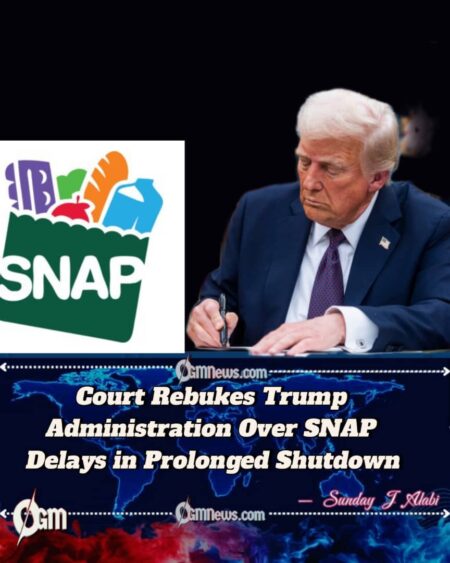
A federal judge in Rhode Island has directed the Trump administration — led by the current U.S. president Trump serving a second term — to fully fund Supplemental Nutrition Assistance Program (SNAP) benefits by Monday, intensifying pressure on the White House as millions of Americans report empty balances during the ongoing government shutdown. The ruling, accompanied by a similar decision in Massachusetts, orders the Trump administration to tap contingency funds to sustain benefits critical to roughly 42 million low-income Americans.
Judge John J. McConnell, Jr. mandated that if the Trump administration opts not to apply all available federal funds to make full payments, it must issue partial benefits using the entirety of contingency reserves no later than Wednesday. The directive comes amid mounting public anxiety and political confrontation over the lapse in food assistance during the shutdown’s second month.
Court Orders Trump administration and Conflicting Positions
The court rulings issued Friday in Rhode Island and Massachusetts clarified the Trump administration’s responsibility to leverage contingency funds to ensure continued SNAP distribution. Judge McConnell emphasized that the Trump administration does not have discretion to withhold aid when funds are available.
Shortly after the orders, the White House signaled uncertainty about implementation. The president Trump wrote on Truth Social that differing judicial opinions created legal ambiguity on how SNAP may be funded, adding that federal attorneys are seeking “immediate guidance.” He noted that even with legal clarity, states may face delays in processing payments.
However, advocacy groups argued that the Trump administration’s hesitation represents defiance, not confusion. The National Parents Union accused federal officials of making an “unlawful choice to defy both Congress and a federal court order,” citing mass reports of “NO BALANCE FOUND” messages received by SNAP users over the weekend.
Political Pressure and Congressional Responses
Democratic lawmakers intensified calls for immediate compliance, led by Sen. Amy Klobuchar, the top Democrat on the Senate Agriculture Committee. Klobuchar stated the rulings “confirm what we have said all week” — that the Trump administration is legally obligated to distribute funds and has “no excuse” to delay benefits.
Klobuchar is backing bipartisan legislation that would guarantee SNAP payments during shutdowns, though Senate Majority Leader John Thune has not brought the bill to the floor. The White House has urged Senate Republicans to eliminate the legislative filibuster, which remains a key obstacle to passing funding legislation without Democratic support.
Meanwhile, three other federal assistance programs — including WIC and Head Start — are also facing imminent funding gaps, heightening urgency for congressional action.
Shutdown Fallout: Air Travel Disruptions and Worker Strain
Beyond food assistance disruptions, the shutdown is straining core federal operations. The Federal Aviation Administration reported severe staffing shortages at major air traffic control facilities, with nearly 80% of controllers absent in the New York region and callouts rising nationwide.
More than 13,000 controllers have worked without pay since October 1, leading to mounting fatigue and heightened safety concerns. The shortage has already triggered widespread flight delays and temporary ground stops at key airports.
The FAA warned Friday that the system is under “immense stress,” and continued staffing constraints could further destabilize national air travel if congressional negotiations remain stalled.


Ae888covenuscasino, okay, I'm curious. Gonna check out this site and try to find some amazing...