


























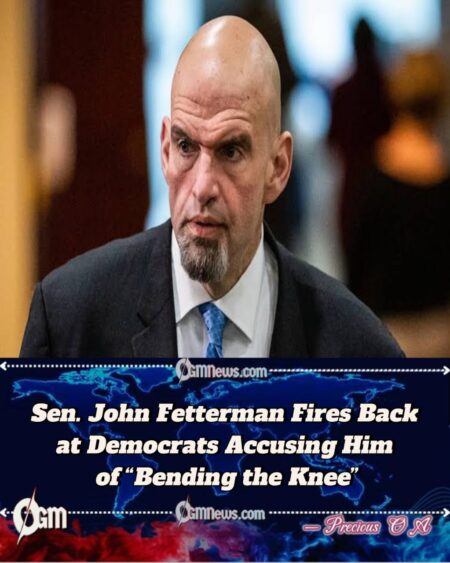
Sen. John Fetterman (D–PA), a prominent figure known for his straightforward communication style, progressive leanings, and reputation as a pragmatic lawmaker focused on working-class issues, has ignited a heated and far-reaching debate within his own party after attending a private dinner with U.S. President Donald Trump earlier this week. Following waves of criticism from Democratic colleagues who accused him of “bending the knee,” Fetterman forcefully defended his decision, arguing that political cooperation must transcend partisan hostility.
The dinner, which took place at a Washington, D.C. restaurant on Thursday evening, reportedly focused on infrastructure, manufacturing, and bipartisan mental health initiatives. It was described by insiders as a surprisingly cordial meeting, with both men engaging in what one observer called “a serious and substantive exchange of ideas.”
John Fetterman, known for his blunt, working-class rhetoric, dismissed the notion that meeting with the president represented political weakness or surrender. “It’s not about bending a knee,” he told reporters outside the Capitol the following morning. “It’s about having a conversation with the president. We have to work together.” The senator emphasized that engaging with President Trump was not a personal or political endorsement but rather a necessary step toward achieving tangible results for the people of Pennsylvania and the nation as a whole. “If we want bridges repaired, factories reopened, and communities rebuilt, someone has to start the conversation,” he said firmly.
John Fetterman’s comments have resonated across the political spectrum, drawing both praise and condemnation in equal measure. Moderates and independents applauded his willingness to engage with an administration many in his party have shunned, calling it a refreshing act of political maturity in a time of escalating division. However, the senator’s stance has infuriated progressive members of his party, who view any form of collaboration with the Trump administration as betrayal. His insistence on dialogue highlights a growing rift within the Democratic Party—between those calling for ideological purity and those advocating for practical governance aimed at results rather than rhetoric.
Political observers say John Fetterman’s move may mark a strategic repositioning ahead of the 2026 midterm elections. By projecting independence from party orthodoxy, he could appeal to moderate voters disillusioned with gridlock in Washington. His willingness to defy the party line also signals a broader recalibration among Democrats seeking to remain electorally viable in Trump-era America. Some analysts even believe Fetterman’s decision may inspire a new wave of Democrats to adopt a more conciliatory and solutions-driven approach, emphasizing outcomes over outrage in an increasingly polarized environment.
Democratic Backlash and Calls for Party Unity
John Fetterman’s dinner with President Trump triggered an immediate and impassioned backlash among Democratic lawmakers, strategists, and activists who viewed his actions as a betrayal of the party’s values and political priorities. Several prominent figures within the Democratic caucus accused him of legitimizing what they described as the president’s divisive political agenda. On social media, outrage spread quickly, with hashtags like #FettermanFolded and #PartyUnityNow trending across progressive circles. Critics charged that his meeting undermined efforts to present a strong, united opposition to the Trump administration’s policies, particularly on immigration, reproductive rights, and climate change.
House progressives were particularly vocal, with some arguing that John Fetterman’s decision weakened the Democratic negotiating position on key legislative issues. “Meeting with President Trump right now undermines our efforts to resist authoritarian tendencies in this administration,” said one House Democrat anonymously, reflecting the deep unease among the party’s left flank. Others even called for party leadership to address what they described as a breach of collective discipline, warning that such acts of defiance could erode trust among Democratic ranks and confuse voters about the party’s message.
John Fetterman’s defenders, however, contend that his critics are missing the larger picture entirely. They argue that refusing to engage with the president only deepens the nation’s political paralysis and alienates millions of Americans who crave cooperation over confrontation. By reaching across the aisle, they claim, Fetterman is doing precisely what voters sent him to Washington to do—solve problems, not score partisan points. His allies insist that leadership requires courage, and that dialogue should never be mistaken for capitulation. “If we can’t talk to each other, we can’t move forward,” one Pennsylvania mayor commented in his defense.
John Fetterman, standing firm amid the controversy, told reporters that he would not apologize for meeting with the president or for seeking bipartisan solutions. “If my colleagues want to fight me for having a conversation, they can,” he said defiantly. “But I didn’t get elected to sit in an echo chamber. I got elected to deliver for my constituents.” His words have now become emblematic of a larger philosophical struggle within the Democratic Party over how to navigate the era of Trump’s second presidency. The senator’s refusal to back down has only intensified speculation about whether his approach could signal a new pragmatic wave within the Democratic establishment.
A Moment That Could Redefine Bipartisan Dialogue
John Fetterman’s meeting with President Trump has sparked conversations well beyond Capitol Hill, with many political observers viewing it as a rare and potentially pivotal attempt to reintroduce civility and cross-party dialogue into national politics. At a time of heightened polarization and political hostility, his outreach has been interpreted as an act of statesmanship—a gesture aimed at lowering the temperature and finding common ground on key national issues. The senator’s emphasis on collaboration stands in stark contrast to the entrenched hostility that has characterized relations between the two major parties for much of the past decade.
Supporters argue that John Fetterman’s approach reflects a genuine desire to achieve measurable progress on issues such as manufacturing, infrastructure, veterans’ care, and mental health—topics that directly impact working families across America. They note that Fetterman’s roots in Pennsylvania’s industrial communities give him a deep understanding of the struggles faced by blue-collar Americans, making his call for cooperation with the president not only politically astute but morally grounded. If his dinner with President Trump leads to tangible policy outcomes, such as infrastructure investment or mental health reform, it could mark a pivotal step toward restoring public trust in Washington’s ability to function.
John Fetterman’s critics, however, remain deeply skeptical. Some believe that the meeting was more symbolic than substantive and that the president may have used it as a political maneuver to project bipartisanship while pursuing a hardline agenda behind the scenes. Others suggest that Fetterman may be underestimating the risks of normalizing engagement with a leader whose policies often clash with Democratic principles. They warn that even well-intentioned gestures can be weaponized in the volatile climate of American politics, where optics often overshadow substance.
John Fetterman’s next moves will likely determine how this controversial episode is remembered—either as a bold act of independent leadership that expanded the possibilities of bipartisanship or as a misstep that alienated his political base. Yet one fact remains undeniable: by insisting, “We have to work together,” the senator has reignited a crucial national conversation about the value of dialogue, compromise, and shared purpose in a democracy under strain. Whether this new tone leads to meaningful cooperation or simply exposes deeper divisions remains to be seen, but Fetterman’s words have already left a lasting mark on the country’s political discourse.
[…] […]