

























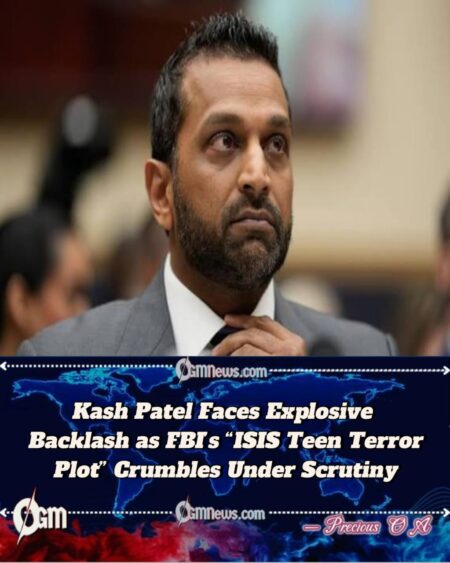
Kash Patel, the FBI Director and one of President Trump’s most trusted national security aides, has long cultivated an image of fierce loyalty, uncompromising patriotism, and an aggressive stance against terrorism. A former Pentagon official and congressional investigator, Patel built his reputation as a no-nonsense operative willing to challenge bureaucratic norms.
On October 31, that image took center stage when he announced that his agency had “disrupted a violent ISIS-inspired terror plot” in Michigan, allegedly planned for Halloween weekend. Patel declared that federal agents had acted swiftly to prevent what he described as “an imminent attack” in the Detroit suburbs of Dearborn and Inkster. According to law enforcement sources, five individuals—aged between 16 and 20—were taken into custody in connection with the supposed plot.
Kash Patel’s high-profile announcement set off an immediate wave of national headlines, with media outlets praising the FBI for its “quick action” and “decisive intelligence work.” Yet, within hours, murmurs of discontent began to circulate within Washington’s law enforcement corridors. Senior officials at the Justice Department and within the FBI itself reportedly expressed unease that Patel had gone public before formal charges were filed, before suspects were properly interrogated, and before investigators had even completed their initial assessment of the case. Some sources claimed Patel’s rush to publicize the arrests risked compromising confidential leads and possibly exposing ongoing intelligence-gathering operations.
Kash Patel’s timing also blindsided several key stakeholders. Dearborn Police confirmed that FBI operations had taken place in their jurisdiction but quickly clarified that “no immediate threat to the community” was present—a statement that appeared to contradict Patel’s dramatic language. Michigan Governor Gretchen Whitmer later disclosed that she had not been briefed until after Patel’s public statement was released, prompting speculation that political considerations rather than procedural coordination had driven the announcement. For many observers, the optics seemed unmistakable: a high-profile FBI chief eager to showcase his department’s vigilance under a law-and-order administration.
Kash Patel’s name has since dominated political debate, with allies defending him as a bold leader confronting terrorism head-on, while critics accuse him of stage-managing a hollow victory to boost his image. Within federal agencies, frustration has reportedly mounted over what some officials describe as “headline-driven policing”—a shift away from quiet professionalism toward media theatrics. Whether Patel’s move was motivated by genuine concern for public safety or a calculated bid for attention remains at the center of the controversy.
Kash Patel’s decision to publicize an ongoing investigation has also raised deeper institutional concerns. Many former intelligence officers warn that such premature announcements could discourage field agents from sharing sensitive findings, fearing political misuse. As one senior official reportedly remarked, “It’s not just about optics—it’s about trust. And trust, once lost inside the Bureau, is nearly impossible to rebuild.”
Weak Foundations: Teen Chatrooms, Not Concrete Plots
Kash Patel’s bold declaration of victory in the fight against terrorism now appears to rest on shaky ground. Investigations have revealed that the so-called “ISIS terror plot” may have been based on online discussions among teenagers rather than any concrete, coordinated plan. Federal sources acknowledge that the group under surveillance had engaged in extremist conversations on encrypted platforms, but the evidence of a credible, actionable plot was exceedingly thin. There were no recovered weapons, no physical materials for bomb-making, and no specific targets identified—just digital chatter and speculative ideas exchanged by impressionable youths.
Kash Patel’s agents reportedly intercepted conversations in which participants discussed vague notions of carrying out symbolic acts of violence, loosely inspired by ISIS propaganda videos. However, there was no indication that any of the suspects had the means or logistical capability to carry out an actual attack. One official familiar with the case admitted that the suspects appeared “more caught up in fantasy than in terrorism.” The only mention of timing—a reference to “pumpkin day”—was believed to be a tongue-in-cheek nod to Halloween, not an operational directive.
Kash Patel’s public framing of the case as a “major terror disruption” has thus come under intense criticism. Civil liberties advocates and legal scholars argue that the arrests reflect a troubling expansion of preemptive policing, where individuals are detained not for committing crimes but for expressing radical ideas online. This approach, they warn, risks criminalizing thought rather than action, especially when minors are involved. The fact that some of those arrested are reportedly high-school students has only deepened the controversy.
Kash Patel’s decision to announce the operation before charges were filed has also created serious legal complications. Defense attorneys are expected to claim that Patel’s public comments prejudiced potential jurors and violated due process. Moreover, without solid evidence of intent or material support for terrorism, prosecutors may find it difficult to secure convictions. The optics of the case—teenagers arrested under sweeping anti-terrorism powers—could fuel a national debate over overreach and governmental abuse of authority.
Kash Patel’s case may therefore serve as a pivotal test of the balance between security and civil rights. If the FBI cannot substantiate its claims with credible evidence, Patel’s triumph could collapse into a cautionary tale—one illustrating how the rush for headlines can undermine justice, alienate communities, and erode the moral authority of law enforcement agencies.
Political Stakes, Internal Rift, and Credibility at Risk
Kash Patel’s handling of the Michigan arrests has reportedly intensified internal divisions within the FBI and the Department of Justice. Multiple insiders have described growing frustration with his leadership style, which they characterize as “politically charged” and “publicity-driven.” As FBI Director under President Trump’s second term, Patel has been under immense pressure to demonstrate effectiveness in combating domestic and international extremism. Yet, this latest incident threatens to backfire, exposing tensions between his assertive public image and the meticulous caution that investigative work demands.
Kash Patel’s close association with the president has fueled speculation that political loyalty may be influencing law enforcement communication. The FBI’s independence—a cornerstone of American democracy—appears increasingly strained as senior officials complain that their director prioritizes political optics over procedural accuracy. Some even suggest that Patel’s approach could undermine morale among agents who value discretion and accuracy over public grandstanding.
Kash Patel’s critics within the bureau warn that his style of leadership blurs the line between law enforcement and political theater. They argue that such behavior not only damages public confidence but also jeopardizes operational integrity, making it harder for the FBI to cooperate with local and international partners. According to several anonymous sources, the Michigan episode has already triggered an internal review to determine whether Patel’s announcement violated any departmental protocols.
Kash Patel’s predicament places the White House in an awkward position. For President Trump, who has long championed aggressive counterterrorism narratives, this development undermines one of his administration’s most symbolic claims: that his leadership has strengthened America’s security apparatus. Instead, the controversy surrounding Patel now risks casting doubt on whether the government’s law enforcement agencies are functioning with professionalism or political influence.
Kash Patel’s future as FBI Director may hinge on the outcome of ongoing internal inquiries. If investigations reveal that the arrests lacked sufficient evidence or were improperly publicized, Patel could face mounting calls for accountability from both political opponents and uneasy allies. The Michigan case, once touted as a major counterterrorism victory, now stands as a test of truth, transparency, and the thin line between vigilance and overreach in an era where public perception can define power.
[…] […]