













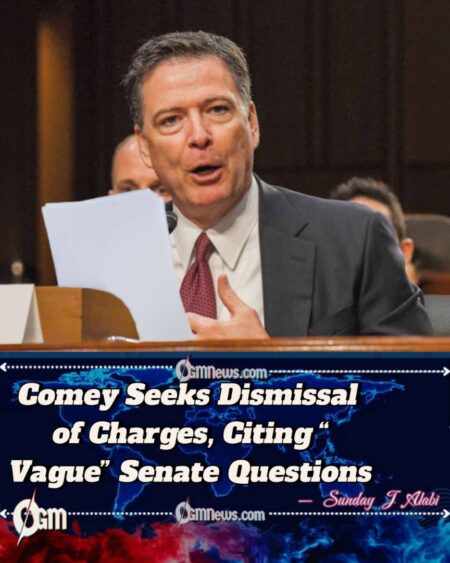
Former FBI Director James Comey is seeking to have federal charges against him dismissed, arguing that the indictment—centered on whether he gave false testimony to Congress—rests on vague and misleading questioning. In a new filing, James Comey’s lawyers contend that the questions posed by Sen. Ted Cruz during a 2020 Senate Judiciary Committee hearing were “confusing,” “ambiguous,” and too imprecise to form the basis for criminal charges. James Comey, who has pleaded not guilty, maintains his original testimony was “literally true.”
The case, which stems from congressional testimony related to investigations involving current U.S. President Donald Trump during his first term, has become a legal flashpoint over witness rights, political accountability, and prosecutorial boundaries. Comey also alleges selective and vindictive prosecution, pointing to the government’s handling of the case and the appointment of interim U.S. Attorney Lindsey Halligan, formerly a defense lawyer for President Trump.
James Comey Defense Claims Questions Were Ambiguous and Testimony Remains Accurate
In court filings, Comey’s legal team argues that prosecutors cannot pursue charges based on answers to what they characterized as “fundamentally ambiguous” questions. They assert that due process requires questioners—in this case, members of Congress—to frame inquiries clearly enough to prevent misinterpretation.
James Comey’s lawyers emphasized that the government has not specifically identified which statements in his four-hour testimony they allege were false. They further claim prosecutors “cherry-picked” portions of his answers and ignore the context of Cruz’s statements, which they say focused narrowly on whether James Comey authorized then-Deputy FBI Director Andrew McCabe to leak information.
According to the defense, a “reasonable person” would have understood Cruz’s questioning to concern McCabe specifically—not any other FBI official or outside intermediary. Comey maintains both that his testimony was truthful and that even his reaffirmation of earlier statements remains accurate, regardless of how those earlier statements are later viewed.
Government’s Allegations and the Role of Daniel Richman
A federal grand jury indicted James Comey last month, charging him with lying to Congress and obstructing a congressional inquiry. Prosecutors allege James Comey allowed Daniel Richman—a Columbia University law professor and longtime confidant—to serve anonymously as a source regarding FBI matters tied to the Clinton email investigation.
Richman, who also served as a “special government employee” at the FBI during James Comey’s tenure, has not been charged and did not play a direct role in the Senate exchange cited in the indictment. James Comey’s defense argues the indictment omits key context regarding Cruz’s focus on McCabe, thereby distorting Comey’s responses and the nature of the discussion.
The defense further asserts the indictment lacks factual detail, calling it “sparse” and insufficient under constitutional standards. James Comey’s team has also requested additional information from prosecutors about the specific conduct underlying the charges.
Strategic Legal Offensive and Claims of Selective Prosecution
James Comey has pursued a multipronged defense strategy. Alongside contesting the clarity of the congressional questioning, his attorneys argue the case reflects political motivation. They contend James Comey has been targeted because of his role in high-profile investigations into President Trump and Hillary Clinton, and cite the appointment of Halligan as interim U.S. attorney as part of that narrative.
In earlier filings, James Comey sought dismissal based on alleged selective and vindictive prosecution, arguing that similarly situated witnesses have not faced criminal charges for disputed congressional testimony. His latest motion underscores the boundaries of constitutional protections for witnesses and the obligation of government actors to avoid exploiting ambiguity in testimony.
The court will now weigh whether the government has articulated sufficient factual claims to proceed—or whether James Comey’s arguments about due process and clarity will prevail. Whatever the outcome, the case marks another chapter in the long-running political and legal battles surrounding the former FBI director’s tenure and the investigations that shaped national politics.

The vibes here are amazing and the winning streaks are real. It feels just like...