




























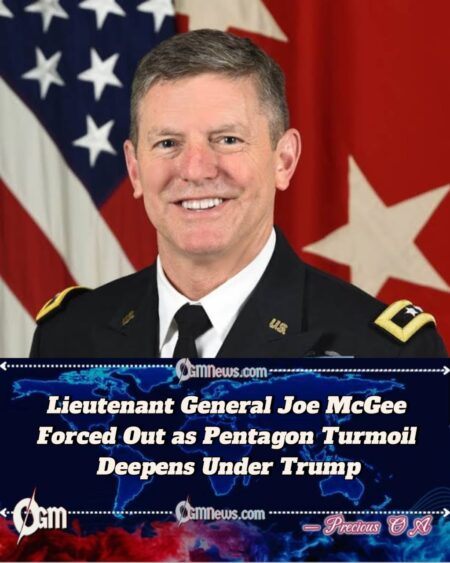
Lieutenant General Joe McGee has resigned in what Pentagon insiders describe as one of the most consequential and unsettling military shakeups of President Donald Trump’s second term in office. The highly decorated three-star general, long respected for his sharp intellect, humility, and deep sense of duty, was reportedly forced out amid what officials are calling “sustained tensions” with Defense Secretary Pete Hegseth — a former Fox News personality turned political appointee. The move has sent ripples of unease through the Pentagon, exposing a growing rift between career military leaders and the politically charged leadership now steering America’s defense strategy.
Joe McGee reportedly found himself in repeated conflict with Hegseth over core issues of military command, institutional discipline, and strategic direction. Sources close to the matter reveal that their disagreements went beyond policy differences, becoming intensely personal and ideological. Hegseth, according to several defense insiders, accused McGee of being “too cautious,” “too conventional,” and not fully aligned with what he described as the “patriotic and fearless” vision of the Trump administration. Those who worked closely with McGee, however, describe him as a soldier’s soldier — disciplined, balanced, and guided by a strong moral compass that refused to bend under political pressure.
Joe McGee had earned widespread respect for his commitment to ethical leadership, transparency, and innovation within the Army. His vision emphasized professional accountability, soldier welfare, and maintaining the apolitical character of the armed forces. His departure, many argue, leaves a void that cannot easily be filled. “We’ve lost one of the rare officers who placed principle above politics,” a senior military official stated grimly. “He represented the kind of leadership that holds the military together when everything else feels uncertain.”
His exit is now being interpreted as part of a broader, more concerning pattern within the Department of Defense, where experienced and respected commanders are being replaced by ideologically loyal figures. This trend, observers warn, could undermine the delicate balance that has long existed between civilian oversight and military independence. Pentagon insiders paint a troubling picture — one where silence has become safer than dissent, and loyalty to leadership increasingly outweighs loyalty to truth. “The environment is shifting,” one anonymous source said. “It’s no longer about what’s right for the country. It’s about who’s in line with the narrative.”
A Divided Command and a Weakening Force
Joe McGee’s departure has amplified fears of a growing crisis of professionalism within the upper echelons of the U.S. Armed Forces. Critics of the administration warn that under President Trump’s renewed leadership, the Pentagon has become dangerously politicized, with military priorities now bending under the weight of partisan agendas. The appointment of Pete Hegseth, a staunch Trump supporter with limited operational experience, as Defense Secretary was controversial from the outset — and McGee’s forced resignation has only deepened that controversy.
Joe McGee had long been regarded as a stabilizing influence, bridging the gap between the traditional military establishment and the evolving demands of modern warfare. Joe McGee championed mentorship, officer education, and ethical reform, helping to rebuild morale in units strained by years of overseas conflict and bureaucratic fatigue. His removal, therefore, represents more than a mere reshuffling — it is, according to insiders, a symbolic rejection of the professional, nonpartisan leadership that once defined America’s military strength. “This is not just one man leaving,” remarked a retired colonel. “This is the unraveling of an institutional standard.”
Joe McGee’s exit has also stirred unease among mid-level officers who describe an increasingly tense environment within the chain of command. Several have voiced concerns that political favoritism now overshadows competence, and that promotions are influenced more by loyalty than merit. One Army officer privately remarked, “We’re watching good men and women walk away because they refuse to play politics. It’s demoralizing.” Such internal disillusionment, many experts fear, could eventually compromise operational readiness, decision-making, and unity of purpose across the ranks.
Morale within the ranks is reported to be slipping at an alarming rate. Soldiers who once felt confident in the impartiality of their leaders now find themselves questioning orders, motives, and even their own sense of purpose. The erosion of trust between civilian leadership and professional officers has created an undercurrent of anxiety that, if left unchecked, could weaken the foundation of the world’s most powerful military force. As one defense analyst bluntly put it, “We are witnessing a slow-motion breakdown of command integrity — and it’s happening under the banner of patriotism.”
America’s Military Identity at a Crossroads
Joe McGee’s forced resignation has reignited a fierce national debate about the future of America’s military identity. For generations, the U.S. Armed Forces have served as the country’s ultimate unifier — an institution that rose above political divides and personal agendas. Yet as the Trump administration presses deeper into its second term, that sacred separation between politics and the military seems to be fading.
Joe McGee’s ouster has become a defining moment in this ongoing transformation. With a former television commentator now leading the Pentagon, critics argue that the very heart of the defense establishment is being shaped more by showmanship and ideological loyalty than by experience and strategic insight. “We’re not watching military leadership evolve — we’re watching it dissolve,” said one retired general, who described the growing culture within the Pentagon as “politics in uniform.”
Joe McGee’s removal has also sent tremors across the international stage. America’s NATO allies and defense partners have begun expressing private concerns about the increasing instability and unpredictability of U.S. defense policy. A European diplomat, speaking candidly, said, “When the United States starts dismissing decorated generals for political reasons, it doesn’t just weaken America — it shakes confidence across the entire alliance.” The message, the diplomat added, is clear: the world’s most powerful military may be losing the one thing it could always rely on — unity of command guided by principle.
Joe McGee’s departure has therefore become far more than a personnel change. It represents a symbolic struggle for the very soul of the U.S. military — a struggle between those who serve out of duty to the Constitution and those who align themselves with political identity. As partisan influence deepens, analysts warn that America’s military power could be undermined not by foreign adversaries, but by its own internal divisions. And as one senior official quietly observed, “Our military grows weaker by the day under Trump — not because of any enemy abroad, but because truth, discipline, and courage are being replaced by loyalty tests and fear.”


[…] […]