



























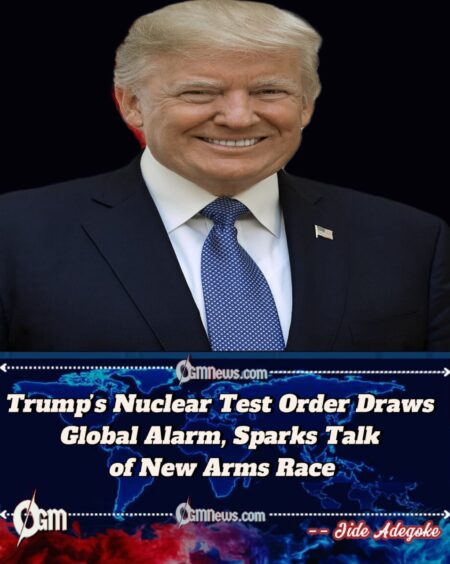
In a move that has reignited international debate over nuclear stability, U.S. President Donald J. Trump — now serving his second term — has offered a controversial justification for his directive to resume nuclear weapons testing for the first time since 1992. Speaking to reporters at the White House, Trump claimed that the United States must demonstrate strength amid what he described as “global nuclear recklessness.”
“They seem to all be nuclear testing. We have more nuclear weapons than anybody,” Trump stated when pressed on why he ordered the Department of Defense to begin testing “immediately.” His comments came just days before a scheduled meeting with Chinese President Xi Jinping, raising fresh diplomatic concerns over the timing and intent of the decision.
The president’s remarks have been described by critics as “unhinged,” while supporters insist the move reaffirms American deterrence power. The decision effectively ends a three-decade U.S. moratorium on explosive nuclear testing that has been in place since the signing of the Comprehensive Nuclear-Test-Ban Treaty (CTBT) in 1996 — a treaty the United States has signed but never ratified.
‘We Have More Nuclear Weapons Than Anybody’: Trump’s Rationale and Strategic Justification
Trump’s comments appeared to center on the notion of deterrence and demonstration of military superiority. According to White House officials, the administration believes that both Russia and China have engaged in low-yield testing in recent years, creating what one aide described as a “strategic imbalance.”
“The president has made it clear that America will not be second to anyone in defense or deterrence capability,” a senior official said on background. “This is about ensuring readiness and modernization, not provocation.”
Defense analysts, however, warn that such reasoning risks triggering a new global arms race. “Once one major nuclear power resumes testing, others will feel compelled to follow suit,” said Dr. Laura Keane, a nuclear policy expert at Georgetown University. “This move could undermine decades of arms control progress and destabilize global non-proliferation efforts.”
Political and International Fallout Over the Testing Decision
The president’s statement drew immediate backlash from U.S. lawmakers, European allies, and disarmament groups. Democratic leaders in Congress called for emergency oversight hearings, arguing that the decision was made without adequate consultation or strategic review. “This is a reckless gamble with global security,” said Senator Chris Murphy, a member of the Senate Foreign Relations Committee.
Internationally, reactions have been swift. The Russian Foreign Ministry warned that any U.S. nuclear test would be viewed as a “serious provocation,” while China urged “restraint and dialogue.” The United Nations has not yet issued a formal statement but is expected to address the development in an emergency session of the General Assembly.
Despite the criticism, President Trump has remained defiant, insisting that the tests are “necessary to keep America safe.” As the world watches closely, the United States faces renewed scrutiny over its role in maintaining — or potentially disrupting — the global nuclear order.


Logging in is a breeze and the site stability is amazing even during peak hours....