



























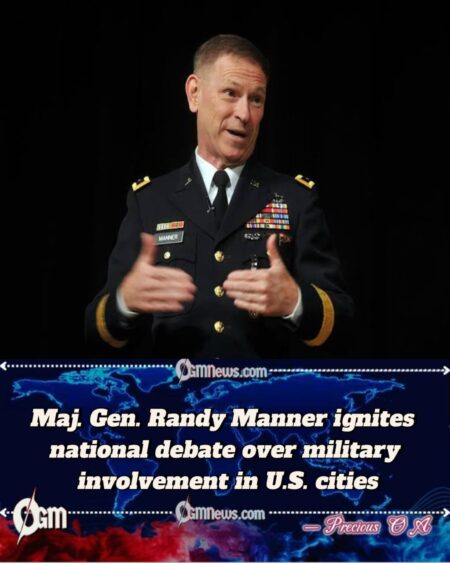
Maj. Gen. Randy E. Manner — a highly decorated retired U.S. Army officer who served as acting Vice Chief of the National Guard Bureau and completed more than 35 years in uniform — has ignited a nationwide debate after sharply criticizing President Trump’s deployment of the National Guard to U.S. cities. He calls the strategy costly, unjustified, and dangerous for military preparedness. Drawing from decades of strategic decision-making and service both at home and abroad, Manner paints a picture of long-term consequences that he believes are being overlooked in the rush to appear strong on matters of national security.
His remarks quickly gained massive attention online, spreading across social platforms where millions of viewers have reacted to his stern warning about the misuse of troops on American streets. The speed with which his comments spread demonstrates not only the power of digital communication but also the appetite among citizens for authoritative voices willing to challenge government actions from a place of genuine experience and concern. The volume of reactions shows that Americans are anxious about how deeply the armed forces should be woven into civilian affairs.
Maj. Gen. Randy E. Manner’s supporters argue that his long career and national-security expertise give him unique authority to challenge the administration’s decisions. They say his critique transcends partisan politics and focuses squarely on constitutional and strategic principles. Many policy specialists and civic groups have cited his credibility as proof that the concerns he is raising are rooted in deep respect for the United States, its institutions, and its democratic traditions. Supporters believe he is speaking up not to criticize leadership for political gain but to preserve the integrity of the military profession.
Maj. Gen. Randy E. Manner’s detractors claim he is undermining federal efforts to maintain public order. They accuse him of fueling political opposition while the nation remains divided over security policies. To them, his warnings appear exaggerated and disconnected from the immediate need to respond to unrest or instability. They maintain that the federal government must have the flexibility to protect citizens when local authorities struggle to do so.
Maj. Gen. Randy E. Manner’s viral influence has placed his concerns front and center in a fast-evolving debate over the proper boundaries of federal power during domestic unrest. With each new interview and social media reaction, the issue grows more complex, highlighting the tension between national security interests and civil liberties.
Legal and Strategic Objections Raised
Maj. Gen. Randy E. Manner argues that deploying the National Guard into cities without clear consent from governors weakens the constitutional balance of federal and state authority. He warns it could set a precedent that future leaders might exploit, slowly shifting military power away from the carefully constructed safeguards that ensure troops are not weaponized to exert political control. He emphasizes that one controversial decision today could create a roadmap for excessive force tomorrow if the bounds of authority are stretched too thin.
He also insists that domestic missions divert soldiers from essential training, reducing their ability to respond to national emergencies and international threats. According to him, it leaves America weaker, not stronger. He stresses that every hour spent patrolling streets instead of preparing for cyberattacks, foreign adversaries, and natural disasters chips away at the Guard’s operational edge — the very readiness that Americans expect in a crisis.
Maj. Gen. Randy E. Manner stresses that the Guard is not trained as a police force and that soldiers should not be placed in positions where they are expected to enforce civilian law. He says such actions risk blurring the military’s identity. In his view, troops are meant to defend the nation from external threats, not become constant figures of authority in neighborhoods already struggling with mistrust of government institutions.
Maj. Gen. Randy E. Manner believes the deployments waste taxpayer dollars at a time when resources should be focused on defense readiness and other legitimate missions that align with national priorities. He highlights the immense logistical cost of mobilizing troops — including equipment, transportation, accommodations, and pay — especially when civilian-driven responses could have been more economical and better aligned with constitutional principles.
Maj. Gen. Randy E. Manner warns that normalizing federal troop involvement in policing could erode civil liberties and weaken public confidence in both civilian authorities and the armed forces. If the line between law enforcement and military operations fades, he fears a future where public protest is met not with dialogue but with armored vehicles and soldiers trained for combat.
Political Ramifications and National Debate
Maj. Gen. Randy E. Manner’s critique has injected high-level military concern into what was previously a partisan fight, forcing lawmakers to confront questions of legality, accountability, and executive restraint. His involvement has given new weight to what many believed was a settled matter, prompting congressional inquiries and legal discussions that could shape future defense legislation.
Maj. Gen. Randy E. Manner’s strong case underscores anxieties among defense analysts that the military’s increased visibility in domestic operations may shift public expectations regarding its role in everyday governance. Experts fear that once the public becomes accustomed to seeing troops performing law-enforcement functions, the threshold for deploying them may become dangerously low.
Many Americans have reconsidered the potential long-term consequences of relying on federal troops to address disruptions that could be handled by civilian agencies. They worry that reliance on military force could discourage investments in community-based solutions and weaken democratic problem-solving processes. These concerns have started surfacing more visibly in town halls, editorial pages, and civic debates.
Maj. Gen. Randy E. Manner’s viral message is driving renewed calls for stronger legislative oversight to ensure that military deployments inside U.S. communities remain rare, lawful, and justified by necessity. His arguments have encouraged lawmakers to re-evaluate old policies and consider whether new safeguards are required to protect constitutional norms.
This intervention has transformed the conversation, shifting attention from short-term security to the broader preservation of democratic boundaries and responsible use of the nation’s armed forces. What began as a controversial statement from one retired general has evolved into a national examination of power, responsibility, and the future identity of the American military.


The weekly tournaments here keep me coming back because the prize pools are surprisingly generous....