


























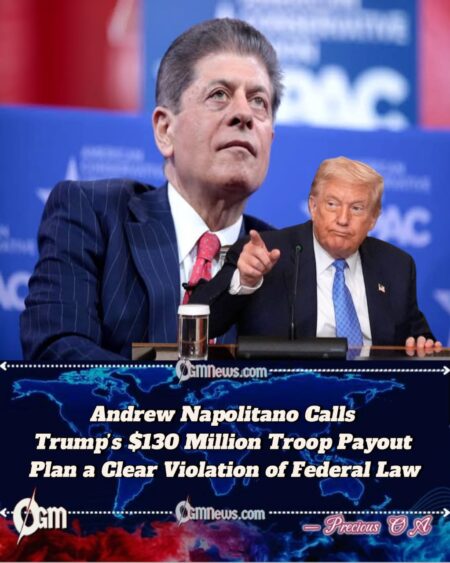
Andrew Napolitano, a former New Jersey Superior Court judge and a prominent legal analyst on Newsmax, stunned viewers when he stated on-air that President Donald Trump’s reported plan to use $130 million from a billionaire supporter to pay U.S. troops is illegal under federal law. Andrew Napolitano’s legal background and reputation for strict constitutional interpretation gave considerable weight to his judgment, making the announcement even more striking as he delivered it on a network often aligned with conservative political messaging and supportive of the administration’s policies.
The proposal, according to Napolitano, violates longstanding rules that ensure only Congress can allocate and approve funds used to compensate members of the armed forces, leaving no legal pathway for private donors to directly influence military pay. The scheme, he implied, could represent a fundamental circumvention of federal authority, undermining the checks and balances that define the United States’ democratic governance. His comments pointed sharply to concerns that military loyalty must remain tied solely to the country and not to influential benefactors with deep pockets and personal interests.
Andrew Napolitano explained that even if the payments are intended to support service members, the use of privately sourced money would bypass constitutional authority granted solely to the legislative branch. He further noted that federal laws involving military appropriations are designed to prevent corruption and protect the integrity of the Armed Forces, ensuring that compensation cannot be manipulated as a tool for political gain or reward. If such a plan were carried out, he warned, the consequences could lead to legal battles that would quickly escalate into a national controversy.
Andrew Napolitano emphasized that the legality of military financing is critical to protecting national sovereignty and preventing wealthy individuals from gaining unregulated influence over the U.S. military. Any deviation from these principles, he argued, may raise suspicions of favoritism, coercion, or private agenda-setting behind the scenes of American defense operations, a scenario the framers of the Constitution sought to avoid entirely.
Andrew Napolitano triggered immediate uproar among viewers and political analysts, who were surprised to hear such a direct legal rebuke on a network known for aggressively defending the administration. His statements ricocheted rapidly across social media platforms, sparking heated debates and further elevating the legitimacy of the concerns he presented.
Legal Questions Around Military Funding
Andrew Napolitano argued that the Constitution explicitly grants Congress the power of the purse, warning that any attempt by the executive branch to fund troops through private channels risks breaching federal appropriations law. The structure of military funding is intentionally rigid, he explained, to prevent the potential privatization of national security responsibilities or any situation where loyalty might be swayed by external money rather than national duty.
The billionaire donor involved is reportedly a close ally of the president, raising additional ethical concerns about favoritism and outsized political leverage within military structures. Critics fear that such a financial arrangement could lead to expectations of preferential treatment, increased access to policymakers, or influence over defense decisions, creating an environment ripe for conflict of interest.
Andrew Napolitano warned that allowing wealthy supporters to bankroll soldiers’ pay could undermine equity across military ranks, creating disparities based on who receives outside sponsorship. Such a system may result in certain units or personnel gaining financial advantages over others, fracturing the sense of unity and equal service conditions that form the backbone of the U.S. Armed Forces.
Andrew Napolitano stressed that the government’s exclusive control over military budgets prevents private interests from steering defense operations toward personal or political agendas. The rule of law, he said, maintains stability within the national defense framework and ensures that service members remain dedicated solely to the defense of the nation rather than individual benefactors.
Andrew Napolitano cautioned that legal challenges could quickly emerge if such a scheme advanced, potentially placing service members and commanders in the middle of a major constitutional crisis. He noted that the judiciary would likely become involved immediately, reviewing not only the origin of the funds but also the motivations behind them, raising the risk of military operations being hindered by courtroom battles.
Political Tensions and Public Response
Andrew Napolitano indirectly fueled fierce political reactions on Capitol Hill, where opposition lawmakers seized upon his statements as evidence that the administration may be abusing executive power. Members of multiple committees have expressed interest in holding hearings to determine how far the proposed plan progressed and whether any preliminary steps may have already violated federal guidelines.
Some conservative supporters expressed unease, worried that the controversy could distract from national priorities and strain relations with military families. They fear the administration’s focus could become diverted into yet another prolonged legal conflict, rather than remaining centered on national security improvements and troop welfare already promised.
Andrew Napolitano became an unexpected focal point in policy debates, with critics emphasizing that even defending troop welfare must occur through lawful, transparent means approved by elected representatives. His willingness to call out potential wrongdoing, despite ideological alignment with the network hosting him, has sparked wider discussions about institutional loyalty versus legal accountability.
Andrew Napolitano’s critique prompted veterans’ organizations to reiterate that compensation for service members should remain solely a government responsibility, insulated from billionaire influence or campaign-style transactions. Representatives stressed that troops deserve financial stability rooted in dependable legislation—rather than unpredictable generosity from private financiers.
Andrew Napolitano has, for now, received no public pushback from the administration, but his statements have placed new scrutiny on the boundaries between private wealth and federal defense authority as lawmakers demand further explanation. Many believe that this development will remain at the forefront of national political conversations until full transparency is provided.
[…] […]