















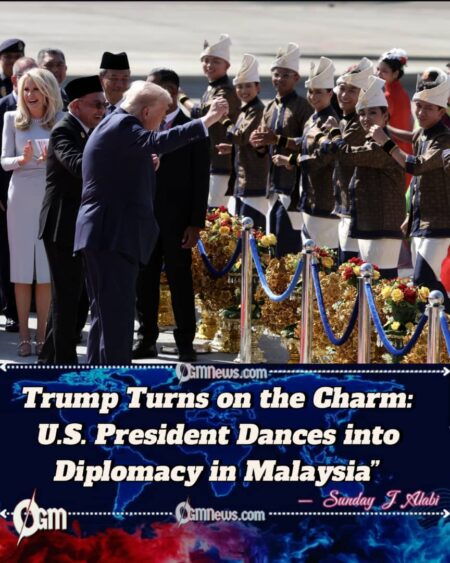
President Donald Trump began his highly anticipated week-long diplomatic mission to Asia with a colorful and jubilant reception in Malaysia’s capital, Kuala Lumpur, on Sunday morning local time. After a 23-hour flight from Washington, D.C., the U.S. president, serving his second term, was greeted by Malaysian dancers performing a traditional welcome ceremony that blended vibrant costumes, rhythmic chants, and lively percussion.
Stepping off Air Force One, Trump responded to the festive atmosphere with his signature fist-pump and rhythmic side-steps — moves that became synonymous with his 2024 campaign trail. The scene drew cheers from a crowd waving American and Malaysian flags, as he joined the performers in a brief dance, symbolizing a lighthearted start to a trip expected to carry heavy diplomatic weight.
Walking beside Malaysian Prime Minister Anwar Ibrahim, Trump posed for photos with the crowd, holding both nations’ flags in what he described as a “celebration of friendship and opportunity.” The ceremony marked the start of a series of crucial meetings that could define the direction of U.S. foreign trade and security partnerships in the Asia-Pacific region.
Peace, Trade, and Tensions: Setting the Agenda For Trump’s Asia Tour
Following his arrival, President Trump attended a ceremonial signing at the 47th ASEAN Summit in Kuala Lumpur, where he oversaw a ceasefire agreement between Thailand and Cambodia. The accord, facilitated under U.S. mediation, was signed by Thai Prime Minister Anutin Charnvirakul and Cambodian Prime Minister Hun Manet. Manet expressed gratitude to Trump for his “decisive lead” in bringing the long-standing border dispute to a peaceful resolution, stating that “no matter how difficult and complex a dispute may be, it must be resolved by peaceful means.”
Trump also announced new trade deals with Malaysia and Cambodia, including a minerals partnership with Thailand aimed at diversifying supply chains away from China. U.S. Trade Representative Jamieson Greer described the trip as “constructive,” noting that talks with Chinese officials in Kuala Lumpur had been “productive” ahead of Trump’s upcoming meeting with Chinese President Xi Jinping.
However, not all receptions were warm. Protests erupted in central Kuala Lumpur, where demonstrators voiced concerns about American economic influence and trade policies. Still, Trump maintained a confident tone, emphasizing that his administration was “committed to fairness, strength, and prosperity for all nations involved.”
Ahead: High-Stakes Diplomacy in Japan, South Korea, and Beyond
After Malaysia, Trump’s itinerary includes meetings in Tokyo with Japan’s newly elected Prime Minister Sanae Takaichi, followed by his attendance at the Asia-Pacific Economic Cooperation (APEC) forum in Seoul, South Korea. His trip will culminate in a closely watched bilateral summit with Chinese President Xi Jinping, where discussions on tariffs, technology access, and manufacturing are expected to dominate the agenda.
Trump’s former chief strategist, Steve Bannon, described the journey as “one of the riskiest of the president’s career,” citing the ongoing U.S.–China trade war as a critical test of the administration’s global economic policy. “This is as high-stakes as it gets,” Bannon said. “The Chinese Communist Party has declared open economic warfare against America.”
Despite skepticism, Trump remains optimistic. Onboard Air Force One, during a refueling stop in Doha, Qatar, he hinted at “big progress” in trade discussions, while reaffirming his commitment to Middle East stability. Meeting with Qatar’s Emir Sheikh Tamim bin Hamad Al Thani, Trump reiterated that “peace in every region begins with strength and trust.”
With tensions high and expectations even higher, Trump’s Asia tour has emerged as a defining moment in his second-term foreign policy — blending showmanship, diplomacy, and strategic negotiation in characteristic fashion.

Logging in is a breeze and the site stability is amazing even during peak hours....