


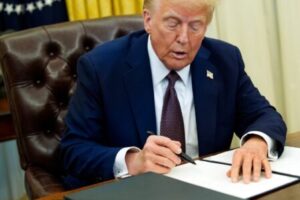


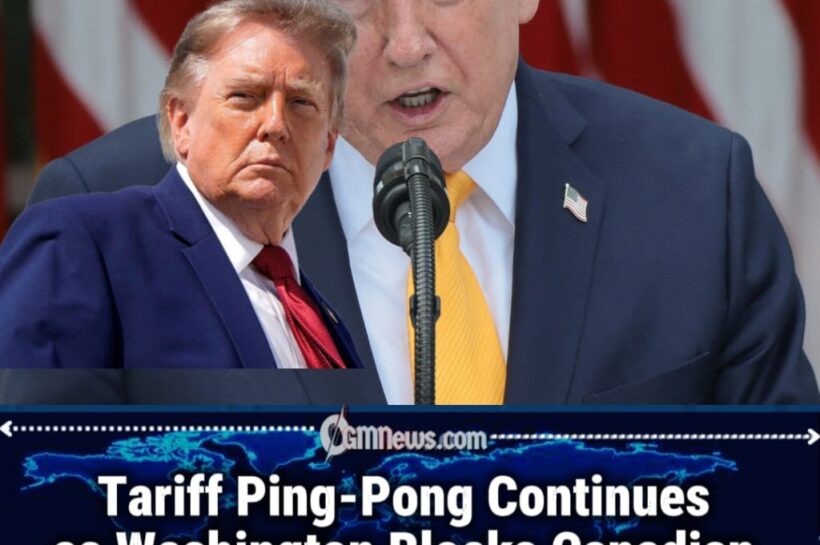





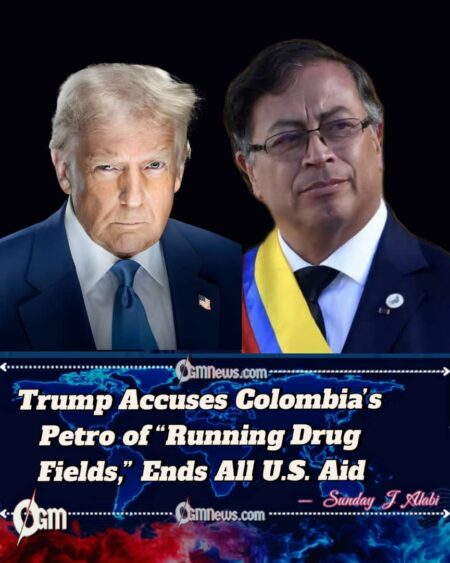
President Donald Trump, currently serving his second term, has announced the immediate termination of U.S. aid to Colombia after accusing its president, Gustavo Petro, of leading an “illegal drug empire.” The statement, made Sunday on Truth Social, marks the latest escalation in the tense relationship between Washington and Bogotá over narcotics enforcement and regional security.
In his post, President Donald Trump charged that Petro has “encouraged the massive production of drugs, in big and small fields,” and declared that “as of today, these payments, or any other form of payment, or subsidies, will no longer be made to Colombia.” The move follows Petro’s criticism of recent U.S. military strikes on vessels in the Caribbean that the Trump administration claimed were carrying narcotics. Petro contended that one such strike killed a Colombian fisherman aboard a civilian fishing vessel, accusing the U.S. of “invading national territory.”
The Trump administration has defended the operations, calling them part of a broader strategy to dismantle international smuggling routes and curb drug trafficking into the United States. However, the diplomatic fallout has intensified as both nations exchange accusations over sovereignty, accountability, and the future of regional anti-drug cooperation.
Trump Accusations, Denials, and a Growing Diplomatic Divide
President Donald Trump’s decision comes weeks after his administration officially added Colombia to the U.S. list of countries “failing to meet international counter-narcotics obligations” — a designation Colombia had avoided for nearly three decades. Despite the designation, the administration had initially granted a waiver allowing aid to continue. Sunday’s statement signals a full reversal of that stance.
In his Truth Social post, President Trump called Petro “a low-rated and very unpopular leader, with a fresh mouth toward America,” warning that “the United States will close up these killing fields for him, and it won’t be done nicely.” The president’s remarks underscore his administration’s growing frustration with what it views as Petro’s lack of cooperation in stemming the flow of cocaine into the U.S.
Petro quickly fired back on X (formerly Twitter), labeling Trump’s comments “rude and ignorant.” He insisted that his government has been “the primary foe of drug trafficking” in Colombia and accused Washington of hypocrisy, saying U.S. drug demand fuels the very trade it condemns. The Colombian leader, a former guerrilla and the country’s first leftist president, has increasingly positioned himself as a critic of U.S. interventionist policies in Latin America.
Regional Fallout and the Uncertain Future of U.S.-Colombia Relations
The dispute has drawn concern across Latin America. Venezuela’s government condemned the U.S. strikes as “acts of aggression,” while regional observers warn that deteriorating relations between Washington and Bogotá could undermine long-standing security partnerships in the hemisphere. The United States has long regarded Colombia as a cornerstone ally in counter-narcotics efforts, with billions of dollars in aid and training provided since the early 2000s under the “Plan Colombia” framework.
The Trump administration has not yet clarified which aid programs will be suspended or how existing defense and intelligence collaborations will be affected. Analysts say the aid cutoff could embolden criminal networks and weaken joint anti-drug initiatives in both nations. Meanwhile, Petro’s growing defiance — including his call last month for U.S. soldiers to “disobey” unlawful orders during a protest event in New York — has fueled Washington’s decision to revoke his U.S. visa.
As both presidents double down, the standoff underscores a sharp turn in hemispheric diplomacy. What was once a model partnership in the war on drugs now risks unraveling into one of the most consequential foreign policy rifts of Trump’s second term.
[…] […]