













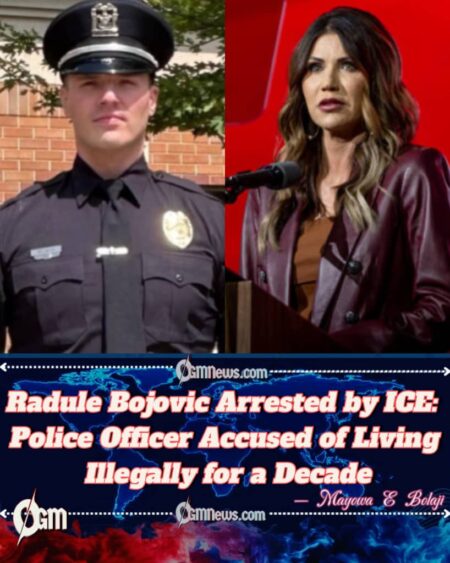
Radule Bojovic, a police officer from Hanover Park, Illinois, has become the center of a national storm after agents of the U.S. Immigration and Customs Enforcement (ICE) arrested him for allegedly being an undocumented migrant from Montenegro. The shocking revelation has left the law enforcement community reeling, as Bojovic had reportedly served actively while living in the United States illegally for about ten years.
According to Tricia McLaughlin, Assistant Secretary of the Department of Homeland Security (DHS), Bojovic’s case represents a grave violation of U.S. immigration and firearm laws. She described his actions as “a felony for aliens to even possess a firearm,” while questioning how a police department could recruit “a law enforcement officer who is actively breaking the law.” Her statement, delivered to CNN, has fueled outrage and raised broader concerns about the reliability of police vetting processes across the country.
Radule Bojovic’s case has also revived debate about the integrity of local police departments and their background-check procedures. Many observers are wondering how a non-citizen without legal residency managed to obtain a badge, firearm, and full employment under a state-recognized department. This lapse has intensified scrutiny over whether small-town police forces possess the necessary resources and systems to verify recruits’ immigration and criminal records effectively.
Radule Bojovic’s Police Career Unravels Amid Hanover Park’s Silence
Radule Bojovic was widely celebrated just weeks ago by the Hanover Park Police Department, which had publicly congratulated him on Facebook for graduating from the Suburban Law Enforcement Academy. The post showed Bojovic standing proudly between Deputy Chief Matt Riedel and Chief Andrew Johnson, marking the beginning of his field training. However, following his arrest, that same image has become a symbol of institutional oversight and embarrassment for the department.
Despite mounting public interest, the Hanover Park Police Department has yet to release an official statement or clarify whether it was aware of Bojovic’s immigration status before his employment. Internal sources suggest that officers were blindsided by the news, learning of his arrest only after ICE conducted what they described as a “targeted enforcement action.” The department’s silence has only deepened speculation and distrust among residents, many of whom are demanding a full investigation into recruitment practices.
For analysts and human rights advocates, Radule Bojovic’s situation raises broader ethical and procedural questions. How could a man allegedly without legal documentation navigate the complex process of joining law enforcement? Was there deliberate negligence or administrative failure? These unanswered questions are driving renewed calls for accountability, transparency, and reform within police recruitment systems nationwide.
Radule Bojovic’s Detention Reignites Debate Over Trump-Era Immigration Crackdowns
Radule Bojovic’s arrest comes at a politically charged moment, as immigration enforcement under President Donald Trump’s policies continues to divide the nation. Critics argue that ICE’s methods—though framed as lawful and necessary—often lead to indiscriminate arrests that target even law-abiding individuals. The agency’s sweeping operations have repeatedly captured people without criminal histories, casting doubt on the claim that they solely target “violent offenders” or “gang members.”
Supporters of the enforcement action, however, maintain that no one should be exempt from the law, regardless of occupation or social status. They argue that Bojovic’s case, if true, highlights systemic vulnerabilities that allow illegal residents to infiltrate sensitive public institutions such as police departments. This view reflects the administration’s stance that strict enforcement ensures national security and upholds the rule of law.
Nonetheless, civil rights groups contend that the Department of Homeland Security has weaponized its authority, transforming immigration enforcement into a political tool. They caution that the Bojovic case symbolizes a broader problem—one where fear, rather than fairness, drives policy. As the story unfolds, Radule Bojovic remains both a symbol of systemic failure and a flashpoint in America’s ongoing struggle over immigration and justice.


Mexican players will love how well this platform handles local payment methods. Deposits via OXXO...