
























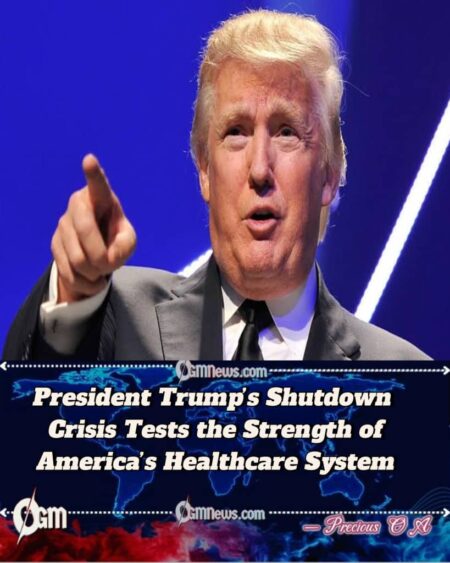
President Trump stands at the center of the nation’s longest government shutdown in years, a political standoff that has now evolved into a full-blown national crisis with far-reaching consequences. As federal workers endure delayed paychecks and vital government services grind to a halt, the real emergency is unfolding quietly in America’s hospitals, clinics, and neighborhoods. Healthcare systems already under immense strain are now being pushed to the brink. For millions who depend on public health programs, local clinics, and government-supported hospitals, the shutdown has become more than a political impasse—it is a direct assault on their wellbeing and security.
President Trump maintains that the shutdown is necessary to force Congress to meet his fiscal and policy demands, insisting that the nation must make tough choices to secure its future. But those choices have carried devastating consequences for ordinary Americans. Across the country, thousands of low-income families have seen delays in Medicaid services, interruptions in prescription drug access, and reduced operating hours in community health centers. Medical research funded by federal agencies has been paused, public health surveillance systems are understaffed, and critical food and housing assistance programs remain suspended—further compounding the health crisis.
President Trump insists his administration is working to protect Americans, yet healthcare experts, governors, and local officials argue that his actions tell a different story. The refusal to release healthcare funds and the ongoing uncertainty in Washington have left patients stranded without medication, hospitals struggling to retain staff, and rural clinics unable to stay open. The shutdown, critics say, has less to do with fiscal discipline and more to do with avoiding accountability for deeper systemic failures—failures that have left millions of Americans paying for political gamesmanship with their health and livelihoods.
Medicaid Under Siege
President Trump has overseen one of the most aggressive efforts to reshape Medicaid since its founding in 1965. While his administration describes its actions as necessary reforms, the effects have been devastating for millions of families who rely on Medicaid for essential healthcare coverage. States encouraged to impose work requirements, tighter eligibility criteria, and reduced federal support have left countless Americans uninsured. Parents caring for disabled children, elderly citizens in nursing homes, and low-wage workers are among those facing the harsh reality of medical neglect and bureaucratic roadblocks. As the shutdown continues, staff who process Medicaid applications and renewals have been furloughed, leaving thousands without clarity or care.
President Trump insists that these policy changes are part of a broader strategy to “modernize” and “streamline” the system, reducing waste and promoting personal responsibility. Yet, according to public health experts, these measures are little more than coded language for systematic cuts. The impact has been particularly harsh in rural and economically distressed regions, where hospitals depend heavily on Medicaid reimbursements to stay afloat. Without timely payments, many facilities face closure, creating healthcare deserts where residents must travel hours for basic medical attention.
President Trump faces mounting criticism even from within his own political circle as the crisis deepens. Some Republican lawmakers have privately expressed concern over the long-term damage being done to America’s healthcare infrastructure. Yet few have been willing to confront the administration directly, leaving the healthcare system trapped in limbo. As partisan tension in Washington intensifies, millions of Americans are left with canceled surgeries, unpaid medical bills, and empty promises of reform. Healthcare, once seen as a bipartisan priority, has become a casualty of political brinkmanship.
Rural Hospitals on the Brink
President Trump presides over a rapidly deteriorating situation in rural America, where small hospitals are shutting down at an alarming rate. These facilities are more than medical centers—they are community lifelines, providing emergency services, maternity care, and chronic disease management for populations often forgotten by national policymakers. Many rely heavily on federal programs like Medicare and Medicaid for funding, and the shutdown has brought those revenue streams to a standstill. Without financial relief, these hospitals are unable to pay staff, replenish critical supplies, or maintain emergency operations. Each passing week brings another closure, another town left without accessible healthcare.
President Trump argues that the long-term economic benefits of his fiscal agenda will outweigh short-term disruptions, emphasizing that his administration is working to rebuild America’s economy and strengthen national security. But for the small towns watching their hospitals close, such promises offer little comfort. Emergency rooms that once operated 24 hours a day are now shuttered. Expectant mothers must travel dozens of miles to give birth. Ambulance services, already stretched thin, are forced to bypass nearby hospitals, costing precious minutes that often mean the difference between life and death.
President Trump remains steadfast in his refusal to compromise, framing the shutdown as a stand for “fiscal integrity” and “American strength.” Yet for the millions of Americans who find themselves without access to doctors, medications, and emergency services, those words ring hollow. The true crisis, health experts warn, is not in the halls of Congress or at the southern border—it is in the heart of struggling communities where sickness, uncertainty, and despair are spreading faster than hope. Unless immediate action is taken, the damage to the nation’s healthcare system may take years to repair, and for some communities, recovery may never come.



https://webtoolsreview.substack.com/p/why-screenshots-arent-the-best-way