






















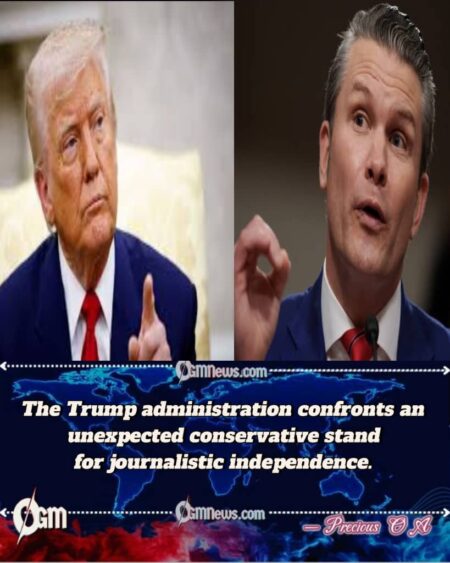
The Trump administration has encountered unexpected resistance from within its own ideological base after a controversial initiative from the Pentagon sought to restrict press freedoms. The so-called “Media Access Pledge,” reportedly drafted under the direction of senior MAGA officials, was designed to limit journalists’ access to defense briefings and field operations unless they agreed to new “national interest” guidelines. The policy, according to insiders, was developed following months of internal debate over how much information should be made public about ongoing U.S. military operations abroad. It was intended to impose a uniform code of conduct for journalists covering defense matters, but it quickly spiraled into a political storm.
The Trump administration introduced the pledge to tighten information security and prevent what officials described as “biased coverage” of military activities. Pentagon spokespersons defended the document as a tool for protecting “sensitive operational data” and ensuring that national defense reporting does not compromise troop safety. However, the measure quickly drew sharp criticism, not from liberal-leaning publications, but from traditionally pro-Trump outlets such as Newsmax and The Washington Times, which refused to sign the pledge, calling it an “overreach that undermines the First Amendment.” The decision to oppose the Pentagon came as a shock to many in Washington, signaling the first time several right-wing outlets had directly challenged a Trump-era national security directive.
The Trump administration was caught off guard by the backlash. Within hours of the Pentagon’s announcement, multiple conservative media platforms echoed similar concerns, arguing that any government-imposed limits on reporting contradicted the values of free press and transparency that conservatives had long defended. Analysts pointed out that this confrontation marked a turning point in the relationship between the administration and its media allies. What began as a dispute over national security policy quickly evolved into a philosophical debate about power, accountability, and the role of journalism in a democracy.
Conservative Media Challenge Pentagon Restrictions
The Trump administration faced a rare rebuke when Newsmax, a long-time ally of the President, issued a public statement criticizing the Pentagon directive. “Our commitment to America’s security does not require surrendering our constitutional rights,” the network declared, noting that freedom of the press must be upheld regardless of which party holds power. The Washington Times followed with an editorial that accused the Pentagon of “abandoning conservative principles in favor of unchecked power.” Both outlets warned that the pledge could set a precedent allowing future administrations to censor the media in the name of national security.
The Trump administration soon found that other right-leaning outlets, including The Daily Caller, the Washington Examiner, and RealClearPolitics, joined the opposition. This growing coalition of conservative media signaled a rare moment of unity across outlets that often compete for influence within the right-wing ecosystem.
For many within conservative circles, the issue was no longer about loyalty to the President but about defending the broader conservative ideal of limited government and press freedom. Political commentators noted that such defiance was almost unheard of during Trump’s first term, reflecting a growing confidence among right-wing journalists to challenge policies that threaten constitutional rights.
The Trump administration saw confusion ripple through the Pentagon as defense officials admitted they had not expected defiance from media allies. “We expected criticism from The New York Times, not Newsmax,” one Pentagon source said, reflecting the surprise within senior ranks. Internal memos reportedly described the situation as “an avoidable communications failure” that risked “alienating loyal partners.” Behind closed doors, some military officials reportedly expressed discomfort with the pledge even before it was released, warning that it could be perceived as a loyalty test rather than a professional code of conduct.
Internal Division and the Battle for Narrative Control
The Trump administration had intended the pledge to restore discipline in handling sensitive military information following a series of leaks that embarrassed the Defense Department earlier this year. Those leaks, which revealed details of covert drone operations and classified briefings, led to intense scrutiny from Congress and raised fears of foreign intelligence exploitation. Senior aides described the pledge as a “responsible safeguard,” not an act of censorship, arguing that a controlled flow of information was essential for national security in a volatile global climate. However, critics countered that no government department should have the authority to decide which stories are acceptable for publication.
The Trump administration insisted that the pledge was voluntary, but reports suggested that journalists who refused to sign could lose access to top-level briefings, press passes, or field embeds. Many described it as a veiled “loyalty test,” sparking concern that political favoritism could shape defense reporting. Legal experts also warned that such a move could blur the line between government transparency and propaganda, especially if press access became conditional upon ideological compliance. In response, advocacy groups like the Committee to Protect Journalists and Reporters Without Borders issued statements condemning the pledge as a “threat to democratic accountability.”
The Trump administration is now at a crossroads. With pressure mounting from both allies and advisers remain split on whether to retract the pledge or stand firm. Some senior officials within the administration reportedly support rewording the document to make it appear less restrictive, while others favor doubling down and framing the controversy as a test of patriotism.
A White House spokesperson said the President “remains committed to both press freedom and national security,” signaling a possible review but leaving open questions about trust and transparency in the administration’s approach to the media. Analysts believe the outcome of this standoff could set the tone for the remainder of Trump’s second term and determine whether his relationship with the press stabilizes or deteriorates further.
[…] […]