







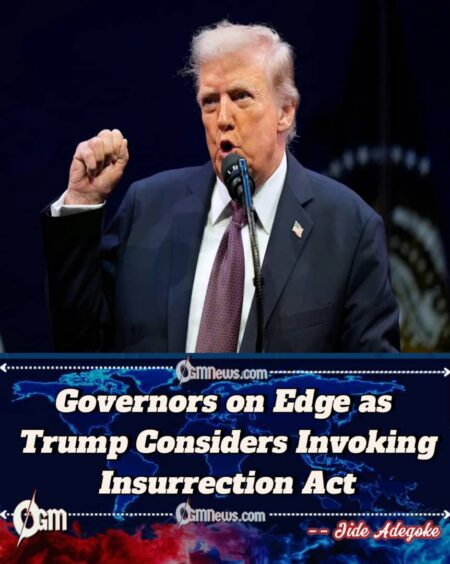
The United States is facing mounting concern over reports that President Donald J. Trump, now serving his second term, is preparing to invoke the Insurrection Act, a rarely used federal law that allows the president to deploy military forces domestically. According to senior political sources, Trump’s advisers have been exploring the scope of the Act in anticipation of what they describe as “civil unrest” and “non-compliance” from Democratic-led states.
Legal experts warn that such a move could constitute an abuse of executive power, especially if used to suppress political opposition or target states resisting federal directives. The Insurrection Act, last invoked during the 1992 Los Angeles riots, requires clear evidence of lawlessness beyond the control of state authorities. Critics argue that Trump’s current posture lacks such justification, calling it a “preemptive strike” on state sovereignty.
Governors in several Blue States have reportedly begun private consultations amid growing fears that the White House could deploy federal troops without their consent. While the administration maintains it is only “evaluating security readiness,” the discussions have fueled deepening mistrust between the federal government and state executives.
Trump Government Faces Pushback Over Alleged Plans to Override States’ Rights
Within hours of reports surfacing, several governors and constitutional scholars began calling for an emergency summit to discuss coordinated responses to any potential federal overreach. The proposed summit, spearheaded by leaders in California, New York, and Massachusetts, aims to establish a unified stance among states should the Trump administration attempt to enforce the Act outside constitutional limits.
The Trump government, for its part, has doubled down on its rhetoric, framing the issue as a matter of “national security and public order.” Administration officials insist that the president has the authority to intervene if “state leaders fail to protect citizens or enforce federal laws.” Yet constitutional experts counter that such language dangerously broadens the scope of executive intervention — effectively granting the president quasi-martial powers over domestic affairs.
Civil rights organizations have begun mobilizing in anticipation of mass protests, warning that any unilateral military deployment could “plunge the country into a constitutional crisis.” Lawmakers in Congress are already drafting resolutions aimed at curbing executive abuse under the Insurrection Act, though their path to passage remains uncertain in a polarized legislature.
Trump Government Defends Strategy Amid National Tension
Amid growing backlash, the Trump administration has maintained that it is acting within the law and that speculation of an “illegal invocation” of the Insurrection Act is politically motivated. In a late-night statement, the White House emphasized the president’s “duty to safeguard national unity,” accusing the media of “amplifying fear narratives designed to undermine the presidency.”
Despite these reassurances, the sense of unease across state governments persists. National Guard units in several states have reportedly been placed on “heightened alert,” though governors maintain this is a precautionary measure, not a coordinated response. Former military and intelligence officials have described the situation as “unprecedented,” warning that even a partial activation of the Act could set a dangerous precedent for federal-state relations.
As the standoff intensifies, the nation watches closely. Should President Trump proceed with invoking the Insurrection Act, the move would mark one of the most consequential confrontations between a sitting president and U.S. state governments in modern history — testing the resilience of American democracy itself.
[…] […]