




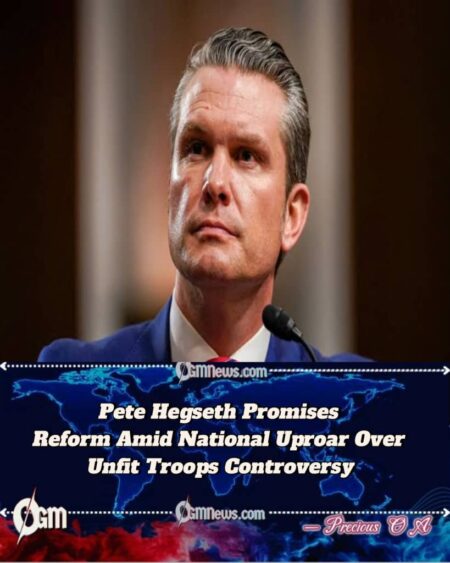
Pete Hegseth, the MAGA-aligned “War” Secretary, is at the center of a national controversy after viral images showed overweight members of the Texas National Guard crossing into Illinois during a politically charged operation. The photos, which spread rapidly across social media, have sparked widespread debate about military fitness, professionalism, and the administration’s use of the National Guard for domestic political purposes.
In a heated press conference, Pete Hegseth dismissed the backlash as “a smear campaign against patriots who risk their lives for this country.” He insisted that “fitness does not define bravery,” emphasizing that the troops had served under “challenging conditions.” His remarks, however, failed to calm critics who accused him of poor leadership and eroding the standards of the military he oversees.
Observers note that this scandal marks one of the most serious challenges of Pete Hegseth’s career. Once regarded as a symbol of loyalty within the MAGA movement, he now faces accusations of negligence and politicization of national defense. Analysts argue that the viral images have not only embarrassed the administration but also raised deeper questions about readiness, morale, and the separation between politics and service.
Pete Hegseth’s public defense has only intensified scrutiny. Many believe his attempt at damage control — including statements on television networks and social media — has done little to restore public trust. Critics argue that instead of addressing accountability, Hegseth’s focus on defending the troops has shifted attention away from questions of oversight and command responsibility.
Political Fallout and Divided Public Opinion
The political backlash following the viral images has been fierce and wide-reaching. Illinois officials described the event as an “unauthorized incursion,” while lawmakers demanded to know under whose authority the National Guard was deployed across state lines. Governor J.B. Pritzker condemned the action as “reckless and unconstitutional,” calling it “a politically motivated stunt that jeopardizes trust in the rule of law.”
Civil rights groups and veterans’ organizations have echoed those concerns, demanding congressional hearings to determine whether federal guidelines were ignored. “This operation appears less about security and more about showmanship,” said advocacy leader Karen Rhodes. The incident has reignited debate over whether the armed forces are being drawn too deeply into partisan battles.
Pete Hegseth has attempted to defend his record amid the growing storm, arguing that “the mission was conducted with proper oversight and integrity.” Yet his words have not stopped the wave of criticism. Within conservative circles, many MAGA supporters remain loyal, viewing him as a target of media bias. But others within the movement admit that the optics are “disastrous” and risk damaging the credibility of the administration.
Social media has amplified the division. Hashtags like #TexasInvasion, #HegsethCrisis, and #UnfitTroops trended for days, with millions of posts mocking the images or questioning leadership accountability. Online satire, memes, and political commentary have turned what might have been an isolated embarrassment into a nationwide debate over the integrity of America’s defense institutions.
Pete Hegseth’s media team continues to fight back, framing the outrage as “politically motivated hysteria.” But analysts suggest that the scandal’s viral nature makes damage control nearly impossible. “Once an image goes viral, it becomes public memory,” said political analyst James Carter. “And public memory is rarely kind to politicians under fire.”
Calls for Reform and Uncertain Future
As the controversy deepens, lawmakers and defense analysts are calling for urgent reforms. Several members of Congress have proposed an independent investigation into how the Texas Guard’s mission was authorized, while others are demanding a full review of National Guard fitness standards. Many see this as an opportunity to confront the growing politicization of the armed forces.
Pete Hegseth has pledged to “review operational readiness and ensure that every soldier represents the professionalism and strength of the United States.” His statement aimed to project authority and reassure the public that lessons would be learned. Yet watchdog organizations remain skeptical. The nonpartisan group Citizens for Military Accountability described his response as “a public relations exercise rather than a commitment to systemic reform.”
Military experts have warned that the scandal could erode morale and confidence among service members. “When the public begins to doubt the credibility of the military, it affects everything from recruitment to respect for command,” said retired General Mark Lawson. “This isn’t about appearances; it’s about discipline and trust.”
Pete Hegseth’s future within the cabinet remains uncertain. While he retains the strong support of the current U.S. president, who is serving his second term, internal reports suggest growing unease among senior officials. Some insiders believe that the “War” Secretary will survive politically but emerge weakened, while others predict this scandal may mark the beginning of a slow exit from the administration.
For now, the controversy surrounding Pete Hegseth continues to dominate headlines and divide the nation. What began as a viral photo scandal has evolved into a larger test of leadership, integrity, and accountability within one of America’s most politicized administrations in modern history.
Downloading the utbetapp was a breeze! The app itself is very intuitive and makes placing...