




























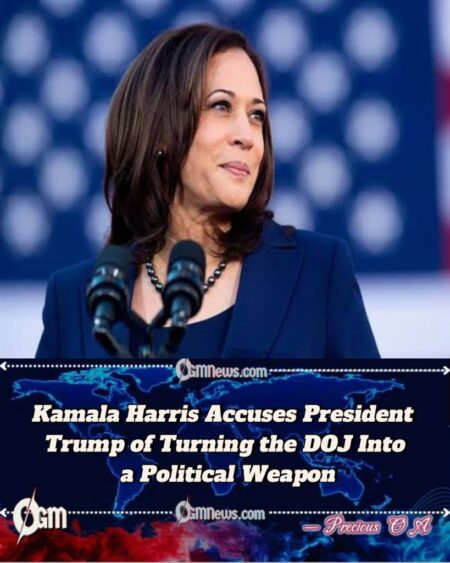
Kamala Harris, the former U.S. Vice President and California’s onetime attorney general, has re-entered the national conversation with strong criticism of President Trump’s handling of the Department of Justice (DOJ). Known for her sharp prosecutorial background and long record of advocacy for equality before the law, she voiced deep concern over what she described as “a government turning its justice system into an instrument of fear and favoritism.” Speaking at a Washington policy event, she argued that the administration has blurred the boundaries between legal authority and political ambition.
Kamala Harris emphasized that the DOJ, once regarded as a pillar of impartial justice, is now being perceived as a tool of political convenience. “When investigations are guided by loyalty instead of law, we lose the essence of what justice means,” she said. Her remarks were met with a mix of applause and tension, particularly from those who see her comments as a challenge to the current government’s legal credibility. She framed her warning as not merely partisan, but as a defense of American democracy itself.
Kamala Harris also pointed to a “pattern of selective accountability,” citing examples where critics of the administration have faced aggressive inquiries while allies seem to evade scrutiny. “Justice cannot depend on proximity to power,” she said firmly, “because once the law starts serving individuals instead of the nation, it stops being justice.” Her speech drew attention from both domestic and international observers who have followed the ongoing tension between the executive branch and the judiciary.
Republican Response and White House Rebuttal
Kamala Harris’s statements sparked immediate responses from Republican lawmakers and administration officials, many of whom accused her of exaggerating the issue for political gain. Senator Josh Hawley described her words as “a strategic attempt to reignite partisan conflict and undermine the DOJ’s legitimate investigations.” Others within the GOP insisted that the DOJ’s current leadership is acting within legal limits and that its critics are motivated by election-year politics.
Kamala Harris’s accusations also drew a direct rebuttal from the White House. In an official statement, a spokesperson for President Trump called her comments “reckless, misleading, and based on misinformation.” The statement insisted that the DOJ continues to uphold its constitutional duties and operates independently of political influence. It further accused her of attempting to “rewrite the narrative to shield those under legitimate investigation.”
Kamala Harris’s remarks, however, were supported by several nonpartisan groups that monitor government integrity. Organizations such as the Project on Government Oversight and the Brennan Center for Justice expressed concern that the balance between executive authority and judicial independence has become increasingly fragile. They urged Congress to review procedural protections within the DOJ to ensure political neutrality remains intact.
A Broader Fight for Judicial Integrity
Kamala Harris’s criticism resonated beyond the immediate political sphere, reflecting a growing public anxiety about institutional credibility. She described the politicization of justice as “a slow corrosion that eats away at trust,” adding that when citizens lose confidence in the fairness of the law, “democracy’s foundation begins to crack.” Her tone was one of urgency, not outrage, as she appealed to Americans to remember that justice is the cornerstone of a functioning republic.
Kamala Harris’s message has found particular support among civic groups and legal professionals who fear the precedent set by unchecked executive influence. They argue that even if the DOJ currently acts within legal limits, continued political pressure could normalize future abuses of power. Her warning, they say, is not just about the present administration but about protecting the country’s institutions for decades to come.
Kamala Harris has also urged Congress to strengthen oversight mechanisms that would prevent the misuse of prosecutorial authority. “This is not a matter of ideology,” she said, “but of integrity. The rule of law cannot depend on who holds office.” Her remarks called on both parties to resist the temptation to use justice as a political weapon — a theme that has sparked new discussions in legislative circles.
Kamala Harris Calls for Reform and Accountability
Kamala Harris concluded her address with a direct appeal to Americans to hold their leaders accountable for preserving judicial independence. “The Department of Justice must belong to the people, not to power,” she declared. “No administration should have the privilege to bend justice toward its own interests.” Analysts saw her statement as a clear call for bipartisan unity in restoring faith in national institutions.
Kamala Harris’s comments have already inspired a wave of editorials and opinion pieces examining the future of the DOJ. While supporters view her as a voice of moral conscience, detractors dismiss her as a political opportunist seeking renewed relevance. Yet both sides agree that her speech has reignited a crucial debate about where power ends and justice begins.
Kamala Harris remains one of the few public figures consistently emphasizing judicial integrity in an increasingly polarized climate. Her insistence that “justice must serve truth, not power” has become a rallying cry among reform advocates. Whether her appeal will translate into legislative action or simply intensify political divides remains to be seen, but her voice continues to shape the national conversation on justice and democracy.

[…] […]