











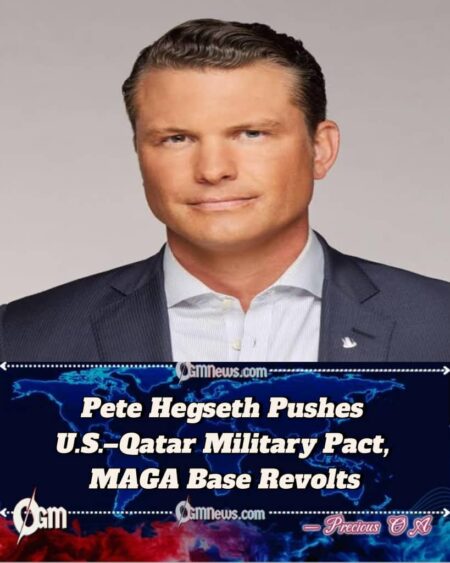
Pete Hegseth, serving as Defense Secretary under President Trump’s second-term administration, formally announced that Qatar would construct a new air force facility at the Mountain Home Air Force Base in Idaho. The project, which has reportedly been under quiet negotiation for several months, will see a contingent of Qatari F-15 fighter jets and pilots operating from U.S. soil. Hegseth described the move as “a historic step toward deepening strategic cooperation between Washington and Doha,” noting that it would enhance mutual defense training and strengthen America’s partnerships in the Middle East.
Pete Hegseth explained that the partnership was not a sudden decision but part of a broader realignment of U.S. foreign policy under President Trump’s renewed leadership. According to him, Qatar’s diplomatic contributions—particularly its recent role in brokering a cease-fire between Israel and Hamas—earned the Gulf nation “a trusted seat at the table of Western defense cooperation.” The new Idaho facility, Hegseth added, would serve as a joint training and interoperability center, designed to allow U.S. and Qatari pilots to coordinate operations more effectively and improve combat readiness against shared threats.
Pete Hegseth also emphasized that the facility would symbolize a new era of collaboration, integrating Qatari and U.S. air forces under a shared mission framework. He claimed that the partnership demonstrates “mutual respect and trust” built over years of diplomatic and military collaboration. Yet, the Defense Department’s announcement left several crucial details unresolved. Questions regarding construction timelines, operational scope, and command hierarchy remain unanswered. Analysts have pointed out that while the United States often allows allied forces to train within its borders, the permanent stationing of a foreign air force on U.S. soil is virtually unprecedented.
Reactions: MAGA Fury Meets Policy Debate
Pete Hegseth’s revelation immediately triggered outrage within the conservative MAGA movement, where many view the deal as an affront to American sovereignty. Prominent voices within Trump’s base accused the administration of compromising national security and “inviting a foreign military power into America’s backyard.” Online forums and conservative talk shows erupted in anger, describing the plan as a “betrayal of patriotic principles.” To many MAGA supporters, allowing Qatari jets and personnel to operate on U.S. soil represents an abandonment of the “America First” philosophy that has defined the movement for years.
Pete Hegseth’s supporters inside the administration, however, offered a different perspective. They argue that the decision aligns with a long-term strategic vision of strengthening defense partnerships with stable allies in the Middle East. According to defense analysts, embedding Qatari forces in Idaho would enhance joint readiness, improve intelligence coordination, and offer a platform for advanced simulation and tactical exchange. One Pentagon official described the project as “the next evolution of military diplomacy,” asserting that “alliances must now operate in integrated environments rather than separate ones.”
Pete Hegseth’s announcement also prompted swift political reactions in Washington. A number of lawmakers—both Republicans and Democrats—have called for congressional oversight of the agreement. Senator Tim Kaine, a member of the Senate Armed Services Committee, demanded a full briefing on the facility’s terms, including legal jurisdiction and funding sources. Some constitutional scholars argue that hosting a foreign military presence on U.S. soil may require either congressional authorization or a formal defense treaty ratification, depending on the scope of Qatar’s operational control. The issue has thus evolved from a defense partnership question into a broader constitutional and political debate.
Implications and Unanswered Questions
Pete Hegseth has portrayed the initiative as a forward-looking experiment in international defense cooperation. He described the Idaho project as “a model for future partnerships with trusted allies,” suggesting that it could reshape how the United States trains and operates with foreign militaries. Supporters see it as an opportunity to build closer ties with Qatar, which already hosts one of the largest U.S. air bases in the Middle East at Al Udeid. They argue that by moving part of the training operations stateside, the U.S. can reduce overseas dependency while reinforcing the strategic value of domestic installations.
Pete Hegseth’s decision, however, continues to divide experts in the defense community. Some analysts warn that such arrangements risk setting a dangerous precedent, paving the way for other nations to request similar basing privileges within U.S. borders. Security specialists have raised concerns about data protection, flight safety, and the handling of classified information during joint operations. Critics also question the political optics of granting Qatar—a nation with a complex history of balancing ties between the West and Iran—such a visible presence on American soil.
Pete Hegseth’s office maintains that all legal and security safeguards are being observed. The Defense Department has pledged transparency with local authorities in Idaho, promising that all Qatari personnel would remain under strict U.S. command supervision. Nonetheless, residents in and around the Mountain Home area have voiced concerns. Town hall meetings have been scheduled to address fears over noise pollution, environmental risks, and the potential militarization of local airspace.
Pete Hegseth, undeterred by criticism, has defended the agreement as “an investment in preparedness and peace.” He argues that fostering cooperation with trusted partners strengthens deterrence and stability, not weakness. “If we expect our allies to fight alongside us abroad,” he said, “we must be willing to train alongside them at home.” Observers say this reflects a key tenet of Trump’s second-term defense strategy—one focused on selective partnership-building rather than large-scale overseas intervention.
Pete Hegseth’s move, however, has underscored a deep ideological divide within the conservative movement. While pragmatic defense strategists see the Qatari deal as a logical step in global readiness, nationalist factions within MAGA circles view it as a dangerous compromise. The outcome of this debate could shape future policy decisions on how the Trump administration manages foreign alliances in an increasingly complex global landscape.
Pete Hegseth’s handling of the situation will likely define his legacy as Defense Secretary. Whether the Idaho facility becomes a symbol of strengthened international partnership or a lightning rod for nationalist backlash remains to be seen. What is certain is that his decision has thrust the question of foreign military presence on U.S. soil to the forefront of national debate—one that is unlikely to fade anytime soon.

Logging in is a breeze and the site stability is amazing even during peak hours....