




























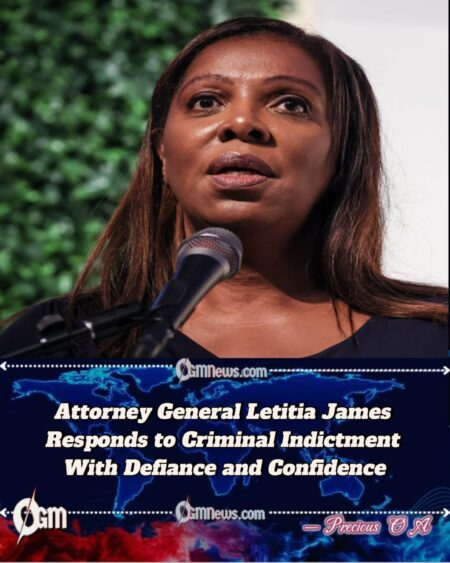
Attorney General Letitia James has been indicted on a federal criminal charge related to alleged bank fraud, sending shockwaves through New York’s political and judicial institutions. The indictment, which stems from a months-long federal investigation, represents one of the most significant legal and political challenges ever faced by a sitting state attorney general.
According to reports, the case centers on financial transactions linked to a campaign-associated account. Prosecutors allege that false information was submitted to a major financial institution to obtain more favorable loan terms. While federal authorities have yet to release full details of the evidence, the news has already generated national debate about ethics, power, and accountability in government.
Attorney General Letitia James has long been known for her aggressive pursuit of justice and her readiness to challenge powerful individuals and corporations. Her high-profile cases have included lawsuits against major real estate firms, global companies, and influential political figures. Ironically, her reputation as a relentless enforcer of the law now contrasts sharply with her current legal predicament, placing her on the defensive in a criminal court.
Letitia James has firmly denied any wrongdoing, calling the indictment “unjustified and politically charged.” Her attorneys maintain that the alleged discrepancies were administrative oversights with no criminal intent. They argue that no bank suffered any financial loss, and that the government’s interpretation of intent overreaches legal boundaries.
Supporters of Letitia James have rallied publicly, claiming the case reflects an effort to discredit her long record of holding powerful entities accountable. Some observers, however, argue that regardless of motive, the justice system must be allowed to function independently. Legal analysts say the situation underscores a crucial truth in democracy: no one, regardless of position, is above the law.
Public Response and the Expanding Legal Storm
Letitia James has addressed the public on several occasions since the indictment, expressing confidence in her defense and pledging to remain focused on her duties. In a brief statement, she said, “I have full faith in the legal process and in the people of New York, who know my commitment to justice.” Her comments drew mixed reactions — admiration from supporters who see her as resilient under pressure, and criticism from opponents who question her credibility in light of the allegations.
The political atmosphere surrounding the case is increasingly charged. Some state lawmakers have expressed concern that the indictment could erode public trust in government institutions. Others have called for patience and due process, emphasizing that an indictment does not equal guilt. The governor’s office released a statement affirming that Letitia James will continue in her role unless convicted or she voluntarily steps down.
Letitia James’s office continues to function with notable adjustments. Senior deputies have assumed oversight of certain high-level investigations to ensure impartiality while she faces trial. According to insiders, these measures are designed to maintain stability and preserve public confidence in the attorney general’s ongoing work.
Legal experts note that the case could hinge on the government’s ability to prove intent — a notoriously complex standard in financial law. If prosecutors cannot establish that the attorney general knowingly misrepresented information for personal or political gain, the case could weaken significantly. Still, the federal indictment itself signals the seriousness with which investigators view the allegations.
Letitia James’s situation has also reignited long-standing debates about political prosecution. Some of her allies argue that the indictment’s timing — just ahead of a critical election cycle — raises questions about partisan interference. Opponents dismiss that notion, insisting that the justice system’s independence must be respected. The clash of narratives has further polarized New York’s already divided political environment.
Implications for Justice, Politics, and the Future
Letitia James’s indictment has drawn attention from across the nation. For many Americans, it highlights the fragile intersection between politics and the law — and the dangers of either side influencing the other. Legal commentators note that while high-ranking officials have faced indictments before, few cases have carried such deep political and institutional implications.
The case also casts a spotlight on how prosecutors handle alleged misconduct among top government officials. Some legal scholars view the indictment as a reaffirmation of the justice system’s independence, while others warn that even the appearance of political bias could damage public trust in future investigations.
Letitia James, through her attorneys, has vowed to fight the charges “with integrity and transparency.” Her defense team is reportedly preparing a detailed legal strategy aimed at exposing procedural flaws and disputing the interpretation of key evidence. Observers expect pre-trial motions to play a critical role in determining whether the case proceeds to full trial or is dismissed on technical grounds.
Beyond the courtroom, the implications are far-reaching. Within her political party, discussions have already begun about potential successors should she step aside, though no formal calls for resignation have been made. If convicted, Letitia James could face prison time and disbarment — effectively ending her public service career. If acquitted, however, she may emerge stronger, portrayed as a symbol of endurance against politically motivated adversity.
Letitia James’s next court appearance is scheduled for later this month, where prosecutors are expected to present additional financial documentation. Political analysts predict that public interest in the proceedings will remain high, as the outcome may influence voter sentiment heading into the upcoming election season.
In the broader sense, the case of Attorney General Letitia James raises timeless questions about power, accountability, and the rule of law. It reminds citizens that justice — whether in favor of or against a public official — must remain rooted in evidence, not perception. As the process unfolds, one thing is certain: the outcome will leave a lasting mark on New York’s legal and political history.



[…] […]