


























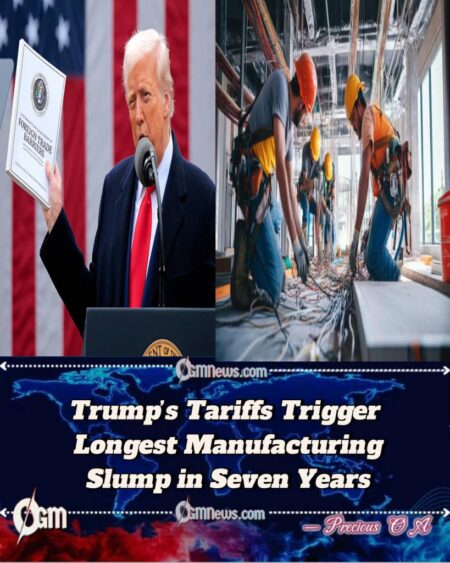
Trump’s tariffs have pushed the U.S. manufacturing industry into its seventh straight month of contraction, as new data from the Institute for Supply Management (ISM) confirms continued weakness across key sectors. The index, which tracks national factory activity, remained below 50 in September — a clear sign that production is still shrinking. Analysts warn that unless major policy adjustments are made, the manufacturing sector could enter one of its longest downturns in recent history.
Trump’s tariffs were introduced to shield American industries from foreign competition and reduce trade deficits. However, manufacturers now say the measures are backfiring. “We’re facing rising prices for imported materials, slower sales, and layoffs,” said a Michigan auto parts producer. “Our margins have evaporated since the tariffs began.” The intended benefits of encouraging local production have been overshadowed by steep costs and supply shortages that many small firms cannot withstand.
Trump’s tariffs have also reshaped global trade relationships, with retaliatory levies from China and the European Union reducing demand for American exports. The result is a shrinking order backlog and mounting financial strain across factories that once thrived on international trade. Sectors like steel, electronics, and heavy machinery have been particularly hard hit. Exports to China, once a key market for American-made industrial goods, have dropped sharply since countermeasures took effect. Some factories have been forced to halt operations temporarily, while others are relocating parts of their production overseas to bypass the tariffs.
Trump’s tariffs have additionally strained the relationship between manufacturers and the administration. While the White House insists the policy is part of a “long game” to rebuild industrial self-reliance, business owners argue that the short-term damage is becoming unbearable. Many firms have reduced work hours, frozen hiring, and delayed capital investments — all signs of fading confidence within the sector. The mounting losses have even prompted some state governments to request federal assistance for struggling industries.
Factories Face Rising Costs and Supply Chain Disruptions
Trump’s tariffs have disrupted critical supply chains that U.S. manufacturers depend on, particularly in steel, aluminum, and electronics. The levies have made imported parts more expensive, forcing many factories to scale back production or pass costs on to consumers. “Our input costs are up nearly 25%,” said a Texas equipment manufacturer. “That’s unsustainable for small operations like ours.” Larger corporations with more capital have managed to absorb the shocks, but smaller firms — often the backbone of local economies — are struggling to survive.
The trade restrictions have also created uncertainty that makes planning difficult. Companies that rely on global suppliers are facing delays and shortages, while domestic producers have struggled to meet demand. “Even when we buy American, prices are higher because everyone’s competing for limited resources,” explained Sarah Klein, a supply chain analyst. Some companies have resorted to stockpiling materials to avoid future price hikes, further distorting market dynamics. The unpredictability of trade policy has made long-term contracts nearly impossible to negotiate, forcing manufacturers to operate month to month instead of year to year.
Rising material costs and unstable supply chains have forced several U.S. companies to explore overseas alternatives. Despite the administration’s push to “bring manufacturing home,” the economic environment has made some businesses relocate operations to countries unaffected by U.S. tariffs. Mexico, Vietnam, and Malaysia have become alternative production hubs for American firms seeking stability. “It’s ironic,” said Dr. Helen Park, an economist at Georgetown University. “The tariffs intended to boost U.S. manufacturing have, in some cases, encouraged companies to move even further away.”
The strain extends to the workforce. While the administration boasts of job creation in some sectors, factory payrolls have declined in regions most dependent on trade. Workers report shorter hours, pay cuts, and mounting uncertainty. “We were told the tariffs would protect our jobs,” said a steelworker from Pennsylvania, “but all we’ve seen are layoffs and uncertainty.” Economists warn that if the policy continues unchanged, more factories could shutter permanently, leading to regional economic instability.
The effects also ripple beyond manufacturing. Rising production costs are driving up prices of goods from construction materials to household appliances. Inflationary pressure is slowly spreading, prompting economists to warn that the ripple effects of prolonged tariffs could extend into consumer markets, tightening budgets for ordinary Americans.
Trump’s Tariffs Spark Economic and Political Debate
Trump’s tariffs remain one of the most controversial economic policies of his second term. Supporters argue that the measures are a necessary step toward rebuilding American manufacturing independence, while critics say they’ve done more harm than good. “We needed to stop foreign exploitation,” President Trump declared recently, “and that’s exactly what these tariffs are achieving.” The administration maintains that short-term difficulties are part of a broader strategy to secure long-term industrial dominance.
Trump’s tariffs have, however, left many economists divided. The White House points to a slight uptick in domestic factory construction and job postings as signs of progress. But industry groups argue that these isolated gains do not offset months of declining output. “This is not sustainable growth,” said Jay Timmons of the National Association of Manufacturers. “The tariffs are eroding our competitiveness, not enhancing it.” Economists from major universities have echoed similar concerns, noting that protectionist measures rarely yield net economic benefits in the modern, interconnected marketplace.
Trump’s tariffs are expected to remain a major policy issue in the coming months, with calls mounting for relief measures or renegotiated trade deals. Business leaders have proposed alternatives, such as targeted incentives for domestic production or limited tariff exemptions for essential components. Lawmakers from both parties are urging the administration to review the policy’s economic impact before the manufacturing slowdown spreads further.
Trump’s tariffs have also become a political flashpoint ahead of upcoming budget negotiations. Supporters within the president’s party see them as a test of national resolve, while opponents accuse the administration of ignoring the real-world consequences on workers and small businesses. As the debate intensifies, the question remains whether the economic pain inflicted by Trump’s tariffs will eventually pave the way for industrial renewal — or cement a new era of uncertainty in America’s manufacturing heartland.

[…] […]