





















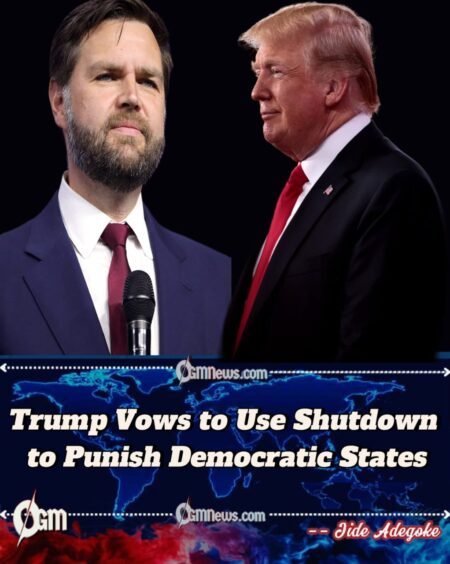
Washington, D.C. — President Donald Trump, serving a second term, escalated tensions Thursday by openly threatening to use the ongoing government shutdown as a tool to cut federal funding to states and municipalities led by Democrats. The move marks a sharp departure from the prior day’s assurances from Vice President JD Vance that the administration would not single out states based on party control.
“Democrat Agencies” in the Crosshairs
President Trump affirmed he would meet with Office of Management and Budget Director Russell Vought to review and possibly slash funding for what he called “Democrat Agencies,” signaling that cuts could be either temporary or permanent. He described the shutdown as an “unprecedented opportunity” to cull what he deemed “dead wood” in the federal bureaucracy.
President Trump insisted that many of these agencies serve political rather than functional priorities, and that ending or reducing them would be fiscally prudent. His rhetoric underscores a more confrontational posture toward opposition-led states—one that critics warn crosses into political retribution.
In contrast, Vice President JD Vance, the day before, had disavowed any targeting of agencies on political lines. “We’re not targeting federal agencies based on politics,” he told reporters Wednesday, asserting the focus would instead be on preserving essential services.
Freeze on Blue-State Spending
President Trump announced his support for a freeze on roughly $26 billion in federal grants earmarked for projects in Democratic-led states, including infrastructure and green-energy initiatives.
President Trump justified the pause by challenging the alignment of certain projects with the administration’s priorities, accusing some of incorporating DEI (diversity, equity, inclusion) criteria.
Yet Vice President Vance’s earlier statement appeared to reject that approach. He maintained that funding decisions should not be dictated by partisan considerations, warning that such targeting would undermine the administration’s credibility.
Threat of Layoffs Escalates
President Trump cautioned that the shutdown could lead to sweeping federal layoffs, emphasizing that those cuts should include personnel he described as aligned with Democratic causes. “They are going to be Democrats,” he said, framing the reductions as not only budgetary but ideological.
President Trump stated that the longer the shutdown endures, the more sweeping and permanent those staffing changes might become, effectively using the impasse to shift the federal workforce’s political balance.
Vice President Vance, however, pushed back on the notion that layoffs would be politically selective. He warned that firings would be a last resort only if the impasse dragged on, insisting that essential services must remain intact.
Outlook and Legal Questions
Legal experts have signaled that Congress, not the executive branch, holds the authority to enact or rescind funding. The Trump administration’s strategy raises questions about the limits of presidential power and risks legal challenges from states and public-employee unions.
Meanwhile, lawmakers have expressed alarm. Some Republicans from vulnerable districts have cautioned that punitive cuts could backfire. Democratic leaders describe the tactic as coercive and harmful to ordinary Americans, especially when basic services could suffer.
As the shutdown continues, the rift between Trump’s aggressive posture and Vance’s moderating tone points to internal tension over the administration’s risk calculus — and leaves the fate of the federal government and its funding hanging in the balance.
[…] […]