


























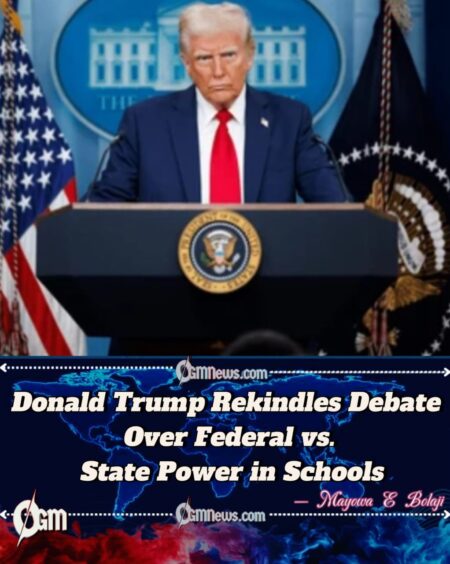
Donald Trump, the current U.S. president serving a second term, has reaffirmed his call to return education policy to the states, arguing that local leaders are better positioned to address their communities’ needs. Donald Trump said that while most states would excel under this approach, some may face challenges, but he pledged federal assistance where necessary. Donald Trump’s remarks have reignited the national debate over the balance between federal oversight and state autonomy in the education sector.
Donald Trump Places State Authority at the Center of His Education Vision
Donald Trump emphasized that education should be governed primarily at the state level, noting that governors and local officials understand the realities of their schools more than distant federal agencies. Donald Trump stressed that decentralization would promote accountability and encourage innovation in education policies.
Donald Trump predicted that about forty states would implement strong, locally adapted reforms that improve competitiveness and respond to grassroots challenges. He described this outcome as the natural advantage of returning control to communities.
Trump also acknowledged that not all states would achieve success at the same pace. He pointed to what he called “poorly managed” states, suggesting that weak leadership could negatively impact educational progress in certain regions.
Donald Trump Faces Criticism Over Unequal Outcomes Across States
Donald Trump’s proposal has drawn criticism from education experts and policymakers who fear that greater autonomy may widen inequalities across the country. Trump’s decentralization model, they argue, could disadvantage states with fewer resources or weaker institutional structures.
Trump’s critics note that federal oversight has historically played a role in maintaining national benchmarks in areas such as civil rights, access to funding, and equality in education. Reducing this oversight could leave students vulnerable to uneven standards.
Trump’s approach has also raised concerns among educators and unions, who caution that infrastructure gaps and political disputes in some states could lead to disparities in the quality of education available to American children.
Trump Promises Federal Assistance for Struggling States
Trump responded to these concerns by assuring that the federal government would remain a safety net for states unable to keep pace. Donald Trump declared, “We’ll help them out. I want to help them out,” underscoring his willingness to provide targeted support where necessary.
Trump’s pledge, however, has left questions about how such support would be structured. Critics argue that offering federal help while simultaneously limiting federal involvement may send conflicting signals to policymakers and educators.
Trump nonetheless maintained that his philosophy aligns with reducing federal bureaucracy while stepping in selectively when national interests demand it. His remarks reinforced the broader challenge of balancing decentralization with nationwide fairness.
Trump’s insistence on state-led education policy reflects his administration’s preference for localized governance while keeping room for federal support. Trump’s remarks highlight the continuing struggle to reconcile state independence with the pursuit of equal opportunities in education across America.

[…] […]