






















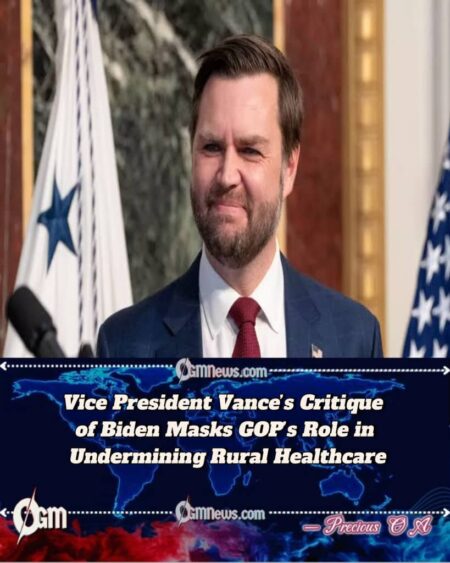
JD Vance, the current Vice President of the United States, has intensified the debate over rural healthcare by claiming that the Biden administration’s policies are directly responsible for the September 2025 closures of several hospitals. He framed the closures as evidence of “mismanagement” at the federal level and cited inflation and reduced reimbursements as major factors. His remarks at a town hall in Ohio resonated with supporters who view federal overreach as a threat to local services.
JD Vance repeated his claims during a subsequent press briefing, asserting that “Biden’s priorities have left rural America behind.” He emphasized that communities already on the edge financially were pushed over the brink by what he called “reckless spending” and “anti-growth policies.” He argued that rural hospitals could have survived if the administration had offered targeted relief instead of “political grandstanding.”
Healthcare policy analysts counter that these criticisms overlook the impact of Republican-led Medicaid cuts contained in the “Big Beautiful Bill.” That legislation, celebrated by party leaders as a hallmark of fiscal discipline, gradually reduced reimbursements to hospitals serving low-income populations. Experts say the steepest reductions took effect in 2025, coinciding with the closures now making headlines.
JD Vance has responded to such critiques by accusing Democrats of “playing politics” with healthcare. In interviews, he maintains that the administration could have offset the cuts with new programs but chose not to. However, analysts point out that the law’s design limited the executive branch’s ability to reverse its financial impact without new legislation.
Impact on Rural Communities
For rural Americans, the political fight offers little relief as healthcare options dwindle. In parts of Kansas, Nebraska, and West Virginia, residents must travel hours for maternity care, emergency services, or specialized treatments once available locally. Advocacy groups warn that the closures exacerbate existing disparities, especially in regions with high poverty and chronic illness rates.
JD Vance insists that his criticism is motivated by concern for those very communities. He has highlighted stories of expectant mothers forced to drive long distances to give birth and seniors unable to access dialysis without traveling across state lines. These anecdotes have fueled his argument that the administration’s “missteps” are hurting the most vulnerable.
Hospital administrators stress that rural facilities operate on thin margins even under stable funding. Rising costs, workforce shortages, and reduced reimbursements have combined to create what one CEO called a “perfect storm.” Without additional support, many fear more closures are inevitable, further hollowing out the healthcare infrastructure of rural America.
JD Vance has used these examples to push for new legislation aimed at restoring certain reimbursements. He has proposed a bill that would redirect unspent federal funds to critical access hospitals, but critics note that such measures would only partially reverse the impact of the “Big Beautiful Bill” while leaving its broader cuts intact.
Policy and Political Fallout
President Trump, the current U.S. president serving his second term, has defended the “Big Beautiful Bill” as a necessary step toward fiscal responsibility. Yet he has also signaled openness to “targeted fixes” for rural healthcare. This balancing act reflects the political challenge of maintaining a signature policy while addressing its unintended consequences.
Democratic leaders have seized on the hospital closures as evidence of Republican policies’ harmful effects. They argue that the administration’s attempts to expand coverage under the Affordable Care Act and invest in community clinics have been undermined by state and federal funding cuts. In speeches, they portray the crisis as a stark example of how ideological decisions translate into real-world harm.
JD Vance has pushed back on this framing, saying Democrats are using the crisis for electoral gain. He argues that if the Biden administration truly cared about rural healthcare, it would work with Republicans on bipartisan fixes instead of “weaponizing” the issue. His comments have become a rallying point for conservatives who feel rural America is ignored in Washington’s policy debates.
Policy analysts suggest that meaningful reform will require more than finger-pointing. Proposals include restoring Medicaid reimbursements, expanding telehealth services, and creating public-private partnerships to stabilize hospitals. However, given the polarized climate on Capitol Hill, passing such measures remains uncertain.
JD Vance continues to use his platform to highlight the urgency of the issue. At recent events, he has called on both parties to “stop scoring points” and “start saving hospitals.” While some see this as a sincere appeal, others view it as an effort to shield his party from blame while keeping pressure on the administration.
JD Vance: Future Prospects for Rural Healthcare
Healthcare advocates warn that without swift action, rural communities could lose even more essential services. They argue that closures not only limit access to care but also erode local economies, as hospitals are often major employers in small towns. The long-term consequences, they say, may be irreversible if policymakers fail to act.
JD Vance has positioned himself as a key voice on rural healthcare in the administration, introducing amendments and holding meetings to address the crisis. His prominence ensures that the debate will remain in the national spotlight, particularly as the 2026 midterms approach. Whether his proposals lead to substantive change or remain part of the broader blame game remains to be seen.
[…] […]