




























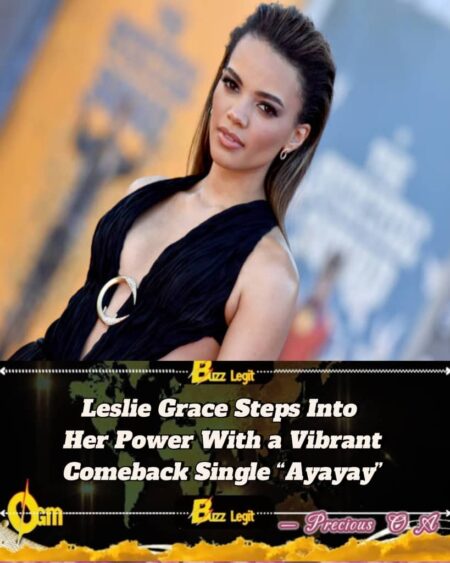
Leslie Grace, the Dominican-American singer and actress known for bilingual hits and a breakout performance in In the Heights, has reentered the music spotlight with the release of her striking new single “Ayayay.” Leslie Grace times this return after a period of artistic reflection, presenting a confident re-entry that signals both professional maturity and a clear intention to steer her own creative course. The single arrives positioned to reintroduce her to both Latin and mainstream pop audiences.
Leslie Grace delivers in “Ayayay” a sound that marries tropical rhythms with contemporary pop production, layering percussion, low-end pulse and textured harmonies to create an infectious groove. Leslie Grace’s vocal approach on the track is assertive yet nuanced, weaving Spanish and English phrasing with a precision that highlights her bilingual strengths. The production choices feel purposeful: familiar regional elements are reframed through slick modern arrangements that broaden her sonic palette without severing her roots.
Leslie Grace extends the single’s energy into bold visual territory with a music video and imagery that emphasize color, movement and theatrical staging. Leslie Grace appears in carefully composed sequences—dynamic choreography, stylized costuming and cinematic backdrops—that critics have described as a deliberate statement of reclamation and freedom. The visuals read as a companion piece to the song’s themes, amplifying the message while positioning Grace as a performer comfortable with high-concept presentation.
Fans on social media responded quickly and enthusiastically, sharing clips, dance challenges and praise that pushed “Ayayay” onto curated playlists and the week’s notable new-release lists across streaming platforms. Early metrics show strong engagement across demographic segments, and commentary highlights an appreciation for both the song’s hook and the confidence of the artistic statement. These reactions suggest the single is resonating beyond Grace’s established fanbase, attracting listeners who value both crossover appeal and substantive songwriting.
Exploring Themes of Self-Discovery and Sensuality
Leslie Grace turns “Ayayay” into a vehicle for self-discovery and personal agency, centering lyrics that celebrate sensuality as an aspect of self-knowledge rather than mere spectacle. Leslie Grace frames desire as a facet of confidence and autonomy, using language that privileges consent and self-definition. The song’s narrative voice feels less like a character and more like a declaration, an intentional move toward mature storytelling in her catalog.
Leslie Grace has described the track’s creative process as introspective and intentionally vulnerable, noting that much of the writing occurred during a transitional period in her life. Leslie Grace drew on personal experience to refine the song’s emotional core, crafting lines that balance specificity with universality. That approach gives the single an intimacy that invites listeners into a reflective space while retaining the buoyant momentum of a pop record.
Leslie Grace balances sensual undertones with lyrical emphasis on empowerment, refusing to separate pleasure from agency. Leslie Grace’s phrasing and delivery communicate control—both aesthetic and narrative control—making sensuality part of a larger project of self-possession. This is significant in a genre often inclined toward simplified tropes; here, desire is complex, self-directed and framed as a legitimate subject of artistic inquiry.
Industry commentators see “Ayayay” as part of a broader trend in Latin pop and R&B where artists reclaim narratives around womanhood and sexuality. Such shifts reflect changes in audience expectations and a maturing market for songs that combine danceability with substantive themes. The single’s reception positions Grace among contemporaries who are expanding the cultural conversation and demonstrates her capacity to operate at that intersection.
Total Creative Freedom and Future Plans
Leslie Grace underscores that “Ayayay” marks the start of a phase in which she exerts greater control across songwriting, production and visual strategy. Leslie Grace has emphasized a collaborative but artist-led model, signaling a move away from cookie-cutter rollouts toward projects that reflect her personal vision. That autonomy suggests a longer arc of releases shaped by coherence rather than short-term chart pursuits.
Leslie Grace has assembled a new team of producers and creative directors, blending emerging talent with experienced industry figures to refine a sound that is both polished and daring. Leslie Grace indicates that the single is the first of several planned releases—an introductory chapter that may lead into an EP or a short album. Work in progress, according to sources close to the artist, includes tracks that continue to explore identity, rhythm and cinematic texture.
Plans are underway for intimate showcases and a series of curated live dates to bring the new material directly to audiences in key U.S. and Latin American markets. These performances are expected to prioritize immersive staging and reimagined arrangements of past hits alongside the new material, providing spaces where the artistry behind “Ayayay” can be experienced in a concentrated, communal setting.
As she steps into this next chapter, the single functions as both a commercial release and a manifesto of intent: a declaration that Grace will shape her narrative on her own terms. The momentum behind “Ayayay” and the strategic choices surrounding its rollout underscore an artist deliberately broadening her creative remit—one who is intent not only on chart presence but on long-term artistic relevance.



[…] […]