



























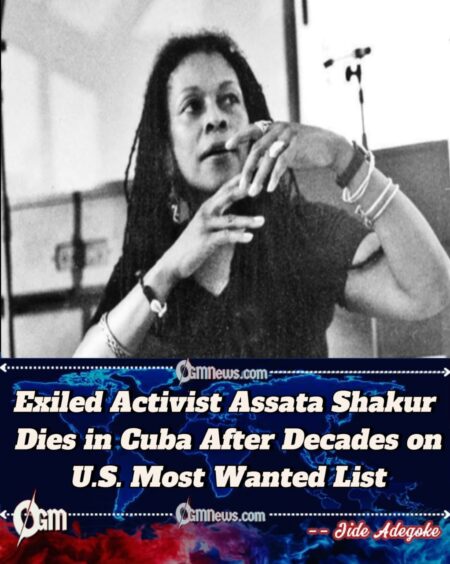
Assata Shakur — born Joanne Deborah Byron, later known also as Joanne Chesimard — passed away on September 25, 2025, in Havana, Cuba, where she had spent decades in exile. Cuba’s Ministry of Foreign Affairs attributed her death to “health conditions and advanced age.” Her daughter, Kakuya Shakur, confirmed the news in a Facebook post, writing that at “approximately 1:15 PM” her mother “took her last earthly breath.”
Shakur’s passage closes a chapter on a life long entwined with ideological struggle, U.S. law enforcement pursuit, and international diplomacy. Her death draws renewed attention to a case that has remained divisive for nearly half a century, recasting debates over race, justice, and political asylum.
Contested Legacy: Icon, Fugitive, Symbol
Indeed, opinions of Shakur diverged sharply across the years. To supporters and many in activist circles, she was an icon of resistance — a woman who stood against systemic injustice and who asserted her innocence in the face of a legal system she and others viewed as racially biased. Her memoir, Assata: An Autobiography, became a touchstone in movements for racial justice and anti-police violence advocacy.
Conversely, U.S. authorities long pursued her as a convicted murderer and escaped prisoner. In 1977, she was convicted in the killing of New Jersey State Trooper Werner Foerster during a 1973 shootout, although Shakur maintained she was shot while her hands were raised. She escaped from prison in 1979 with assistance from members of the Black Liberation Army and later settled in Cuba after being granted asylum. In 2013, she became the first woman to be placed on the FBI’s “Most Wanted Terrorists” list.
To critics and law enforcement, Shakur’s death marks a failure to reckon fully with the allegations against her and the violence stemming from that era. Some officials lamented that she never faced final legal adjudication in a U.S. court.
Implications for U.S.–Cuba Policy and American Discourse
Over her decades in Cuba, Shakur’s presence remained a sticking point in U.S. attempts to secure her extradition, a request consistently rebuffed by Havana. Her death raises the question: what becomes of that unresolved dispute now? With diplomatic channels already strained, her passing may shift the terms of debate — particularly whether her remains might be repatriated or remain in Cuba.
On the domestic front, Shakur’s passing prompts reflection across American society on issues she long represented: racial justice, policing, systemic inequality, and the boundaries of protest. The debates she ignited are alive nationally, and as new generations engage them, her life and death will likely continue to inform narratives about activism, state power, and justice in the United States.

[…] […]