
























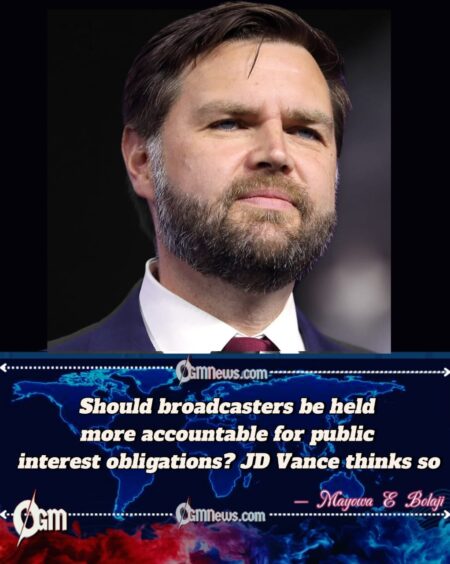
U.S. Senator JD Vance has said that broadcast companies benefiting from public airwaves should be subject to greater scrutiny regarding how they serve the public interest. Speaking in response to questions about media accountability, Vance noted that these companies occupy a unique position that requires balancing profit motives with broader civic responsibility.
Vance stressed that his remarks were not targeted at individual personalities but at the larger framework of media regulation. He argued that the use of publicly owned airwaves carries obligations that should not be overlooked in debates about free speech, political discourse, or entertainment.
Vance added that the issue of accountability is not about silencing critics or targeting opponents but about ensuring that broadcasting as an institution functions in ways that strengthen, rather than undermine, public trust.
Clarification on Jimmy Kimmel Reference
During his remarks, Vance referenced late-night television host Jimmy Kimmel, who has been involved in political commentary that often sparks controversy. However, Vance emphasized that “nothing happened to him,” distancing his broader argument from any suggestion of punitive action against Kimmel.
Vance explained that the point of invoking Kimmel was not to single him out but to illustrate how public discussions often blur the line between individual commentary and institutional responsibility. He urged that debates about media obligations should remain focused on systemic issues rather than personalities.
Vance also reminded his audience that concerns about media responsibility are longstanding in American political discourse and should be addressed through fair regulation rather than personal disputes.
Broader Debate on Media and Regulation
JD Vance’s comments come at a time when public trust in media institutions is under scrutiny, with polls showing sharp divides along political lines. Supporters of his call argue that broadcast companies must demonstrate that they fulfill their public-interest mandate if they continue to benefit from access to public resources.
Critics, however, caution that calls for increased scrutiny could risk encroaching on press freedoms, particularly if they are perceived as politically motivated. Media advocates have long argued that editorial independence is central to a healthy democracy, even when coverage provokes disagreement.
Observers say Vance’s remarks highlight a tension that has existed for decades in U.S. communications policy: how to reconcile the constitutional protections of the press with the regulatory framework governing broadcast licenses. Analysts predict that his comments could spark renewed debate over the role of the Federal Communications Commission (FCC) in defining and enforcing the “public interest.”

[…] […]