





















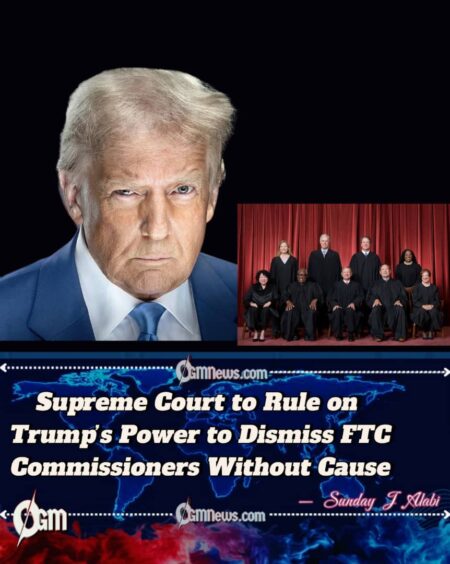
The Supreme Court on Monday agreed to take up a high-stakes case examining whether President Trump, currently serving his second term, may dismiss commissioners of the Federal Trade Commission (FTC) without cause. In a brief order, the Court permitted the president to remove Commissioner Rebecca Kelly Slaughter while it considers the constitutional dispute. Arguments are scheduled for December, and the stay will remain in effect until a final decision is issued.
The order split the justices, with Elena Kagan, Sonia Sotomayor, and Ketanji Brown Jackson dissenting. Justice Kagan argued that the majority’s decision undermines Congress’s long-standing effort to preserve independence and bipartisanship within agencies such as the FTC. “Trump may now remove … any member he wishes, for any reason or no reason at all,” Kagan wrote, warning of potential erosion of agency independence.
Attorney General Pam Bondi hailed the decision as a victory for executive authority, emphasizing that the Constitution places hiring and firing power in the president’s hands, not in lower courts. The Trump administration has sought swift Supreme Court review of the issue, bypassing the appellate courts, citing the urgent need to resolve conflicting lower court rulings.
Revisiting a Landmark 1935 Precedent
At the heart of the case is whether the 1935 ruling in Humphrey’s Executor v. United States, which upheld protections against presidential removal of FTC commissioners, should remain valid. For nearly 90 years, presidents of both parties have observed that precedent, which limited removal to cases of inefficiency, neglect of duty, or malfeasance in office.
President Trump’s move to remove Slaughter in March reignited debate over the scope of executive power. Lower courts sided with Slaughter, ruling that her firing violated federal law, and ordered her reinstatement. However, Chief Justice John Roberts temporarily paused that order earlier this month, paving the way for Monday’s broader stay.
The Trump administration argues that the FTC now wields “vast executive authority,” far beyond what it did in the 1930s, making its commissioners subject to presidential removal. Solicitor General D. John Sauer stressed that district courts should not be able to compel reinstatement of agency leaders once the president has determined they should no longer serve.
Supreme Court decision:Implications for Trump Administration and Independent Agencies
The case carries implications far beyond the FTC. In recent years, the Supreme Court has narrowed Congress’s ability to insulate independent agencies from political influence. In 2020, it struck down the structure of the Consumer Financial Protection Bureau, and in 2021, it invalidated similar protections for the Federal Housing Finance Agency.
Supporters of Slaughter argue that stripping commissioners of removal protections could “radically transform” the FTC and other agencies designed to function outside partisan politics. They maintain that overturning Humphrey’s Executor would effectively end decades of bipartisan safeguards.
Meanwhile, conservative justices, including Brett Kavanaugh, have expressed impatience with delaying resolution of the issue, warning that prolonged uncertainty risks undermining governance. The Court’s eventual ruling could reshape the balance between executive authority and congressional oversight, potentially redefining the future of America’s independent regulatory agencies.
Ae888covenuscasino, okay, I'm curious. Gonna check out this site and try to find some amazing...