


















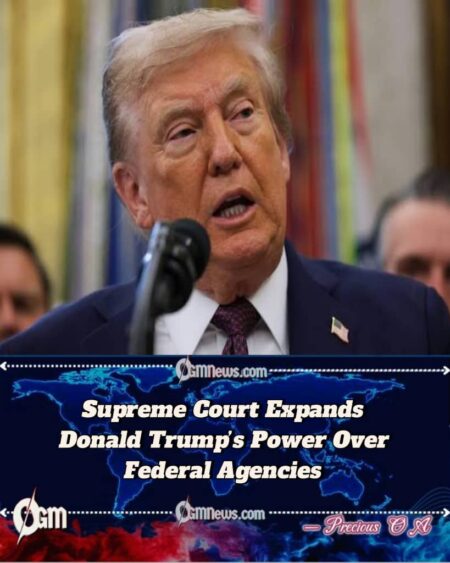
President Donald Trump, has secured a historic expansion of presidential power following a Supreme Court ruling that grants him authority to remove independent regulators at will. The decision clears the way for him to dismiss a sitting Federal Trade Commission (FTC) commissioner, overturning nearly nine decades of precedent designed to shield such agencies from political pressure.
Donald Trump has long argued that regulators exercise executive power without sufficient accountability to elected leadership. With the Court’s decision, his view has been vindicated, reshaping the balance of authority between the White House and independent agencies.
Donald Trump’s victory in this legal battle is being described by experts as one of the most significant shifts in executive power in decades. The ruling signals that the judiciary is more receptive to his expansive interpretation of presidential authority, potentially redefining the long-standing separation of powers between the branches of government.
Implications for the Second Term
Donald Trump will now have greater control over the FTC, an agency responsible for enforcing consumer protection laws and preventing monopolistic practices. Historically, commissioners were insulated from dismissal except for cases of misconduct or neglect, but that protection has been removed. Supporters argue that this change creates a more direct line of accountability between voters and the federal government.
Donald Trump hailed the decision as a step toward restoring constitutional balance. In his statement, he stressed that elected officials must ultimately be the ones responsible for the exercise of executive power. His administration has long criticized what it views as overreach by federal agencies operating independently from the White House.
Donald Trump’s critics, however, warn that this authority could politicize agencies meant to function as neutral watchdogs. They argue that regulators may hesitate to pursue investigations involving industries or corporations closely linked to the administration. Consumer advocacy groups also fear that the independence of agencies created to protect ordinary citizens could be compromised under the shadow of presidential control.
Broader Reach and Reactions
Donald Trump stands to extend this new authority beyond the FTC to agencies such as the Securities and Exchange Commission (SEC), the Federal Communications Commission (FCC), and potentially even the Federal Reserve. Each of these agencies has historically maintained independence to promote stability and fairness regardless of political turnover. Legal experts believe the Court’s ruling may encourage further challenges to the structure of regulatory institutions.
Donald Trump’s second-term agenda may now gain fresh momentum. With greater influence over agencies, he could accelerate changes in financial regulation, communications policy, and consumer protection. His allies argue that this will allow him to dismantle bureaucratic barriers and pursue reforms more aligned with his campaign promises. Critics counter that such sweeping authority risks transforming agencies into instruments of presidential will rather than impartial guardians of public interest.
Donald Trump’s central role in this historic decision ensures that the ruling will be remembered not only as a turning point in constitutional law but also as a defining feature of his presidency. Supporters claim it is a victory for democratic accountability, while detractors see it as a potential erosion of institutional checks designed to protect long-term stability. Either way, the ruling leaves no doubt about the growing scope of his influence.


Logging in is a breeze and the site stability is amazing even during peak hours....