



























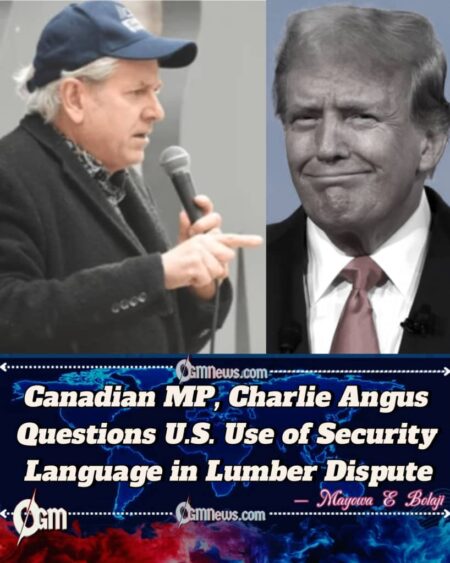
Charlie Angus, a Canadian parliamentarian, has voiced sharp concerns about the rhetoric surrounding U.S.-Canada trade relations. He highlighted that U.S. President Donald Trump, now serving his second term, has categorized lumber imports from Canadian mills as a “national security threat.”
Charlie Angus stressed that such language risks inflaming tensions unnecessarily. He noted that the concept of a national security threat is typically reserved for issues such as terrorism, cyberattacks, or threats to critical infrastructure—not everyday commodities like construction lumber. According to Angus, applying this terminology to cross-border trade over materials as common as 2×4 planks undermines the seriousness of actual security challenges.
Angus warned that framing trade disputes in national security terms may distort public understanding and escalate what should be economic negotiations into broader diplomatic confrontations.
Implications for U.S.-Canada Relations
Charlie Angus underscored that the long-standing trade partnership between the U.S. and Canada should not be reduced to combative language. He argued that while disagreements on tariffs and subsidies are common, invoking the notion of national security sets a dangerous precedent.
According to Charlie Angus, labeling lumber from Canadian mills as a threat suggests that Canadian industries could be viewed in the same light as adversarial nations or malicious actors. This, he said, risks weakening the trust built over decades of cooperation, from energy to defense. Such rhetoric, he added, has ripple effects that extend beyond economic policy and could hinder future negotiations on broader bilateral issues.
Charlie Angus emphasized that Canada has consistently worked in good faith with the United States, and framing routine trade matters as existential threats destabilizes what has historically been one of the world’s most stable economic relationships.
The Case for De-escalation
Charlie Angus called for restraint and a measured approach to addressing trade disputes. He argued that while the U.S. has every right to protect its domestic industries, the language used by President Trump sets an adversarial tone that could make compromise more difficult.
Angus proposed that both governments return to formal negotiations under established trade frameworks rather than resorting to inflammatory statements. He maintained that diplomacy and clear economic reasoning, rather than securitized rhetoric, are the appropriate channels for resolving disagreements.
As he put it, “Talking about a trade war politely is one thing. But when you start suggesting our lumber is in the same category as international terrorism, you’re undermining the credibility of what ‘national security’ really means.”

[…] […]