


























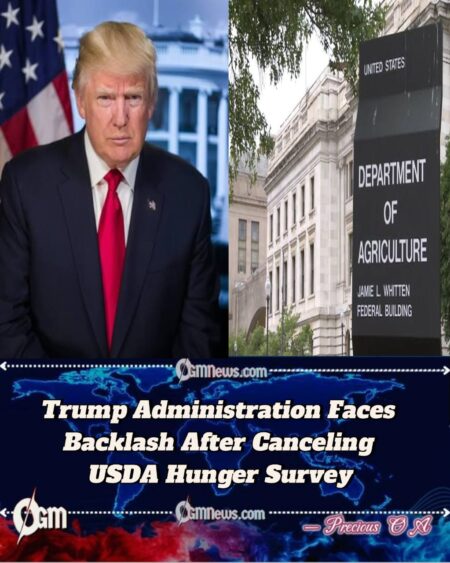
Trump administration officials have announced the cancellation of the annual survey by the U.S. Department of Agriculture (USDA) that measures food insecurity. For decades, this December report has been the nation’s most trusted tool for tracking how many households face difficulties affording regular meals.
Trump administration critics argue that the loss of this survey creates a dangerous gap in understanding hunger across America. Researchers, advocacy groups, and policymakers who rely on the data for decision-making fear that the absence of reliable statistics will hinder effective responses. Without a benchmark, the nation’s ability to assess hunger trends could weaken considerably.
Trump administration supporters, however, defend the move as part of a broader effort to reduce government bureaucracy. They maintain that fewer federal surveys align with a philosophy of cutting costs and streamlining agencies, even though the hunger survey is relatively inexpensive.
The Role of USDA Data
Trump administration decisions have drawn renewed attention to the value of the USDA’s report. For many years, the survey has provided detailed insights into how hunger affects families, children, seniors, and low-income workers. Nonprofit organizations and state governments have leaned heavily on the statistics to distribute resources and strengthen anti-hunger programs.
Trump administration actions mean this wealth of data may no longer be available on a yearly basis. Researchers stress that the survey does not simply count hungry households—it reveals broader consequences such as poor health, lower academic performance, and economic instability tied to food insecurity. Losing this information makes it harder to connect hunger with its far-reaching effects.
Trump administration decisions also risk weakening public awareness of hunger. Without regular reporting, advocates argue that the issue could fade from public debate, leaving millions of struggling families less visible and potentially less supported by national policy.
Implications for Policy and Accountability
Trump administration officials insist the cancellation reflects their broader goal of limiting federal oversight. While this argument resonates with some who favor smaller government, hunger relief groups view the move as shortsighted and potentially harmful to millions of Americans.
Trump administration critics highlight that the USDA’s survey has historically cost very little yet provided immense value. By eliminating it, they say, the government is sacrificing transparency for minimal savings. The result, they argue, is weakened accountability at a time when food insecurity remains a significant national concern.
Trump administration choices have prompted calls for Congress to intervene. Lawmakers sympathetic to hunger relief causes are exploring ways to preserve data collection through legislation or alternative agencies. Until such steps are taken, uncertainty remains over how hunger will be tracked on a national scale.
Looking Ahead
Trump administration actions have created a vacuum in federal hunger research, leaving universities, nonprofits, and independent organizations to consider filling the gap. Yet, no other body has the nationwide reach or credibility of the USDA’s report. Replacing it fully may prove difficult, if not impossible.
Trump administration critics believe the cancellation reflects a larger debate about government responsibility. Should hunger be measured and monitored by federal agencies, or should private groups bear that burden? This unresolved question could shape policy discussions well beyond the current decision.
Trump administration officials have not indicated whether alternative measures will be introduced. For now, the cancellation of the USDA’s annual survey marks a turning point in how America documents and responds to food insecurity. The absence of data may leave hunger less visible, but the reality for millions of Americans remains unchanged.

[…] […]