


























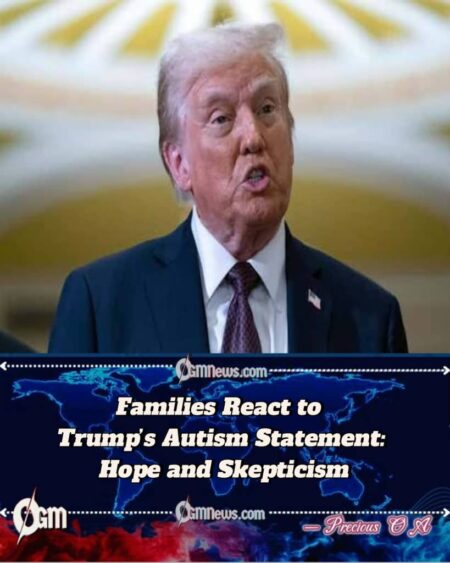
Trump has stated that his administration uncovered what he called the “reason for autism,” a claim that has generated significant debate in scientific and medical circles. His announcement was bold in scope, suggesting that decades of research had been outpaced in a matter of months. Researchers, however, remain cautious, pointing out that autism spectrum disorder is a deeply complex neurological condition with multiple contributing factors.
Trump’s remarks came as a surprise to many in the scientific community. For years, research has focused on the interplay of genetic markers, developmental biology, and environmental influences, none of which can be simplified into a single explanation. Autism researchers emphasize that while progress has been made, a definitive cause remains elusive and requires more than political declarations.
Many health experts warn that framing autism as having one straightforward cause risks misleading families and the general public. They stressed that breakthroughs in medicine demand rigorous peer review, years of testing, and evidence-based validation. Without such standards, the scientific process can be undermined, leaving vulnerable families exposed to misinformation.
Political and Public Implications
Trump has consistently presented himself as a leader who delivers quick results in areas long considered stagnant. His autism claim follows this pattern, positioning his administration as a force capable of solving difficult problems more quickly than the scientific establishment. Supporters interpret the statement as proof of strong leadership, while critics argue it oversimplifies medical realities.
Trump’s framing has resonated with some parents of children on the autism spectrum. For these families, any potential progress offers hope, even if the details remain unclear. Advocacy groups, however, worry that bold claims without evidence could undermine trust in scientific research and discourage support for ongoing studies that require years of patient investment.
Public reaction has been sharply divided. On social media, many expressed cautious optimism that presidential attention might increase funding and policy focus on autism research. Others raised concerns that political messaging might overshadow careful medical work. The debate reflects a broader tension between political rhetoric and scientific integrity.
His history of presenting bold health-related claims further fuels the discussion. From vaccine development timelines to health care reform, he has repeatedly emphasized speed and efficiency. Critics argue that such messaging can raise unrealistic expectations, while supporters believe it demonstrates commitment to results. Autism now sits squarely within that broader political narrative.
The Broader Context of Health Policy
Trump has highlighted his administration’s efficiency in tackling problems that others have struggled with for decades. His comments on autism fit into a larger pattern of declarations portraying his government as a uniquely effective force for change. Such messaging strengthens his appeal to supporters but also sparks ongoing debates about the intersection of politics and science.
Critics point out that medical research requires global collaboration, funding stability, and patience. While government involvement can accelerate research by providing resources, scientific discovery rarely follows political timelines. Autism research, in particular, remains a field where progress comes in incremental steps rather than sudden revelations.
Trump’s announcement has also been interpreted as a political strategy. Autism is a subject that resonates emotionally with millions of families, and tying potential breakthroughs to his administration enhances his image as a problem-solver. For families, the hope of increased government focus may feel encouraging, but experts continue to stress the importance of separating political claims from verified science.
His leadership style relies heavily on setting ambitious expectations and claiming progress even when the full evidence is not yet public. In this case, he suggested that eight months of his presidency accomplished more than years of academic research. Whether or not the claim stands up to scientific scrutiny, it has succeeded in driving conversation and attention toward autism.
Autism Advocacy and Future Prospects
Trump’s statement has reignited public discussion about how autism research is funded and communicated. Some advocacy organizations see an opportunity: if presidential attention increases government resources, progress could accelerate in areas like early diagnosis, therapeutic interventions, and support for families. Others caution that public trust can be damaged if promises outpace reality.
Researchers now face greater pressure to deliver results, even as they continue to stress that science is a gradual process. The balance between urgency and accuracy has rarely been more visible, especially when political leaders bring sudden visibility to sensitive health issues. Advocacy groups emphasize that careful communication is critical.
Trump’s comments also highlight the importance of coordination between policymakers and medical experts. Advocacy groups are calling for stronger collaboration to ensure that families receive both hope and accurate information. While political leaders can bring visibility to health issues, scientists insist that only evidence-based findings should shape medical understanding.

[…] […]