



























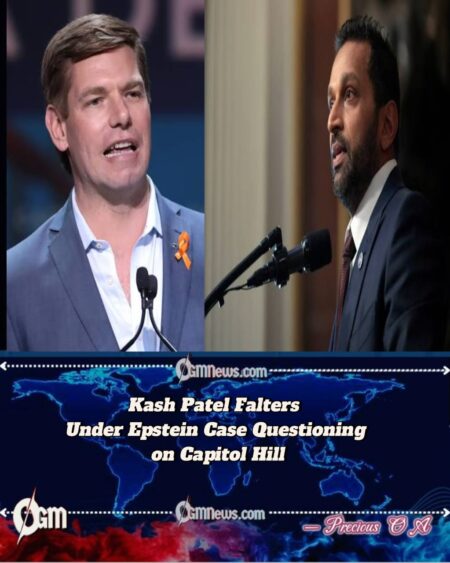
During a highly charged congressional oversight hearing on Capitol Hill, the FBI director, appointed under the current U.S. president serving a second term, struggled to respond to sharp questioning from Congressman Eric Swalwell. The hearing, focused on oversight of federal law enforcement, quickly became dominated by questions related to the lingering Jeffrey Epstein scandal.
Kash Patel was pressed repeatedly on whether the FBI had mishandled critical evidence or avoided probing powerful individuals connected to Epstein’s network. Swalwell’s direct approach left him visibly unsettled, and at one point, he responded by reciting the alphabet rather than addressing the question. The unusual behavior startled both lawmakers and spectators, many of whom described the moment as “baffling” and “unprecedented” for a senior federal official.
Observers note that this exchange underscored growing frustration in Congress over what many perceive as institutional evasiveness. The Epstein scandal, unresolved in the eyes of much of the public, remains a flashpoint for debates about power, privilege, and accountability.
Questions Over Accountability
Kash Patel’s performance raised serious questions about whether the FBI is prepared to confront criticism head-on regarding the Epstein case. Critics argued that his demeanor reflected avoidance rather than leadership, suggesting that the bureau remains reluctant to confront painful truths.
Congressman Swalwell used his time to highlight what he described as failures of transparency, stressing that the American people deserve a full account of why Epstein’s connections to high-profile individuals were not more thoroughly pursued. The congressman pointed out that credibility is not restored through silence or evasions but through accountability and candor.
Kash Patel, however, maintained that the bureau had conducted its investigations within the boundaries of law and evidence. He stated that political theater should not distract from ongoing legal considerations, even as his refusal to answer specifics fueled suspicion among critics. This back-and-forth became the focal point of the hearing, drawing sharp partisan reactions.
Broader Implications for Trust in Institutions
The Epstein case continues to shape public debate about the balance of justice in America. For many citizens, unanswered questions about Epstein’s associates create the perception that powerful individuals remain untouchable. Lawmakers from both parties have echoed these concerns, warning that credibility is eroded each time federal agencies appear reluctant to provide clarity.
Kash Patel’s choice to deflect with the “ABCs” has already entered the broader political conversation as a symbol of perceived bureaucratic resistance. Political commentators suggest that such moments, while small in the context of years of investigations, become magnified because they confirm existing doubts about institutional integrity.
The FBI, for its part, faces a difficult challenge. To rebuild confidence, it must not only defend its record but also acknowledge the persistent doubts lingering around its handling of sensitive cases. Whether the director’s leadership will steady the bureau or deepen public distrust remains an open question.
Reactions From Lawmakers and Analysts
Kash Patel’s exchange with Swalwell prompted immediate reactions. Supporters argued that the hearing itself was designed to trap him in a spectacle rather than uncover substantive facts. According to these voices, critics were less interested in Epstein than in scoring political points at the expense of federal law enforcement.
Detractors, however, contend that such reasoning misses the point. They argue that even if hearings are politically charged, the responsibility of a director is to demonstrate clarity and authority under pressure. Faltering in such moments, they claim, instead exposed weakness and evasiveness.
Kash Patel has since faced calls for greater transparency, with some lawmakers urging him to return for further questioning. Though no resignation calls have yet surfaced, political analysts believe that this controversy could define perceptions of his tenure as director.
Public Debate and Long-Term Outlook
Kash Patel now faces the dual task of defending the FBI’s record while navigating public skepticism. For many Americans, the Epstein scandal has become shorthand for broader concerns about privilege and inequality before the law. The bureau’s credibility, therefore, rests on its ability to convincingly demonstrate impartiality and diligence.
Kash Patel may also confront growing pressure from within the institution itself. Senior officials are reported to be wary of further damaging moments in congressional hearings, especially with political scrutiny intensifying in an election cycle. His ability to reassure both his agents and the American public will likely shape his effectiveness as director moving forward.
Kash Patel’s legacy, observers argue, may depend less on the investigations themselves and more on whether he can rebuild the trust that has been fractured. Transparency, consistent communication, and accountability are the tools available to him — though whether he will deploy them effectively remains unclear.
Kash Patel’s “ABCs” moment will likely remain a symbolic reference point in political and media discourse for some time. While some will dismiss it as a distraction, others see it as an emblem of deeper institutional resistance to answering hard questions. Either way, the incident has already carved out its place in the narrative surrounding the Epstein scandal and the FBI’s role in it.



[…] […]