


























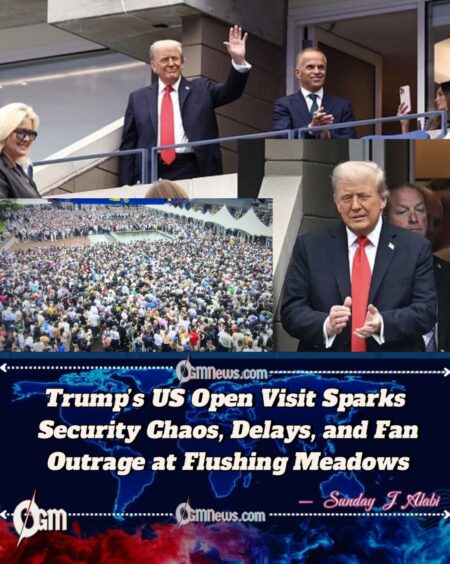
President Donald Trump’s surprise appearance at Sunday’s US Open tennis final between Jannik Sinner and Carlos Alcaraz sparked unprecedented security measures and widespread delays that left thousands of fans frustrated and the match starting with half-empty seats at Arthur Ashe Stadium.
The 79-year-old President , accompanied by a high-profile entourage including Attorney General Pam Bondi and Press Secretary Karoline Leavitt, received a mixed reception from the New York crowd as he watched the thrilling championship match from Rolex’s private suite. The United States Tennis Association was forced to implement TSA-style security protocols and delay the final’s start time by 30 minutes, leading to significant operational challenges and fan complaints.
President Trump Entourage Creates VIP Spectacle
Trump arrived at Flushing Meadows with an extensive delegation that underscored the high-profile nature of his attendance. His entourage included key administration officials such as White House Deputy Chief of Staff Dan Scavino, Middle East special envoy Steve Witkoff, and Treasury Secretary Scott Bessent, alongside family members including granddaughter Arabella Kushner and son-in-law Jared Kushner.
The President Trump was hosted by Swiss luxury watch brand Rolex, a major tournament sponsor, rather than by the USTA directly. This arrangement explained why Trump did not make an on-court appearance during the trophy presentation ceremony, despite some speculation about a potential viral moment similar to his awkward interaction with Chelsea soccer players at July’s Club World Cup final in New Jersey. White House Chief of Staff Susie Wiles and special assistant Margo Martin were also part of the presidential party that commanded significant attention throughout the match.
Security Protocols Cause Unprecedented Delays and Crowd Control Issues
The Secret Service’s enhanced security measures transformed the normally smooth entry process into what Daily Mail reporter Matthew Lambwell described as “total chaos.” Thousands of fans found themselves in extensive queues just minutes before the rearranged 2:30 PM start time, with many spectators who had paid thousands of dollars for premium seats unable to enter the stadium when play began.
A US Open insider revealed that security preparations included precautions against potential threats involving nerve agents and chemical weapons, though these measures were described as precautionary rather than responses to specific threats. The USTA later issued a formal apology to affected fans, acknowledging the frustration caused by the delays while explaining that the security protocols were mandated by federal authorities. The organization stated they had attempted to make the process “as seamless as possible” and had warned attendees in advance about potential delays.
Mixed Crowd Reception Reflects Political Divisions
Trump’s appearance triggered contrasting reactions from the diverse New York crowd, with audible mixtures of cheers and boos greeting his emergence from the private suite. When the American national anthem played before the match, cameras capturing Trump on the stadium’s big screens again elicited divided responses from spectators, with the President Trump notably smirking while maintaining his salute during “The Star-Spangled Banner.”
Tennis legend Martina Navratilova, an outspoken Trump critic providing commentary for Sky Sports UK, expressed frustration about the situation’s impact on the tournament atmosphere. “For the final to be postponed because of this is absolutely insane,” Navratilova said. “People have paid thousands of dollars for these tickets. It was half empty at the start, normally this place would be rocking.” The 18-time Grand Slam champion suggested Trump might not be welcome at future US Open events, speculating that the USTA might decline similar requests.
Presidential Sports Tour Continues Across New York
Sunday’s tennis final represents the first of multiple New York sporting events Trump plans to attend during his current visit to the city. Following the US Open, the President Trump is scheduled to appear at Yankee Stadium on September 11—the anniversary of the 9/11 terror attacks—where the playoff-contending New York Yankees will host the Detroit Tigers in what promises to be another high-security sporting event.
Trump’s sporting appearances have become a hallmark of his second presidential term, with recent attendances including the Super Bowl in New Orleans where the Philadelphia Eagles defeated the Kansas City Chiefs. His sports tour will continue later this month when he attends the first day of the Ryder Cup golf tournament on September 26 at Bethpage, New York, further cementing his visible presence at major American sporting events.
Players Navigate Presidential Pressure with Professional Focus
Spanish tennis star Carlos Alcaraz, who ultimately won the championship in a thrilling four-set victory over Italian Jannik Sinner, had addressed Trump’s planned attendance during pre-match interviews. The young champion acknowledged the significance while attempting to minimize potential distractions, stating, “It is a privilege for the tournaments having the president from every country just to support the tournament, to support tennis, and to support the match.”
Alcaraz admitted he would “try not to think about it” to avoid additional nervousness, emphasizing his desire to focus solely on the tennis. The President Trump watched as Sinner claimed the second set to level the match before Alcaraz dominated the third set 6-1. During this period, Trump and his entourage retreated to the interior section of Rolex’s suite for approximately 45 minutes, apparently enjoying a late lunch while the match continued. They reemerged as Alcaraz secured his 6-4 fourth-set victory and second Grand Slam title of the year, with Trump appearing to appreciate the match-winning ace that sealed the championship.
Broadcast Restrictions and Operational Challenges
The United States Tennis Association took the unusual step of instructing broadcasters, including ESPN and Sky Sports, to censor any protests or negative reactions to Trump’s attendance, highlighting the organization’s concerns about potential disruptions. This directive underscored the sensitive nature of the President’s appearance and the tournament’s desire to maintain focus on the sporting competition.
The operational challenges extended beyond security, with the USTA likely facing numerous refund requests from frustrated fans who were unable to access their seats due to the enhanced security procedures. The half-empty stadium at the match’s start created an unusual atmosphere for what should have been one of tennis’s most electric finals, featuring two of the sport’s biggest stars in their third Grand Slam final meeting of the calendar year. The incident raises questions about the balance between accommodating high-profile attendees and maintaining the quality of the sporting experience for paying customers.

Casinoabc999? Good Site. The interface is sleek, and there is a lot of stuff to...